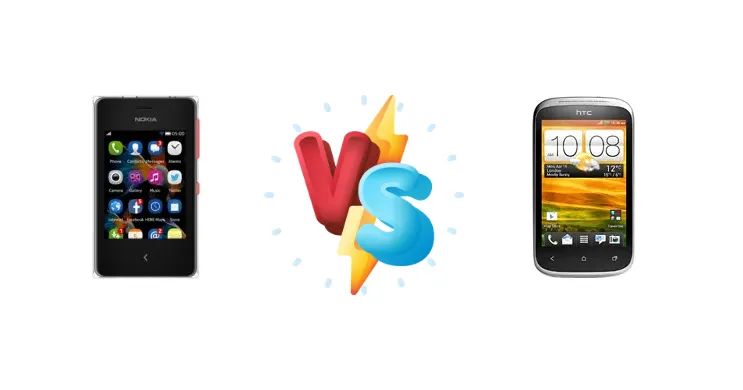
The Nokia Asha 500 and HTC Desire C represent distinct approaches to affordable mobile technology from the early 2010s. The Asha 500, a Series 40 feature phone, aimed to bridge the gap between basic phones and smartphones, while the Desire C was HTC’s entry-level Android offering powered by Qualcomm’s Snapdragon S1. This comparison examines how these two devices stacked up against each other, considering their hardware and target audiences.
🏆 Quick Verdict
For the average user seeking basic connectivity and long battery life, the Nokia Asha 500 likely offers a more practical experience. However, the HTC Desire C, with its Android OS and Qualcomm Snapdragon S1 chipset, provides access to a wider range of applications and a more familiar smartphone experience, albeit with performance limitations.
| Network |
|---|
| 2G bands | GSM 850 / 900 / 1800 / 1900 | GSM 850 / 900 / 1800 / 1900 |
| 3G bands | - | HSDPA 900 / 2100 |
| EDGE | Up to 236.8 kbps | - |
| GPRS | Up to 42.8 kbps | - |
| Speed | - | HSPA 14.4/5.76 Mbps |
| Technology | GSM | GSM / HSPA |
| Launch |
|---|
| Announced | 2013, October. Released 2013, December | 2012, May. Released 2012, June |
| Status | Discontinued | Discontinued |
| Body |
|---|
| Dimensions | 100.3 x 58.1 x 12.8 mm, 70.9 cc (3.95 x 2.29 x 0.50 in) | 107.2 x 60.6 x 12.3 mm (4.22 x 2.39 x 0.48 in) |
| SIM | Micro-SIM | Mini-SIM |
| Weight | 101 g (3.56 oz) | 100 g (3.53 oz) |
| Display |
|---|
| Resolution | 240 x 320 pixels, 4:3 ratio (~143 ppi density) | 320 x 480 pixels, 3:2 ratio (~165 ppi density) |
| Size | 2.8 inches, 24.3 cm2 (~41.7% screen-to-body ratio) | 3.5 inches, 36.5 cm2 (~56.1% screen-to-body ratio) |
| Type | TFT, 256K colors | IPS LCD |
| Platform |
|---|
| CPU | - | 600 MHz Cortex-A5 |
| Chipset | - | Qualcomm MSM7225A Snapdragon S1 |
| GPU | - | Adreno 200 |
| OS | Nokia Asha software platform 1.1.1, upgradable to 1.4 | Android 4.0 (Ice Cream Sandwich), not upgradable to 4.1 (Jelly Bean), Sense UI 4 |
| Memory |
|---|
| Card slot | microSDHC (dedicated slot), 4 GB included | microSDHC (dedicated slot) |
| Internal | 64MB RAM | 4GB 512MB RAM |
| Main Camera |
|---|
| Single | 2 MP | 5 MP |
| Video | 320p@13fps | Yes |
| Sound |
|---|
| 3.5mm jack | Yes | Yes |
| 35mm jack | Yes | Yes |
| Loudspeaker | Yes | Yes |
| | - | Beats Audio |
| Comms |
|---|
| Bluetooth | 3.0, A2DP | 3.0, A2DP |
| NFC | No | Optional |
| Positioning | No | GPS, A-GPS |
| Radio | Stereo FM radio | Stereo FM radio, RDS |
| USB | microUSB 2.0 | microUSB 2.0 |
| WLAN | Wi-Fi 802.11 b/g/n | Wi-Fi 802.11 b/g/n, hotspot |
| Features |
|---|
| Sensors | Accelerometer, proximity | Accelerometer, proximity |
| | SNS apps
MP4/H.263 player
MP3/WAV/AAC player
Photo editor
Organizer
Voice memo
Predictive text input | DivX/XviD/MP4/H.264/WMV player
Dropbox (25 GB cloud storage)
MP3/eAAC+/WMA/WAV player
Organizer
Document viewer/editor
Voice memo/dial
Predictive text input |
| Battery |
|---|
| Music play | Up to 46 h | - |
| Stand-by | Up to 840 h | - |
| Talk time | Up to 14 h | - |
| Type | Li-Ion 1200 mAh, removable (BL-4U) | Removable Li-Ion 1230 mAh battery |
| Misc |
|---|
| Colors | Bright Red, Bright Green, Cyan, Yellow, White and Black | Polar White, Stealth Black, Flamenco Red |
| Price | About 60 EUR | About 120 EUR |
| SAR | 1.47 W/kg (head) 1.38 W/kg (body) | 0.75 W/kg (head) 0.64 W/kg (body) |
| SAR EU | 1.28 W/kg (head) 0.94 W/kg (body) | - |
| Tests |
|---|
| Audio quality | - |
Noise -87.3dB / Crosstalk -84.5dB |
| Camera | - |
Photo |
| Display | - |
Contrast ratio: 723 (nominal) / 1.300:1 (sunlight) |
| Loudspeaker | - |
Voice 64dB / Noise 64dB / Ring 72dB |
Nokia Asha 500
- Exceptional battery life due to low-power design.
- Durable build quality typical of Nokia feature phones.
- Simple and intuitive Series 40 user interface.
- Limited functionality compared to smartphones.
- Lack of access to Android apps.
- Lower-resolution display.
HTC Desire C
- Access to the Android operating system and Google Play Store.
- Qualcomm Snapdragon S1 processor enables basic app functionality.
- Higher display contrast ratio for improved visibility.
- Limited processing power and RAM.
- Shorter battery life compared to feature phones.
- Potentially slow performance with demanding apps.
Display Comparison
The HTC Desire C boasts a contrast ratio of 723 (nominal) and 1.300:1 in sunlight, suggesting a reasonable level of visibility even outdoors. The Asha 500’s display specifications are unavailable, but given its market positioning, it likely featured a lower-resolution and lower-contrast LCD panel. The Desire C’s higher contrast ratio would translate to more vibrant colors and deeper blacks, enhancing the viewing experience for media consumption. The Asha 500’s display was likely optimized for power efficiency rather than visual fidelity.
Camera Comparison
Both devices feature a camera described simply as 'Photo'. Without further details like megapixel count or sensor size, it’s difficult to make a direct comparison. However, given the Desire C’s smartphone positioning, its camera likely offered more features and potentially better image quality than the Asha 500’s. The Desire C’s camera likely benefited from basic image processing capabilities within the Android OS, while the Asha 500’s camera was likely focused on simple snapshot capture.
Performance
The HTC Desire C is powered by the Qualcomm MSM7225A Snapdragon S1, featuring a 600 MHz Cortex-A5 CPU. This chipset, while dated, provided a basic level of smartphone functionality. The Asha 500, lacking a detailed specification, likely relied on a significantly less powerful processor designed for feature phone tasks. The Snapdragon S1 allows the Desire C to run Android and basic apps, while the Asha 500 is limited to Series 40 applications. The Cortex-A5 architecture in the Desire C, though slow by modern standards, offers a degree of multitasking capability absent in the Asha 500.
Battery Life
Specific battery capacities for both devices are unavailable. However, feature phones like the Asha 500 are renowned for their exceptional battery life due to their low-power components and simple operating systems. The Desire C, running Android and utilizing the Snapdragon S1, would have significantly shorter battery life. The Asha 500 likely offered days of use on a single charge, while the Desire C would likely require daily charging with moderate use.
Buying Guide
Buy the Nokia Asha 500 if you prioritize extreme battery life, a durable build, and a simple, uncluttered user interface for basic communication. Buy the HTC Desire C if you prefer the flexibility of the Android operating system, access to apps via the Play Store, and a more conventional smartphone experience, understanding that performance will be limited by the Snapdragon S1 chipset.
Frequently Asked Questions
❓ Is the Snapdragon S1 in the HTC Desire C powerful enough for modern apps?
No, the Snapdragon S1 is a very old processor and struggles with modern apps. It was designed for basic Android functionality and will be slow and unresponsive with most current applications. Expect limited performance even with lightweight apps.
❓ What kind of apps can I run on the Nokia Asha 500?
The Nokia Asha 500 runs Series 40, a feature phone operating system. It supports Java-based apps, but the selection is limited compared to Android or iOS. Expect apps focused on basic communication, utilities, and simple games.
❓ Which phone is better for someone who primarily needs a phone for calls and texts?
The Nokia Asha 500 is the better choice for calls and texts. Its exceptional battery life ensures it will last for days on a single charge, and its simple interface is optimized for core communication functions.
❓ Can I upgrade the operating system on either of these phones?
Upgrading the operating system on either phone is extremely limited. The Asha 500 is capped at Series 40, and the Desire C is likely stuck on the version of Android it shipped with due to hardware limitations and lack of official support.