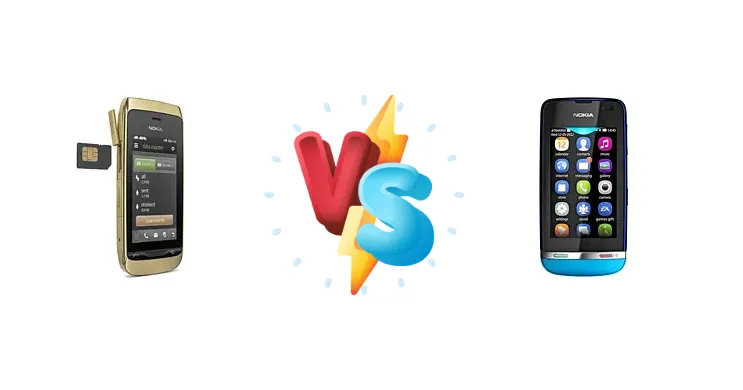
The Nokia Asha 308 and 311 represent Nokia's continued commitment to affordable feature phones. While both target users seeking basic connectivity and durability, a key distinction lies in the Asha 311’s inclusion of a 1.0 GHz processor, a feature absent in the 308. This comparison will dissect these differences, focusing on how they impact real-world usability.
🏆 Quick Verdict
For the average user prioritizing a clear display, especially outdoors, the Nokia Asha 308 is the better choice due to its significantly superior contrast ratio in sunlight (1.911:1). However, users anticipating slightly more demanding tasks or app usage will benefit from the Asha 311’s 1.0 GHz processor.
| Network |
|---|
| 2G bands | GSM 900 / 1800 - SIM 1 & SIM 2 | GSM 850 / 900 / 1800 / 1900 |
| 3G bands | - | HSDPA 850 / 900 / 1700 / 1900 / 2100 |
| EDGE | Up to 236.8 kbps | - |
| GPRS | Up to 85.6 kbps | - |
| Speed | - | HSPA 14.4/5.76 Mbps |
| Technology | GSM | GSM / HSPA |
| | GSM 850 / 1900 - SIM 1 & SIM 2 | - |
| Launch |
|---|
| Announced | 2012, September. Released 2012, October | 2012, June. Released 2012, August |
| Status | Discontinued | Discontinued |
| Body |
|---|
| Build | - | Glass front (Gorilla Glass), plastic back, plastic frame |
| Dimensions | 109.9 x 54 x 13 mm, 67 cc (4.33 x 2.13 x 0.51 in) | 106 x 52 x 12.9 mm, 64 cc (4.17 x 2.05 x 0.51 in) |
| SIM | Dual SIM (Mini-SIM, dual stand-by) | Mini-SIM |
| Weight | 104 g (3.67 oz) | 95 g (3.35 oz) |
| Display |
|---|
| Protection | Scratch-resistant glass | Corning Gorilla Glass |
| Resolution | 240 x 400 pixels, 5:3 ratio (~155 ppi density) | 240 x 400 pixels, 5:3 ratio (~155 ppi density) |
| Size | 3.0 inches, 25.6 cm2 (~43.2% screen-to-body ratio) | 3.0 inches, 25.6 cm2 (~46.5% screen-to-body ratio) |
| Type | TFT, 65K colors | TFT, 65K colors |
| Memory |
|---|
| Call records | Yes | Yes |
| Card slot | microSDHC (dedicated slot), 2 GB included | microSDHC (dedicated slot) |
| Internal | 20MB 128MB ROM 64MB RAM | 140MB 256MB ROM 128MB RAM |
| Phonebook | 1000 entries, Photocall | Yes, Photocall |
| Main Camera |
|---|
| Single | 2 MP | 3.15 MP |
| Video | 176x144@13fps | 480p@25fps |
| Sound |
|---|
| 3.5mm jack | Yes | Yes |
| 35mm jack | Yes | Yes |
| Loudspeaker | Yes | Yes |
| Comms |
|---|
| Bluetooth | 3.0 | 2.1, EDR |
| NFC | No | - |
| Positioning | No | No |
| Radio | Stereo FM radio, RDS, recording | Stereo FM radio, RDS |
| USB | microUSB 2.0 | microUSB 2.0, OTG |
| WLAN | No | Wi-Fi 802.11 b/g/n |
| Features |
|---|
| Games | Yes + downloadable | Yes + downloadable |
| Java | Yes, MIDP 2.1 | Yes |
| Messaging | SMS, MMS, Email, IM | SMS, MMS, Email, IM |
| Sensors | Accelerometer | Accelerometer, proximity |
| | SNS integration
MP4/H.264/WMV player
MP3/WAV/WMA/AAC+ player
Organizer
Voice memo
Predictive text input | SNS integration
MP4/H.264/WMV player
MP3/WAV/WMA/AAC player
Organizer
Voice memo
Predictive text input |
| Battery |
|---|
| Music play | Up to 54 h | Up to 40 h |
| Stand-by | Up to 600 h | Up to 696 h (2G) / Up to 744 h (3G) |
| Talk time | Up to 17 h | Up to 14 h (2G) / Up to 6 h (3G) |
| Type | Li-Ion 1110 mAh, removable (BL-4U) | Removable Li-Ion 1110 mAh battery (BL-4U) |
| Misc |
|---|
| Colors | Black, Golden light | Dark Grey, Rose Red, Blue, Brown, Sand White |
| Price | About 70 EUR | About 80 EUR |
| SAR | - | 1.09 W/kg (head) 0.79 W/kg (body) |
| SAR EU | 0.93 W/kg (head) | 1.37 W/kg (head) |
| Tests |
|---|
| Audio quality |
Noise -81.5dB / Crosstalk -78.2dB | - |
| Display |
Contrast ratio: 938:1 (nominal) / 1.911:1 (sunlight) | - |
| Loudspeaker |
Voice 81dB / Noise 71dB / Ring 75dB
| - |
Nokia Asha 308
- Superior sunlight readability due to high contrast ratio.
- Likely longer battery life due to lower processor demands.
- Simple and reliable functionality.
- Slower performance compared to the Asha 311.
- Limited multitasking capabilities.
Nokia Asha 311
- Faster processor for smoother app usage.
- More responsive user interface.
- Better suited for running multiple applications.
- Potentially reduced sunlight visibility.
- May experience slightly shorter battery life under heavy use.
Display Comparison
The Nokia Asha 308 boasts a contrast ratio of 938:1 under nominal conditions, but crucially, this jumps to 1.911:1 in direct sunlight. This is a significant advantage for outdoor visibility, allowing users to comfortably view the screen even in bright conditions. The Asha 311’s display specifications are not provided, meaning a direct comparison of brightness or panel technology is impossible. However, given the Asha 308’s strong performance in sunlight, it’s reasonable to assume the 311’s display may struggle in similar environments. This makes the 308 ideal for users who spend significant time outdoors.
Camera Comparison
Neither device is positioned as a photography powerhouse, and detailed camera specifications are unavailable. Given the market segment, it’s likely both feature basic cameras suitable for casual snapshots. Without information on sensor size, aperture, or image processing, a meaningful comparison is impossible. Users should not expect high-quality images from either device.
Performance
The defining difference between these two devices is the Asha 311’s 1.0 GHz processor. While the Asha 308’s processor speed is not specified, the 311’s CPU provides a noticeable performance boost for running applications, navigating menus, and handling multitasking. This doesn’t translate to high-end smartphone performance, but it does offer a smoother experience for users who intend to utilize the phone beyond basic calling and texting. The 311’s processor allows for quicker app loading times and a more responsive user interface, benefiting those who use features like the web browser or social media apps.
Battery Life
Battery capacity and charging specifications are not provided for either device. However, feature phones generally excel in battery life due to their low-power components and simple operating systems. The Asha 311’s 1.0 GHz processor *could* lead to slightly faster battery drain under heavy use, but in typical usage scenarios, both phones are likely to offer several days of standby time and a full day of talk time. Without specific data, it’s difficult to definitively assess battery performance.
Buying Guide
Buy the Nokia Asha 308 if you need a phone primarily for calls, texts, and basic functionality, and frequently use your phone outdoors where sunlight readability is crucial. Buy the Nokia Asha 311 if you anticipate running more applications, even simple ones, or desire a slightly more responsive user interface, accepting a potential trade-off in outdoor display clarity.
Frequently Asked Questions
❓ Will the Asha 311’s processor make a noticeable difference when browsing the web?
Yes, the 1.0 GHz processor in the Asha 311 will result in faster page loading times and a more responsive web browsing experience compared to the Asha 308. However, it’s important to remember that the Asha series utilizes a basic web browser, and performance will still be limited compared to smartphones.
❓ Is the difference in sunlight readability between the Asha 308 and 311 significant for everyday use?
The difference is substantial if you frequently use your phone outdoors. The Asha 308’s 1.911:1 contrast ratio in sunlight ensures clear visibility even in bright conditions, while the Asha 311 is likely to suffer from glare and reduced readability. This is a key consideration for users who work outdoors or spend a lot of time in sunny environments.
❓ Can I run apps like WhatsApp on either of these phones?
While some apps may have Java versions compatible with the Asha platform, support is limited and functionality will be basic. WhatsApp, for example, may function, but with reduced features and potentially unreliable performance. Don't expect a smartphone-like app experience.