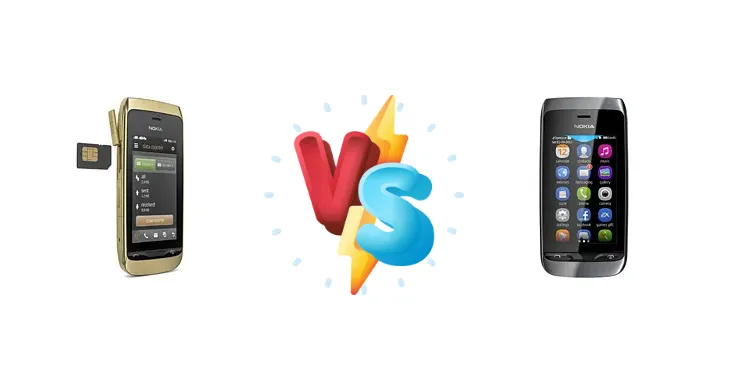
The Nokia Asha line represented a bridge between basic feature phones and early smartphones. While both the Asha 308 and 309 target the budget-conscious user, the 309 introduces a significant hardware upgrade with the inclusion of a Qualcomm Snapdragon processor, fundamentally altering the user experience. This comparison dissects the differences to determine which Asha best suits your needs.
🏆 Quick Verdict
For the average user prioritizing basic connectivity and a reliable experience, the Nokia Asha 308 remains a solid choice. However, the Asha 309’s Qualcomm Snapdragon S2 chipset delivers a noticeable performance boost, making it the better option for those who intend to utilize more demanding applications or appreciate a smoother interface.
| Network |
|---|
| 2G bands | GSM 900 / 1800 - SIM 1 & SIM 2 | GSM 850 / 900 / 1800 / 1900 |
| 3G bands | - | HSDPA 900 / 2100 - WT19i |
| EDGE | Up to 236.8 kbps | Up to 236.8 kbps |
| GPRS | Up to 85.6 kbps | Up to 85.6 kbps |
| Speed | - | HSPA 7.2/5.76 Mbps |
| Technology | GSM | GSM |
| | GSM 850 / 1900 - SIM 1 & SIM 2 | - |
| Launch |
|---|
| Announced | 2012, September. Released 2012, October | 2012, September. Released 2012, December |
| Status | Discontinued | Discontinued |
| Body |
|---|
| Dimensions | 109.9 x 54 x 13 mm, 67 cc (4.33 x 2.13 x 0.51 in) | 109.9 x 54 x 13.2 mm, 67 cc (4.33 x 2.13 x 0.52 in) |
| SIM | Dual SIM (Mini-SIM, dual stand-by) | Mini-SIM |
| Weight | 104 g (3.67 oz) | 102 g (3.60 oz) |
| Display |
|---|
| Protection | Scratch-resistant glass | Scratch-resistant glass |
| Resolution | 240 x 400 pixels, 5:3 ratio (~155 ppi density) | 240 x 400 pixels, 5:3 ratio (~155 ppi density) |
| Size | 3.0 inches, 25.6 cm2 (~43.2% screen-to-body ratio) | 3.0 inches, 25.6 cm2 (~43.2% screen-to-body ratio) |
| Type | TFT, 65K colors | TFT, 65K colors |
| Platform |
|---|
| CPU | - | 1.0 GHz Scorpion |
| Chipset | - | Qualcomm MSM8255 Snapdragon S2 |
| GPU | - | Adreno 205 |
| OS | - | Android 2.3 (Gingerbread), upgradable to 4.0 (Ice Cream Sandwich) |
| Memory |
|---|
| Call records | Yes | Yes |
| Card slot | microSDHC (dedicated slot), 2 GB included | microSDHC (dedicated slot), 2 GB included |
| Internal | 20MB 128MB ROM 64MB RAM | 20MB 128MB ROM 64MB RAM |
| Phonebook | 1000 entries, Photocall | 2000 entries, Photocall |
| Main Camera |
|---|
| Features | - | LED flash |
| Single | 2 MP | 2 MP |
| Video | 176x144@13fps | 176x144@10fps |
| Selfie camera |
|---|
| Single | - | VGA |
| | No | No |
| Sound |
|---|
| 3.5mm jack | Yes | Yes |
| 35mm jack | Yes | Yes |
| Loudspeaker | Yes | Yes |
| Comms |
|---|
| Bluetooth | 3.0 | 3.0, A2DP |
| NFC | No | No |
| Positioning | No | No |
| Radio | Stereo FM radio, RDS, recording | Stereo FM radio, RDS, recording |
| USB | microUSB 2.0 | microUSB 2.0 |
| WLAN | No | Wi-Fi 802.11 b/g/n |
| Features |
|---|
| Games | Yes + downloadable | Yes + downloadable |
| Java | Yes, MIDP 2.1 | Yes, MIDP 2.1 |
| Messaging | SMS, MMS, Email, IM | SMS, MMS, Email, IM |
| Sensors | Accelerometer | Accelerometer |
| | SNS integration
MP4/H.264/WMV player
MP3/WAV/WMA/AAC+ player
Organizer
Voice memo
Predictive text input | SNS integration
MP4/H.264/WMV player
MP3/WAV/WMA/AAC+ player
Organizer
Voice memo
Predictive text input |
| Battery |
|---|
| Music play | Up to 54 h | Up to 40 h |
| Stand-by | Up to 600 h | Up to 650 h |
| Talk time | Up to 17 h | Up to 6 h |
| Type | Li-Ion 1110 mAh, removable (BL-4U) | Li-Ion 1110 mAh, removable (BL-4U) |
| Misc |
|---|
| Colors | Black, Golden light | Black, White |
| Price | About 70 EUR | About 90 EUR |
| SAR EU | 0.93 W/kg (head) | 0.93 W/kg (head) |
| Tests |
|---|
| Audio quality |
Noise -81.5dB / Crosstalk -78.2dB |
Noise -88.1dB / Crosstalk -87.9dB |
| Camera | - |
Photo / Video |
| Display |
Contrast ratio: 938:1 (nominal) / 1.911:1 (sunlight) | - |
| Loudspeaker |
Voice 81dB / Noise 71dB / Ring 75dB
|
Voice 75dB / Noise 68dB / Ring 78dB |
Nokia Asha 308
- Potentially better nominal display contrast ratio.
- Simpler user interface for basic tasks.
- Likely lower price point.
- Significantly slower performance.
- Limited application support.
- Less responsive user experience.
Nokia Asha 309
- Faster performance thanks to Snapdragon S2.
- Video recording capability.
- Smoother multitasking and app loading.
- Potentially shorter battery life (though likely minimal).
- May be slightly more expensive.
- Display contrast ratio not specified.
Display Comparison
The Nokia Asha 308 boasts a contrast ratio of 938:1 under nominal conditions, dropping to 1.911:1 in direct sunlight. While the Asha 309’s display specifications are not provided, it’s reasonable to assume a similar LCD panel. The key difference isn’t necessarily the panel itself, but how the processor in the 309 can potentially optimize display rendering. The 308’s higher nominal contrast ratio suggests deeper blacks and more vibrant colors indoors, but the 309’s processing power could improve image clarity and responsiveness during scrolling.
Camera Comparison
The Asha 308’s camera specifications are not detailed beyond its existence. The Asha 309, however, is listed as having both photo and video capabilities. While the resolution and sensor size are unknown for both, the 309’s inclusion of video recording is a notable advantage. Given the target market, image quality is unlikely to be a primary concern, but the 309 offers a broader range of creative options.
Performance
This is where the Asha 309 truly differentiates itself. The inclusion of a 1.0 GHz Qualcomm MSM8255 Snapdragon S2 chipset is a substantial upgrade over the Asha 308’s unspecified processor. The Snapdragon S2, while dated by today’s standards, provides a significant leap in processing power, enabling smoother multitasking, faster application loading times, and a more responsive user interface. This benefits users who intend to use the Asha 309 for more than just calls and texts, such as browsing the web or using social media apps.
Battery Life
Battery life for both devices is likely similar, given their feature phone nature and relatively low-power components. The Asha 309’s Snapdragon processor *could* consume more power, but its efficiency optimizations might offset this. Without specific battery capacity figures, it’s difficult to definitively state which device offers superior battery performance. However, the 309’s faster processing allows for quicker completion of tasks, potentially reducing overall screen-on time and conserving battery.
Buying Guide
Buy the Nokia Asha 308 if you need a simple, dependable feature phone primarily for calls and texts, and value a potentially better display contrast ratio in nominal conditions. Buy the Nokia Asha 309 if you prefer a faster, more responsive experience, anticipate using the device for more than basic communication, and want the capability to run more complex applications thanks to the Snapdragon processor.
Frequently Asked Questions
❓ Will the Snapdragon processor in the Asha 309 significantly impact battery life?
While the Snapdragon S2 is more powerful, Qualcomm processors are generally optimized for efficiency. The impact on battery life is likely to be minimal, and the faster processing speed could actually *reduce* battery drain by completing tasks more quickly.
❓ Can the Asha 309 run modern apps like WhatsApp or Facebook?
The Asha 309 runs on Series 40, a feature phone platform. While some limited versions of apps like WhatsApp and Facebook were available for Series 40, they are often outdated and lack the full functionality of their smartphone counterparts. Expect a basic experience, if compatibility exists at all.
❓ Is the camera on the Asha 309 a significant upgrade over the Asha 308?
The primary advantage of the Asha 309’s camera is its ability to record video, a feature absent in the Asha 308. Image quality is likely similar, given the limitations of both devices’ sensors. Don't expect smartphone-level photography from either.