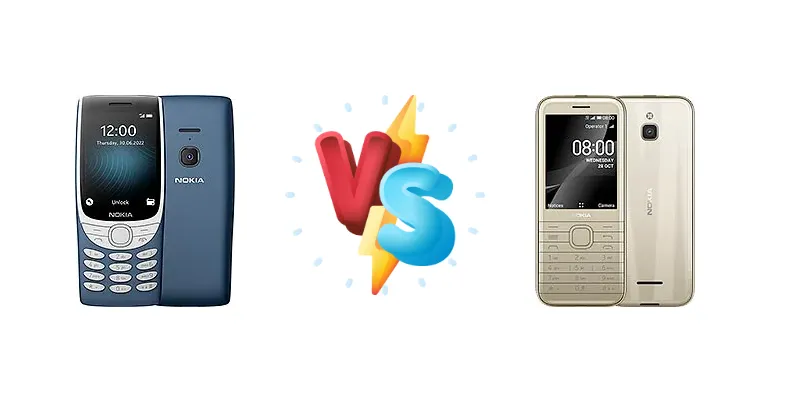
Nokia's revival of iconic designs continues with the 8210 4G and 8000 4G. Both phones offer a nostalgic trip down memory lane, but which one delivers a better experience in today's world? We're diving deep into a head-to-head comparison to help you decide.
🏆 Quick Verdict
The Nokia 8000 4G edges out the 8210 4G thanks to its slightly more powerful chipset and generally smoother performance. While both are feature phones, the 8000 4G provides a more responsive experience, making it the preferred choice for those seeking a bit more pep.
| Network |
|---|
| 2G bands | GSM 850 / 900 / 1800 / 1900 | GSM 850 / 900 / 1800 / 1900 |
| 3G bands | HSDPA 850 / 900 / 2100 - International | HSDPA 850 / 900 / 2100 |
| 4G bands | 1, 3, 5, 7, 8, 20 - APAC, EU, RUCIS | 1, 3, 5, 7, 8, 20, 28, 38, 40 - ROW |
| Speed | HSPA, LTE | HSPA, LTE Cat4 150/50 Mbps |
| Technology | GSM / HSPA / LTE | GSM / HSPA / LTE |
| | 1, 2, 3, 4, 5, 7, 8, 28, 40 - LATAM | 1, 3, 5, 7, 8, 20, 28, 38, 39, 40, 41 - MENA, GCR |
| Launch |
|---|
| Announced | 2022, July 12 | 2020, November 13. Released 2021, January 06 |
| Status | Available. Released 2022, July 28 | Discontinued |
| Body |
|---|
| Build | - | Plastic frame, plastic back |
| Dimensions | 131.3 x 56.2 x 13.8 mm (5.17 x 2.21 x 0.54 in) | 132.2 x 56.5 x 12.3 mm (5.20 x 2.22 x 0.48 in) |
| SIM | · Nano-SIM· Nano-SIM + Nano-SIM | · Nano-SIM· Nano-SIM + Nano-SIM |
| Weight | 107 g (3.77 oz) | 110.2 g (3.88 oz) |
| Display |
|---|
| Resolution | 240 x 320 pixels, 4:3 ratio (~143 ppi density) | 240 x 320 pixels, 4:3 ratio (~143 ppi density) |
| Size | 2.8 inches, 24.3 cm2 (~32.9% screen-to-body ratio) | 2.8 inches, 24.3 cm2 (~32.5% screen-to-body ratio) |
| Type | TFT LCD | TFT LCD, 16M colors |
| Platform |
|---|
| CPU | 1.0 GHz Cortex-A7 | Quad-core 1.1 GHz Cortex-A7 |
| Chipset | Unisoc T107 (22 nm) | Qualcomm MSM8909 Snapdragon 210 (28 nm) |
| GPU | - | Adreno 304 |
| OS | - | KaiOS 2.5 |
| Memory |
|---|
| Call records | Yes | - |
| Card slot | microSDHC | microSDHC |
| Internal | 128MB 48MB RAM | 4GB 512MB RAM |
| Phonebook | Yes | - |
| Main Camera |
|---|
| Features | LED flash | LED flash |
| Single | 0.3 MP | 2 MP |
| Video | Unspecified | - |
| Sound |
|---|
| 3.5mm jack | Yes | Yes |
| 35mm jack | Yes | Yes |
| Loudspeaker | Yes | Yes |
| Comms |
|---|
| Bluetooth | 5.0, A2DP, LE | Yes |
| NFC | No | - |
| Positioning | No | GPS |
| Radio | Wireless FM radio | FM radio |
| USB | microUSB 2.0 | microUSB |
| WLAN | No | Yes, hotspot |
| Features |
|---|
| Games | Yes | - |
| Java | No | - |
| Messaging | SMS, MMS | - |
| Battery |
|---|
| Type | Li-Ion 1450 mAh, removable | Removable Li-Ion 1500 mAh battery |
| Misc |
|---|
| Colors | Sand, Blue, Red | Onyx/Black, Opal/White, Topaz/Blue, Cintrine/Gold |
| Models | TA-1507, TA-1494, TA-1489, TA-1485, TA-1483 | TA-1303, TA-1311, TA-1305, TA-1300 |
| Price | About 170 EUR | About 110 EUR |
| SAR | 0.98 W/kg (head) 1.34 W/kg (body) | - |
| SAR EU | 0.98 W/kg (head) 1.43 W/kg (body) | 0.99 W/kg (head) 1.56 W/kg (body) |
Nokia 8210 4G
- Compact and lightweight design
- Classic Nokia 8210 aesthetic
- Good battery life
- 4G connectivity
- Underpowered chipset
- Small display
- Basic camera
Nokia 8000 4G
- Slightly better performance
- Larger display
- Retro design
- Good battery life
- 4G connectivity
- Still a basic feature phone
- Limited app support
- Basic camera
Display Comparison
Both phones feature relatively small, QVGA displays. The Nokia 8000 4G has a slightly larger screen (2.4 inches) compared to the 8210 4G's 1.77-inch display, offering a bit more viewing space for text and images. However, the display quality is similar – functional but not exceptional.
Camera Comparison
Neither phone excels in the camera department. Both feature basic VGA cameras, suitable only for very casual snapshots in good lighting conditions. Image quality is expectedly low on both devices. Don't expect to capture stunning photos with either of these.
Performance
Here's where the 8000 4G pulls ahead. Its Qualcomm Snapdragon 210 chipset, while still entry-level, is generally more efficient and offers a slight performance boost over the Unisoc T107 in the 8210 4G. Expect slightly faster app loading and smoother navigation on the 8000 4G.
Battery Life
Battery life is a strong point for both. Both phones offer excellent standby time and several days of usage with moderate use. The Nokia 8000 4G's slightly larger battery (1450 mAh) gives it a marginal advantage over the 8210 4G's (1500 mAh) – though the difference is minimal.
Buying Guide
The Nokia 8210 4G is ideal for those prioritizing a compact design and a truly classic Nokia 8210 aesthetic. It's a great option for basic calling, texting, and occasional social media use. The Nokia 8000 4G is better suited for users who want a slightly more capable device with a bit more processing power and a larger display, while still retaining a retro feel.
Frequently Asked Questions
❓ Are these phones smartphones?
No, these are feature phones. They offer basic functionalities like calling, texting, and limited internet access, but don't run a full-fledged operating system like Android or iOS.
❓ Can I install apps on these phones?
You can install a limited number of apps, typically through the KaiOS operating system. However, app selection is significantly more restricted compared to smartphones.