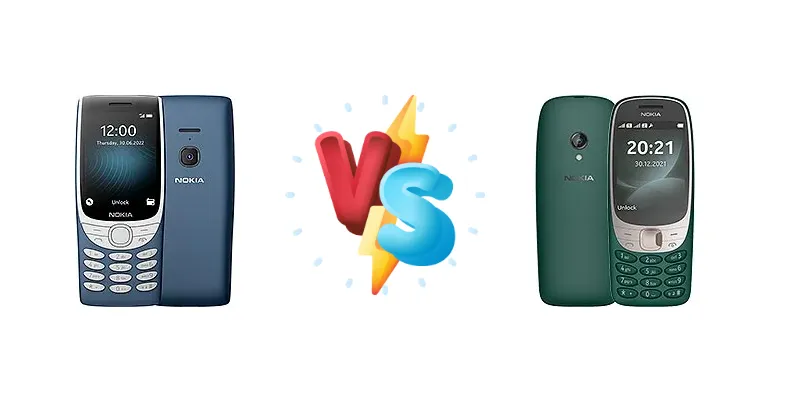
Nokia's revival of classic phones continues with the 8210 4G and the 6310 (2021). Both offer a nostalgic design and simplified experience, but which one delivers the better package? This comparison dives deep into their features, performance, and overall value.
🏆 Quick Verdict
The Nokia 6310 (2021) edges out the 8210 4G thanks to its slightly more powerful chipset and improved battery life. While both are excellent for basic communication and nostalgia, the 6310 offers a more robust and enjoyable user experience.
| Network |
|---|
| 2G bands | GSM 850 / 900 / 1800 / 1900 | GSM 900 / 1800 |
| 3G bands | HSDPA 850 / 900 / 2100 - International | - |
| 4G bands | 1, 3, 5, 7, 8, 20 - APAC, EU, RUCIS | - |
| EDGE | - | Yes |
| GPRS | - | Yes |
| Speed | HSPA, LTE | - |
| Technology | GSM / HSPA / LTE | GSM |
| | 1, 2, 3, 4, 5, 7, 8, 28, 40 - LATAM | - |
| Launch |
|---|
| Announced | 2022, July 12 | 2021, July 27 |
| Status | Available. Released 2022, July 28 | Available. Released 2021, August 27 |
| Body |
|---|
| Dimensions | 131.3 x 56.2 x 13.8 mm (5.17 x 2.21 x 0.54 in) | 135.5 x 56 x 14.1 mm, 44.8 cc (5.33 x 2.20 x 0.56 in) |
| SIM | · Nano-SIM· Nano-SIM + Nano-SIM | Mini-SIM + Nano-SIM |
| Weight | 107 g (3.77 oz) | 98 g (3.46 oz) |
| Display |
|---|
| Resolution | 240 x 320 pixels, 4:3 ratio (~143 ppi density) | 240 x 320 pixels, 4:3 ratio (~143 ppi density) |
| Size | 2.8 inches, 24.3 cm2 (~32.9% screen-to-body ratio) | 2.8 inches, 24.3 cm2 (~32.0% screen-to-body ratio) |
| Type | TFT LCD | TFT LCD |
| Platform |
|---|
| CPU | 1.0 GHz Cortex-A7 | - |
| Chipset | Unisoc T107 (22 nm) | Unisoc 6531F |
| Memory |
|---|
| Call records | Yes | Yes |
| Card slot | microSDHC | microSDHC |
| Internal | 128MB 48MB RAM | 16MB 8MB RAM |
| Phonebook | Yes | Yes |
| Main Camera |
|---|
| Features | LED flash | LED flash |
| Single | 0.3 MP | VGA |
| Video | Unspecified | Unspecified |
| Sound |
|---|
| 3.5mm jack | Yes | Yes |
| 35mm jack | Yes | Yes |
| Loudspeaker | Yes | Yes |
| Comms |
|---|
| Bluetooth | 5.0, A2DP, LE | 5.0, A2DP, LE |
| NFC | No | No |
| Positioning | No | No |
| Radio | Wireless FM radio | Wireless FM radio |
| USB | microUSB 2.0 | microUSB |
| WLAN | No | No |
| Features |
|---|
| Games | Yes | Yes |
| Java | No | No |
| Messaging | SMS, MMS | SMS, MMS |
| Battery |
|---|
| Type | Li-Ion 1450 mAh, removable | Li-Ion 1150 mAh, removable |
| Misc |
|---|
| Colors | Sand, Blue, Red | Yellow, Black, Dark Green |
| Models | TA-1507, TA-1494, TA-1489, TA-1485, TA-1483 | TA-1400 |
| Price | About 170 EUR | About 60 EUR |
| SAR | 0.98 W/kg (head) 1.34 W/kg (body) | - |
| SAR EU | 0.98 W/kg (head) 1.43 W/kg (body) | 0.97 W/kg (head) 1.26 W/kg (body) |
Nokia 8210 4G
- Extremely compact and lightweight
- Stylish and vibrant color options
- 4G connectivity
- Classic Nokia design
- Weak performance
- No camera
- Smaller display
- Shorter battery life
Nokia 6310 (2021)
- Improved performance compared to 8210 4G
- Longer battery life
- Basic camera
- Classic Nokia feel
- Snake game pre-installed
- Larger and heavier than 8210 4G
- Basic camera quality
- Limited app support
Display Comparison
Both phones feature small, 2.4-inch QVGA displays. The 6310 (2021) has a slightly better viewing angle and color reproduction, though both are adequate for their intended purpose. The 8210 4G's display is noticeably smaller, contributing to its more compact form factor.
Camera Comparison
The Nokia 6310 (2021) includes a basic 2MP rear camera, while the 8210 4G lacks a camera entirely. Image quality on the 6310 is passable for quick snapshots, but don't expect anything impressive. The absence of a camera on the 8210 4G is a trade-off for its smaller size.
Performance
The Nokia 6310 (2021) boasts the Unisoc 6531F chipset, offering a modest performance advantage over the 8210 4G's Unisoc T107. This translates to slightly smoother navigation and app loading times, though neither phone is designed for demanding tasks. Both handle basic tasks like calling, texting, and simple games without issue.
Battery Life
The Nokia 6310 (2021) has a significantly larger 1500mAh battery compared to the 8210 4G's 1450mAh. This results in noticeably longer battery life, easily lasting for several days of moderate use. The 8210 4G typically requires daily charging.
Buying Guide
The Nokia 8210 4G is ideal for those seeking a truly compact and stylish retro phone primarily for calls and texts, with a focus on a vibrant color palette. The Nokia 6310 (2021) is better suited for users who want a slightly more capable device with a longer battery life and a more classic Nokia feel, including basic games.
Frequently Asked Questions
❓ Are these phones smartphones?
No, these are feature phones. They offer basic functionalities like calling, texting, and limited app support, but don't run a full-fledged operating system like Android or iOS.
❓ Do these phones support 4G?
Yes, both phones support 4G connectivity, allowing you to access the internet and make calls over 4G networks.
❓ Can I install apps on these phones?
Yes, but app support is limited. They primarily support Java-based apps, which are less common than Android or iOS apps.
❓ Which phone is more durable?
Both phones are built with durable materials, but the Nokia 6310 (2021) is generally considered more robust due to its slightly larger size and more substantial build.