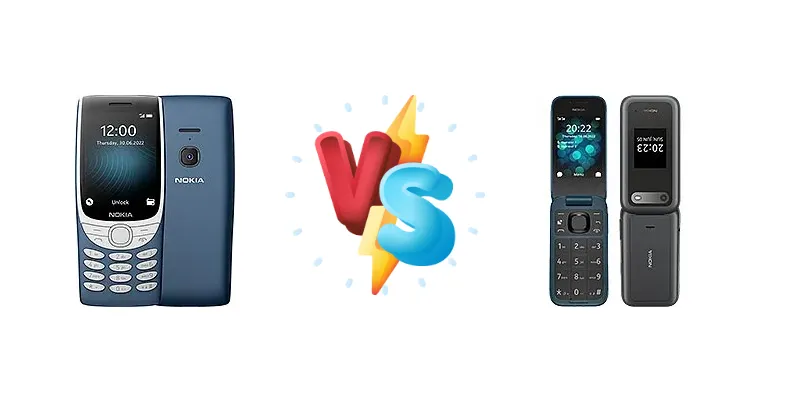
Nokia's resurgence in the retro phone market continues with the 8210 4G and the 2660 Flip. Both offer a nostalgic design and 4G connectivity, but which one truly delivers the best experience? We're diving deep into a head-to-head comparison to help you decide.
🏆 Quick Verdict
The Nokia 2660 Flip edges out the 8210 4G thanks to its convenient charging cradle and slightly more refined design. While both share the same basic chipset, the 2660 Flip's added usability makes it the better choice for most users seeking a simple, stylish flip phone.
| Network |
|---|
| 2G bands | GSM 850 / 900 / 1800 / 1900 | GSM 850 / 900 / 1800 / 1900 |
| 3G bands | HSDPA 850 / 900 / 2100 - International | HSDPA 850 / 900 / 2100 - International |
| 4G bands | 1, 3, 5, 7, 8, 20 - APAC, EU, RUCIS | 1, 3, 5, 7, 8, 20 - EU, RUCIS |
| Speed | HSPA, LTE | HSPA, LTE |
| Technology | GSM / HSPA / LTE | GSM / HSPA / LTE |
| | 1, 2, 3, 4, 5, 7, 8, 28, 40 - LATAM | 1, 2, 3, 4, 5, 7, 8, 28 - LATAM, BR |
| Launch |
|---|
| Announced | 2022, July 12 | 2022, July 12 |
| Status | Available. Released 2022, July 28 | Available. Released 2022, July 28 |
| Body |
|---|
| Dimensions | 131.3 x 56.2 x 13.8 mm (5.17 x 2.21 x 0.54 in) | - |
| SIM | · Nano-SIM· Nano-SIM + Nano-SIM | · Nano-SIM· Nano-SIM + Nano-SIM |
| Weight | 107 g (3.77 oz) | 123 g (4.34 oz) |
| Display |
|---|
| Resolution | 240 x 320 pixels, 4:3 ratio (~143 ppi density) | 240 x 320 pixels, 4:3 ratio (~143 ppi density) |
| Size | 2.8 inches, 24.3 cm2 (~32.9% screen-to-body ratio) | 2.8 inches, 24.3 cm2 |
| Type | TFT LCD | TFT LCD |
| | - | Secondary external 1.77" display |
| Platform |
|---|
| CPU | 1.0 GHz Cortex-A7 | 1.0 GHz Cortex-A7 |
| Chipset | Unisoc T107 (22 nm) | Unisoc T107 (22 nm) |
| Memory |
|---|
| Call records | Yes | Yes |
| Card slot | microSDHC | microSDHC |
| Internal | 128MB 48MB RAM | 128MB 48MB RAM |
| Phonebook | Yes | Yes |
| Main Camera |
|---|
| Features | LED flash | LED flash |
| Single | 0.3 MP | 0.3 MP |
| Video | Unspecified | Yes |
| Sound |
|---|
| 3.5mm jack | Yes | Yes |
| 35mm jack | Yes | Yes |
| Loudspeaker | Yes | Yes |
| Comms |
|---|
| Bluetooth | 5.0, A2DP, LE | 4.2, A2DP |
| NFC | No | No |
| Positioning | No | No |
| Radio | Wireless FM radio | Wireless FM radio |
| USB | microUSB 2.0 | microUSB 2.0 |
| WLAN | No | No |
| Features |
|---|
| Games | Yes | Yes |
| Java | No | No |
| Messaging | SMS, MMS | SMS, MMS |
| Battery |
|---|
| Charging | - | Compatible with a charging cradle |
| Type | Li-Ion 1450 mAh, removable | Li-Ion 1450 mAh, removable |
| Misc |
|---|
| Colors | Sand, Blue, Red | Gray, Blue, Red, Lush Green, Pop Pink |
| Models | TA-1507, TA-1494, TA-1489, TA-1485, TA-1483 | TA-1480, TA-1474, TA-1469 |
| Price | About 170 EUR | € 59.99 / $ 190.00 / £ 69.00 / ₹ 4,499 |
| SAR | 0.98 W/kg (head) 1.34 W/kg (body) | 0.47 W/kg (head) 1.16 W/kg (body) |
| SAR EU | 0.98 W/kg (head) 1.43 W/kg (body) | 0.36 W/kg (head) 1.48 W/kg (body) |
Nokia 8210 4G
- More vibrant color options
- Slightly more modern design
- 4G connectivity
- Basic performance
- Poor camera quality
- No charging cradle
Nokia 2660 Flip
- Convenient charging cradle
- Classic Nokia design
- Simple and easy to use
- 4G connectivity
- Basic performance
- Poor camera quality
- Limited features
Display Comparison
Both phones feature small, 2.4-inch QVGA displays. The 8210 4G offers a slightly more vibrant color palette, while the 2660 Flip maintains a more traditional, understated look. Resolution and viewing angles are basic on both.
Camera Comparison
Both phones have a basic 0.8MP rear camera. Image quality is poor in all lighting conditions and should be considered a novelty rather than a serious photography tool. Don't expect anything beyond basic snapshots.
Performance
Performance is virtually identical. Both are powered by the Unisoc T107 chipset, which is adequate for basic calling, texting, and light browsing. Don't expect to run demanding apps or games on either device. Lag is present with heavier usage.
Battery Life
The Nokia 2660 Flip has a slight edge here due to its charging cradle, which simplifies the charging process. Battery life is generally good on both, offering several days of moderate use. Exact mAh ratings are not publicly available, but both are designed for longevity.
Buying Guide
The Nokia 8210 4G is ideal for those who want a more vibrant color palette and a slightly more modern (though still basic) feature set. The Nokia 2660 Flip is perfect for users prioritizing ease of use, a classic Nokia aesthetic, and the convenience of a charging cradle.
Frequently Asked Questions
❓ What is the difference between the Nokia 8210 4G and the Nokia 2660 Flip?
The main differences are the color options (8210 4G has more vibrant choices) and the charging method (2660 Flip uses a cradle). Performance and core features are largely the same.
❓ Can I use these phones for serious photography?
No. Both phones have very basic 0.8MP cameras that are only suitable for occasional, low-quality snapshots.