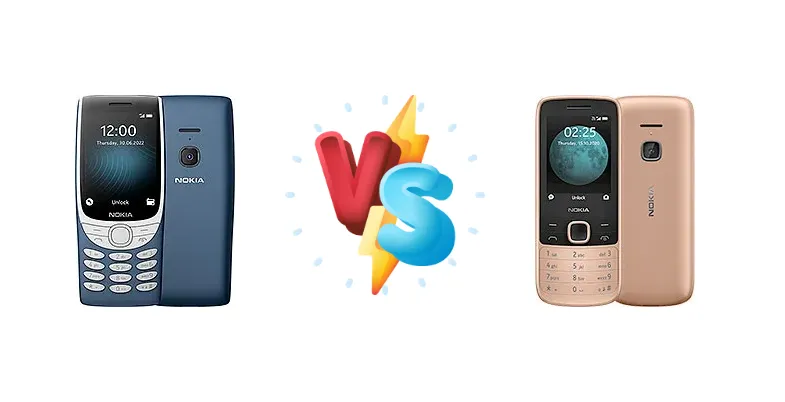
Nokia's resurgence in the feature phone market continues with the 8210 4G and 225 4G. Both offer a nostalgic design and 4G connectivity, but cater to slightly different audiences. This comparison dives deep into their specs, performance, and overall value to help you choose the right retro companion.
🏆 Quick Verdict
The Nokia 225 4G edges out the 8210 4G thanks to its slightly more efficient chipset and generally better value proposition. While the 8210 boasts a more stylish design, the 225 provides a more practical and reliable experience for everyday use.
| Network |
|---|
| 2G bands | GSM 850 / 900 / 1800 / 1900 | GSM 850 / 900 / 1800 / 1900 |
| 3G bands | HSDPA 850 / 900 / 2100 - International | HSDPA 850 / 900 / 2100 - International |
| 4G bands | 1, 3, 5, 7, 8, 20 - APAC, EU, RUCIS | 1, 3, 5, 7, 8, 20, 38, 40 - EU, APAC, SSA |
| Speed | HSPA, LTE | HSPA, LTE |
| Technology | GSM / HSPA / LTE | GSM / HSPA / LTE |
| | 1, 2, 3, 4, 5, 7, 8, 28, 40 - LATAM | 2, 3, 4, 5, 7, 12, 13, 17, 28 - NA, LATAM |
| Launch |
|---|
| Announced | 2022, July 12 | 2020, October 10. Released 2020, October 17 |
| Status | Available. Released 2022, July 28 | Discontinued |
| Body |
|---|
| Dimensions | 131.3 x 56.2 x 13.8 mm (5.17 x 2.21 x 0.54 in) | 124.7 x 51 x 13.7 mm (4.91 x 2.01 x 0.54 in) |
| SIM | · Nano-SIM· Nano-SIM + Nano-SIM | · Nano-SIM· Nano-SIM + Nano-SIM |
| Weight | 107 g (3.77 oz) | 90.1 g (3.17 oz) |
| Display |
|---|
| Resolution | 240 x 320 pixels, 4:3 ratio (~143 ppi density) | 240 x 320 pixels, 4:3 ratio (~167 ppi density) |
| Size | 2.8 inches, 24.3 cm2 (~32.9% screen-to-body ratio) | 2.4 inches, 17.8 cm2 (~28.0% screen-to-body ratio) |
| Type | TFT LCD | TFT LCD, 256K colors |
| Platform |
|---|
| CPU | 1.0 GHz Cortex-A7 | - |
| Chipset | Unisoc T107 (22 nm) | Unisoc UMS9117 |
| Memory |
|---|
| Call records | Yes | Yes |
| Card slot | microSDHC | microSDHC |
| Internal | 128MB 48MB RAM | 128MB 64MB RAM |
| Phonebook | Yes | Yes |
| Main Camera |
|---|
| Features | LED flash | - |
| Single | 0.3 MP | 0.3 MP |
| Video | Unspecified | - |
| Sound |
|---|
| 3.5mm jack | Yes | Yes |
| 35mm jack | Yes | Yes |
| Loudspeaker | Yes | Yes |
| Comms |
|---|
| Bluetooth | 5.0, A2DP, LE | 5.0 |
| NFC | No | No |
| Positioning | No | No |
| Radio | Wireless FM radio | FM radio, built-in antenna |
| USB | microUSB 2.0 | microUSB 2.0 |
| WLAN | No | No |
| Features |
|---|
| Games | Yes | Yes |
| Java | No | - |
| Messaging | SMS, MMS | SMS(threaded view), MMS, IM |
| | - | MP3 player |
| Battery |
|---|
| Type | Li-Ion 1450 mAh, removable | Li-Ion 1150 mAh, removable |
| Misc |
|---|
| Colors | Sand, Blue, Red | Black, Classic Blue, Metallic Sand |
| Models | TA-1507, TA-1494, TA-1489, TA-1485, TA-1483 | TA-1321, TA-1296, TA-1279, TA-1276, TA-1282 |
| Price | About 170 EUR | About 60 EUR |
| SAR | 0.98 W/kg (head) 1.34 W/kg (body) | 1.41 W/kg (head) 1.34 W/kg (body) |
| SAR EU | 0.98 W/kg (head) 1.43 W/kg (body) | 1.63 W/kg (head) 1.79 W/kg (body) |
Nokia 8210 4G
- Stylish retro design
- 2MP rear camera
- Slightly larger display
- 4G connectivity
- Slower performance
- Low resolution display
- Limited storage
- Less efficient chipset
Nokia 225 4G
- More efficient chipset
- Dual SIM support
- Excellent battery life
- Durable build quality
- Affordable price
- Basic design
- No rear camera
- Small display
- Limited storage
Display Comparison
Both phones feature small, basic LCD displays. The Nokia 8210 4G has a slightly larger 2.8-inch screen compared to the 225 4G's 2.4-inch display, offering marginally more viewing space. However, resolution is low on both, prioritizing battery life over visual fidelity.
Camera Comparison
The Nokia 8210 4G includes a basic 2MP rear camera, while the Nokia 225 4G lacks a camera entirely. Image quality on the 8210 is passable for quick snapshots, but don't expect anything impressive.
Performance
The Nokia 225 4G's Unisoc UMS9117 chipset generally provides slightly smoother performance than the 8210 4G's Unisoc T107. While neither phone is a powerhouse, the 225 handles basic tasks and apps with a bit more responsiveness. Expect some lag on both devices when multitasking.
Battery Life
Both phones offer excellent battery life thanks to their low-power components. The Nokia 225 4G typically provides slightly longer standby time due to its more efficient chipset and lack of a camera.
Buying Guide
The Nokia 8210 4G is ideal for those prioritizing aesthetics and a more premium feel, wanting a phone primarily for calls, texts, and basic apps. The Nokia 225 4G is better suited for users seeking a durable, affordable, and reliable device for communication and media consumption, especially those who appreciate its dual SIM functionality.
Frequently Asked Questions
❓ What is the difference between the Nokia 8210 4G and Nokia 225 4G?
The 8210 4G has a more stylish, retro design and a basic camera, while the 225 4G offers dual SIM support, slightly better performance, and longer battery life.
❓ Are these phones good for gaming?
No, neither phone is suitable for gaming. Their processors are too weak and their displays are too small and low-resolution for a decent gaming experience.