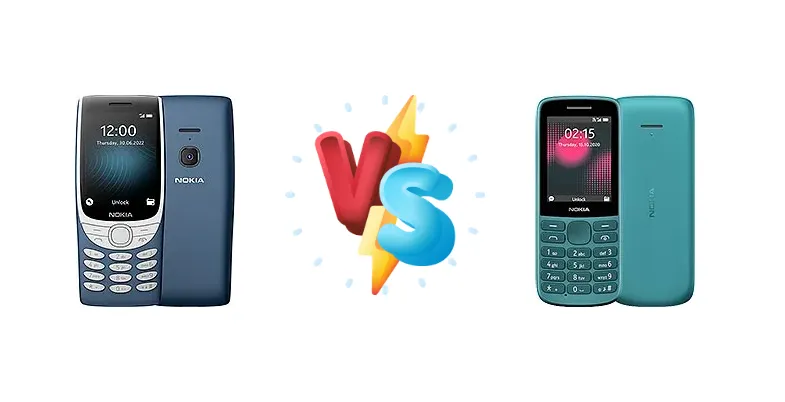
Nokia's resurgence in the feature phone market continues with the 8210 4G and 215 4G. Both offer a nostalgic design and 4G connectivity, but cater to slightly different audiences. This comparison dives deep into their specs, features, and overall value to help you choose the right one.
🏆 Quick Verdict
The Nokia 8210 4G boasts a slightly more modern design, a better screen, and a more powerful (though still basic) chipset. However, the Nokia 215 4G is the more affordable option and excels in pure battery life. For a touch more style and functionality, the 8210 4G wins, but budget buyers should lean towards the 215 4G.
| Network |
|---|
| 2G bands | GSM 850 / 900 / 1800 / 1900 | GSM 850 / 900 / 1800 / 1900 |
| 3G bands | HSDPA 850 / 900 / 2100 - International | HSDPA 850 / 900 / 2100 - International |
| 4G bands | 1, 3, 5, 7, 8, 20 - APAC, EU, RUCIS | 1, 3, 5, 7, 8, 20, 38, 40 - EU, APAC, SSA |
| Speed | HSPA, LTE | HSPA, LTE |
| Technology | GSM / HSPA / LTE | GSM / HSPA / LTE |
| | 1, 2, 3, 4, 5, 7, 8, 28, 40 - LATAM | 2, 3, 4, 5, 7, 12, 13, 17, 28 - NA, LATAM |
| Launch |
|---|
| Announced | 2022, July 12 | 2020, October 10. Released 2020, October 17 |
| Status | Available. Released 2022, July 28 | Discontinued |
| Body |
|---|
| Dimensions | 131.3 x 56.2 x 13.8 mm (5.17 x 2.21 x 0.54 in) | 124.7 x 51 x 13.7 mm (4.91 x 2.01 x 0.54 in) |
| SIM | · Nano-SIM· Nano-SIM + Nano-SIM | · Nano-SIM· Nano-SIM + Nano-SIM |
| Weight | 107 g (3.77 oz) | 90.3 g (3.17 oz) |
| Display |
|---|
| Resolution | 240 x 320 pixels, 4:3 ratio (~143 ppi density) | 240 x 320 pixels, 4:3 ratio (~167 ppi density) |
| Size | 2.8 inches, 24.3 cm2 (~32.9% screen-to-body ratio) | 2.4 inches, 17.8 cm2 (~28.0% screen-to-body ratio) |
| Type | TFT LCD | TFT LCD, 256K colors |
| Platform |
|---|
| CPU | 1.0 GHz Cortex-A7 | - |
| Chipset | Unisoc T107 (22 nm) | Unisoc UMS9117 |
| Memory |
|---|
| Call records | Yes | Yes |
| Card slot | microSDHC | microSDHC |
| Internal | 128MB 48MB RAM | 128MB 64MB RAM |
| Phonebook | Yes | Yes |
| Main Camera |
|---|
| Features | LED flash | - |
| Single | 0.3 MP | - |
| Video | Unspecified | - |
| Sound |
|---|
| 3.5mm jack | Yes | Yes |
| 35mm jack | Yes | Yes |
| Loudspeaker | Yes | Yes |
| Comms |
|---|
| Bluetooth | 5.0, A2DP, LE | 5.0 |
| NFC | No | No |
| Positioning | No | No |
| Radio | Wireless FM radio | FM radio, built-in antenna |
| USB | microUSB 2.0 | microUSB 2.0 |
| WLAN | No | No |
| Features |
|---|
| Games | Yes | Yes |
| Java | No | - |
| Messaging | SMS, MMS | SMS(threaded view), MMS, IM |
| | - | MP3 player |
| Battery |
|---|
| Type | Li-Ion 1450 mAh, removable | Li-Ion 1150 mAh, removable |
| Misc |
|---|
| Colors | Sand, Blue, Red | Black, Cyan Green |
| Models | TA-1507, TA-1494, TA-1489, TA-1485, TA-1483 | TA-1284, TA-1281, TA-1272, TA-1264 |
| Price | About 170 EUR | About 40 EUR |
| SAR | 0.98 W/kg (head) 1.34 W/kg (body) | 1.14 W/kg (head) 1.35 W/kg (body) |
| SAR EU | 0.98 W/kg (head) 1.43 W/kg (body) | 1.63 W/kg (head) 1.79 W/kg (body) |
Nokia 8210 4G
- More stylish design
- Slightly better display
- More modern chipset (marginally)
- Available in multiple color options
- Higher price
- Shorter battery life compared to 215 4G
- Basic camera quality
Nokia 215 4G
- More affordable
- Exceptional battery life
- Compact and lightweight
- FM Radio
- Less stylish design
- Basic display
- Slightly slower performance
Display Comparison
The Nokia 8210 4G features a 2.4-inch QVGA display, offering a slightly larger and more vibrant viewing experience compared to the Nokia 215 4G's 2.4-inch QVGA display. While both are basic, the 8210 4G's screen generally appears more modern.
Camera Comparison
Both phones feature a basic VGA camera. Image quality is expected to be low on both devices, suitable only for very casual snapshots. Don't expect high-resolution photos from either.
Performance
The Nokia 8210 4G utilizes a Unisoc T107 chipset with a 1.0 GHz Cortex-A7 CPU, a minor upgrade over the Nokia 215 4G's Unisoc UMS9117. In real-world usage, both phones offer basic performance suitable for calls, texts, and light browsing, but the 8210 4G might feel marginally snappier.
Battery Life
The Nokia 215 4G typically offers significantly longer battery life due to its more efficient chipset and smaller display. Expect several days of usage on a single charge, while the Nokia 8210 4G will likely require charging every 1-2 days with moderate use.
Buying Guide
The Nokia 8210 4G is ideal for those seeking a stylish retro phone with slightly improved features and a better display for browsing and media consumption. The Nokia 215 4G is perfect for users prioritizing affordability, long battery life, and basic communication needs – a reliable backup phone or for those new to smartphones.
Frequently Asked Questions
❓ What is the difference between the Nokia 8210 4G and Nokia 215 4G?
The 8210 4G has a slightly more modern design, a marginally better chipset, and a slightly larger display. The 215 4G is more affordable and offers significantly longer battery life.
❓ Are these phones good for gaming?
No, neither phone is suitable for gaming. Their chipsets are designed for basic tasks like calls, texts, and light browsing. Gaming performance will be extremely limited.