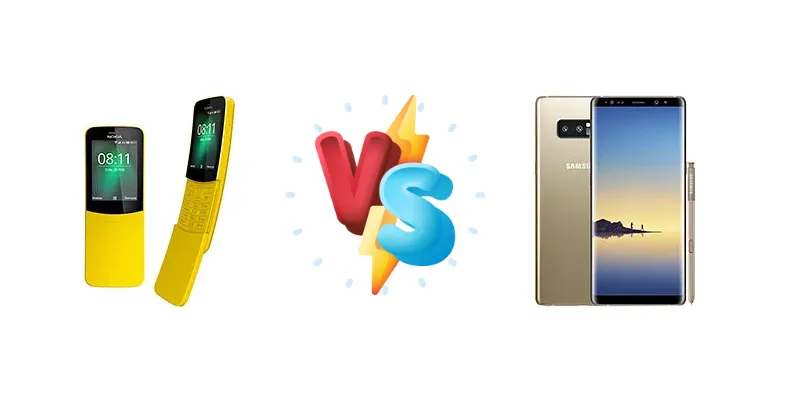
The Nokia 8110 4G, affectionately known as the 'Banana Phone,' evokes nostalgia with its iconic slider design. Meanwhile, the Samsung Galaxy Note8 represents the pinnacle of flagship smartphone technology. Can a retro icon compete with a powerhouse? Let's dive into a detailed comparison.
🏆 Quick Verdict
The Samsung Galaxy Note8 utterly dominates in performance, camera quality, and display technology. However, the Nokia 8110 4G offers a unique, nostalgic experience and surprising 4G connectivity at a budget price. It's a battle of priorities: power vs. retro charm.
| Network |
|---|
| 2G bands | GSM 900 / 1800 | GSM 850 / 900 / 1800 / 1900 - SIM 1 & SIM 2 (dual-SIM model only) |
| 3G bands | HSDPA 850 / 900 / 2100 - Europe | HSDPA 850 / 900 / 1700(AWS) / 1900 / 2100 |
| 4G bands | 1, 3, 5, 7, 8, 20 - Europe | 1, 2, 3, 4, 5, 7, 8, 12, 13, 17, 18, 19, 20, 25, 26, 28, 32, 38, 39, 40, 41, 66 |
| Speed | HSPA 42.2/5.76 Mbps, LTE Cat4 150/50 Mbps | HSPA 42.2/5.76 Mbps, LTE (5CA) Cat16 1024/150 Mbps |
| Technology | GSM / HSPA / LTE | GSM / HSPA / LTE |
| | 1, 3, 5, 7, 8, 20, 38, 39, 40, 41 - MENA/China | - |
| Launch |
|---|
| Announced | 2018, February 25. Released 2018, April 23 | 2017, August 23. Released 2017, September |
| Status | Discontinued | Discontinued |
| Body |
|---|
| Build | Glass front, plastic back, plastic frame | Glass front (Gorilla Glass 5), glass back (Gorilla Glass 5), aluminum frame |
| Dimensions | 133.5 x 49.3 x 14.9 mm (5.26 x 1.94 x 0.59 in) | 162.5 x 74.8 x 8.6 mm (6.40 x 2.94 x 0.34 in) |
| SIM | · Micro-SIM· Micro-SIM + Nano-SIM | · Nano-SIM· Nano-SIM + Nano-SIM |
| Weight | 117 g (4.13 oz) | 195 g (6.88 oz) |
| | Drip protection
Flashlight | IP68 dust/water resistant (up to 1.5m for 30 min)
Stylus |
| Display |
|---|
| Protection | - | Corning Gorilla Glass 5 |
| Resolution | 240 x 320 pixels, 4:3 ratio (~167 ppi density) | 1440 x 2960 pixels, 18.5:9 ratio (~521 ppi density) |
| Size | 2.4 inches, 17.8 cm2 (~27.1% screen-to-body ratio) | 6.3 inches, 101.1 cm2 (~83.2% screen-to-body ratio) |
| Type | TFT | Super AMOLED, HDR10 |
| | - | 3D Touch (home button only)
Always-on display |
| Platform |
|---|
| CPU | Dual-core (2x1.1 GHz Cortex-A7) | Octa-core (4x2.3 GHz Mongoose M2 & 4x1.7 GHz Cortex-A53) - EMEAOcta-core (4x2.35 GHz Kryo & 4x1.9 GHz Kryo) - USA & China |
| Chipset | Qualcomm MSM8905 Snapdragon 205 (28 nm) | Exynos 8895 (10 nm) - EMEAQualcomm MSM8998 Snapdragon 835 (10 nm) - USA & China |
| GPU | Adreno 304 | Mali-G71 MP20 - EMEAAdreno 540 - USA & China |
| OS | KaiOS 2.5.1 | Android 7.1.1 (Nougat), upgradable to Android 9.0 (Pie) |
| Memory |
|---|
| Card slot | microSDHC (dedicated slot) | microSDXC (uses shared SIM slot) - dual SIM model only |
| Internal | 4GB 512MB RAM | 64GB 6GB RAM, 128GB 6GB RAM, 256GB 6GB RAM |
| | eMMC 4.5 | UFS 2.1 |
| Main Camera |
|---|
| Dual | - | 12 MP, f/1.7, 26mm (wide), 1/2.55", 1.4µm, dual pixel PDAF, OIS
12 MP, f/2.4, 52mm (telephoto), 1/3.6", 1.0µm, AF, OIS, 2x optical zoom |
| Features | LED flash | LED flash, auto-HDR, panorama |
| Single | 2 MP | - |
| Video | Yes | 4K@30fps, 1080p@30/60fps, 720p@240fps, stereo sound rec., HDR, gyro-EIS |
| Selfie camera |
|---|
| Dual | - | 8 MP, f/1.7, 25mm (wide), 1/3.6", 1.22µm, AF
2 MP (dedicated iris scanner camera) |
| Features | - | HDR |
| Video | - | 1440p@30fps |
| | No | - |
| Sound |
|---|
| 3.5mm jack | Yes | Yes |
| 35mm jack | Yes | Yes |
| Loudspeaker | Yes | Yes |
| | - | 32-bit/384kHz audio
|
| Comms |
|---|
| Bluetooth | 4.1, A2DP, LE | 5.0, A2DP, LE, aptX |
| NFC | No | Yes |
| Positioning | GPS | GPS, GLONASS, BDS, GALILEO |
| Radio | FM radio | No |
| USB | microUSB 2.0 | USB Type-C 3.1 |
| WLAN | Wi-Fi 802.11 b/g/n | Wi-Fi 802.11 a/b/g/n/ac, dual-band, Wi-Fi Direct |
| Features |
|---|
| Sensors | - | Iris scanner, fingerprint (rear-mounted), accelerometer, gyro, proximity, compass, barometer, heart rate, SpO2 |
| | Downloadable applications Facebook, Gmail, Whatsapp, etc.
Audio/Video player | Samsung DeX (desktop experience support)
ANT+
Bixby natural language commands and dictation
Samsung Pay (Visa, MasterCard certified) |
| Battery |
|---|
| Charging | - | 15W wired, QC2
Wireless (Qi) (market dependent) |
| Music play | Up to 48 h | Up to 74 h |
| Stand-by | Up to 408 h | - |
| Talk time | Up to 11 h | Up to 22 h (3G) |
| Type | Li-Ion 1500 mAh battery | Li-Ion 3300 mAh, non-removable |
| Misc |
|---|
| Colors | Traditional Black, Banana Yellow | Midnight Black, Maple Gold, Orchid Gray, Deep Sea Blue, Star Pink |
| Models | TA-1071, TA-1067 | SM-N950F, SM-N950U, SM-N9500, SM-N950U1, SM-N950N, SM-N950W, SC-01K, SM-N950FD |
| Price | About 140 EUR | About 500 EUR |
| SAR | 1.16 W/kg (head) 1.18 W/kg (body) | 0.61 W/kg (head) 0.56 W/kg (body) |
| SAR EU | 0.95 W/kg (head) 1.48 W/kg (body) | 0.17 W/kg (head) 1.29 W/kg (body) |
| Tests |
|---|
| Audio quality | - |
Noise -92.5dB / Crosstalk -93.2dB |
| Battery life | - |
Endurance rating 89h
|
| Camera | - |
Photo / Video |
| Display | - |
Contrast ratio: Infinite (nominal), 4.148(sunlight) |
| Loudspeaker | - |
Voice 67dB / Noise 69dB / Ring 71dB
|
| Performance | - |
AnTuTu: 201065 (v7)
GeekBench: 6784 (v4.4)
GFXBench: 13fps (ES 3.1 onscreen) |
Nokia 8110 4G
- Unique retro design
- 4G connectivity
- Surprisingly affordable
- Durable build
- Weak performance
- Low-resolution display
- Basic camera
- Limited storage
Samsung Galaxy Note8
- Exceptional performance
- Stunning display
- Excellent camera
- Wireless charging
- S Pen stylus
- Expensive
- Large size
- Battery life could be better (though still good)
- Outdated compared to newer models
Display Comparison
The Galaxy Note8 boasts a vibrant, expansive Super AMOLED display with a stunning contrast ratio and excellent outdoor visibility. The Nokia 8110 4G's smaller, LCD screen is functional but lacks the Note8's color accuracy and resolution. The Note8's screen is significantly superior.
Camera Comparison
The Galaxy Note8's camera system is far more advanced, offering superior image quality, features like OIS, and impressive video recording capabilities. The Nokia 8110 4G's camera is adequate for casual snapshots but lacks detail and dynamic range. The Note8 is the clear camera champion.
Performance
The Note8's Exynos/Snapdragon 835/8895 chipset and Octa-core processor leave the Nokia 8110 4G's dual-core Snapdragon 205 in the dust. The Note8 handles demanding apps and games with ease, while the 8110 4G struggles with anything beyond basic tasks. Performance is a clear win for the Note8.
Battery Life
While both phones offer impressive endurance ratings (89h for the Note8), the Note8's larger battery capacity and more efficient processor contribute to longer real-world usage. Both support fast charging, but the Note8 has wireless charging capabilities.
Buying Guide
Who should buy the Nokia 8110 4G? Those seeking a conversation starter, a simple phone for basic communication, and a touch of retro flair. Who should buy the Samsung Galaxy Note8? Power users, photographers, and anyone demanding a top-tier smartphone experience with a stunning display and powerful performance.
Frequently Asked Questions
❓ Is the Nokia 8110 4G worth buying in 2024?
It's a niche purchase. If you value nostalgia and a simple phone experience, it can be fun. Don't expect flagship performance.
❓ How does the Samsung Galaxy Note8 compare to newer Samsung phones?
The Note8 is an older flagship. Newer models offer improved processors, cameras, and features, but the Note8 remains a capable device.