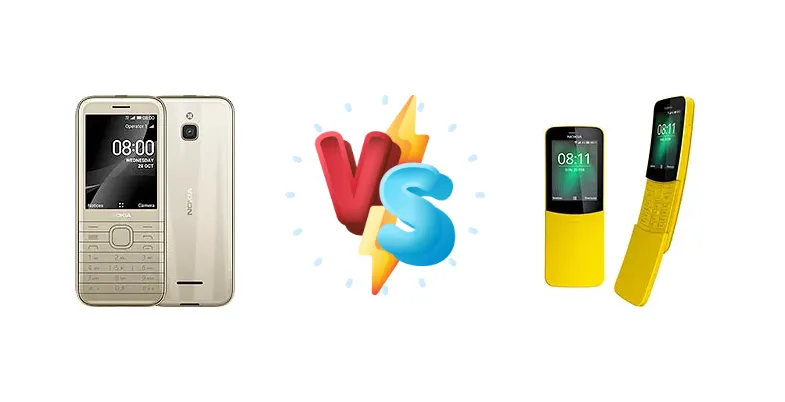
The Nokia 8000 4G and 8110 4G represent HMD Global’s continued commitment to the feature phone market, offering 4G connectivity in a familiar form factor. While both cater to users seeking a simple, reliable mobile experience, a key differentiator lies beneath the surface: their chipsets. This comparison dissects the Qualcomm Snapdragon 210 in the 8000 4G versus the Snapdragon 205 in the 8110 4G, revealing which device provides a smoother, more responsive user experience.
🏆 Quick Verdict
For the average user prioritizing responsiveness and future-proofing, the Nokia 8000 4G emerges as the better choice. Its quad-core CPU, powered by the Snapdragon 210, offers a noticeable performance advantage over the dual-core Snapdragon 205 in the 8110 4G, translating to faster app loading and smoother multitasking.
| Network |
|---|
| 2G bands | GSM 850 / 900 / 1800 / 1900 | GSM 900 / 1800 |
| 3G bands | HSDPA 850 / 900 / 2100 | HSDPA 850 / 900 / 2100 - Europe |
| 4G bands | 1, 3, 5, 7, 8, 20, 28, 38, 40 - ROW | 1, 3, 5, 7, 8, 20 - Europe |
| Speed | HSPA, LTE Cat4 150/50 Mbps | HSPA 42.2/5.76 Mbps, LTE Cat4 150/50 Mbps |
| Technology | GSM / HSPA / LTE | GSM / HSPA / LTE |
| | 1, 3, 5, 7, 8, 20, 28, 38, 39, 40, 41 - MENA, GCR | 1, 3, 5, 7, 8, 20, 38, 39, 40, 41 - MENA/China |
| Launch |
|---|
| Announced | 2020, November 13. Released 2021, January 06 | 2018, February 25. Released 2018, April 23 |
| Status | Discontinued | Discontinued |
| Body |
|---|
| Build | Plastic frame, plastic back | Glass front, plastic back, plastic frame |
| Dimensions | 132.2 x 56.5 x 12.3 mm (5.20 x 2.22 x 0.48 in) | 133.5 x 49.3 x 14.9 mm (5.26 x 1.94 x 0.59 in) |
| SIM | · Nano-SIM· Nano-SIM + Nano-SIM | · Micro-SIM· Micro-SIM + Nano-SIM |
| Weight | 110.2 g (3.88 oz) | 117 g (4.13 oz) |
| | - | Drip protection
Flashlight |
| Display |
|---|
| Resolution | 240 x 320 pixels, 4:3 ratio (~143 ppi density) | 240 x 320 pixels, 4:3 ratio (~167 ppi density) |
| Size | 2.8 inches, 24.3 cm2 (~32.5% screen-to-body ratio) | 2.4 inches, 17.8 cm2 (~27.1% screen-to-body ratio) |
| Type | TFT LCD, 16M colors | TFT |
| Platform |
|---|
| CPU | Quad-core 1.1 GHz Cortex-A7 | Dual-core (2x1.1 GHz Cortex-A7) |
| Chipset | Qualcomm MSM8909 Snapdragon 210 (28 nm) | Qualcomm MSM8905 Snapdragon 205 (28 nm) |
| GPU | Adreno 304 | Adreno 304 |
| OS | KaiOS 2.5 | KaiOS 2.5.1 |
| Memory |
|---|
| Card slot | microSDHC | microSDHC (dedicated slot) |
| Internal | 4GB 512MB RAM | 4GB 512MB RAM |
| | - | eMMC 4.5 |
| Main Camera |
|---|
| Features | LED flash | LED flash |
| Single | 2 MP | 2 MP |
| Video | - | Yes |
| Sound |
|---|
| 3.5mm jack | Yes | Yes |
| 35mm jack | Yes | Yes |
| Loudspeaker | Yes | Yes |
| Comms |
|---|
| Bluetooth | Yes | 4.1, A2DP, LE |
| NFC | - | No |
| Positioning | GPS | GPS |
| Radio | FM radio | FM radio |
| USB | microUSB | microUSB 2.0 |
| WLAN | Yes, hotspot | Wi-Fi 802.11 b/g/n |
| Features |
|---|
| | - | Downloadable applications Facebook, Gmail, Whatsapp, etc.
Audio/Video player |
| Battery |
|---|
| Music play | - | Up to 48 h |
| Stand-by | - | Up to 408 h |
| Talk time | - | Up to 11 h |
| Type | Removable Li-Ion 1500 mAh battery | Li-Ion 1500 mAh battery |
| Misc |
|---|
| Colors | Onyx/Black, Opal/White, Topaz/Blue, Cintrine/Gold | Traditional Black, Banana Yellow |
| Models | TA-1303, TA-1311, TA-1305, TA-1300 | TA-1071, TA-1067 |
| Price | About 110 EUR | About 140 EUR |
| SAR | - | 1.16 W/kg (head) 1.18 W/kg (body) |
| SAR EU | 0.99 W/kg (head) 1.56 W/kg (body) | 0.95 W/kg (head) 1.48 W/kg (body) |
Nokia 8000 4G
- Faster processor for smoother multitasking
- Quad-core CPU offers better app performance
- Potentially more future-proof for app updates
- May have slightly shorter battery life (though likely negligible)
- Potentially higher price point
Nokia 8110 4G
- Simpler user experience
- Potentially lower price point
- Excellent standby time
- Slower processor can lead to lag
- Dual-core CPU struggles with multitasking
- Less responsive user interface
Display Comparison
Both devices feature relatively small displays, and detailed display specifications are not provided. However, given their market segment, we can assume both utilize LCD panels optimized for power efficiency rather than color accuracy or peak brightness. The focus is on readability under various lighting conditions, not immersive viewing. Bezels are likely substantial on both models, consistent with their design language.
Camera Comparison
Neither device is positioned as a photography powerhouse. Detailed camera specifications are unavailable, but feature phones in this category typically include basic cameras for casual snapshots. Image quality will be limited by the sensors and image processing capabilities of the respective chipsets. Expect adequate performance in well-lit conditions, but poor results in low light. Focusing on camera performance is not a primary consideration for these devices.
Performance
The core difference lies in the chipsets. The Nokia 8000 4G’s Qualcomm MSM8909 Snapdragon 210, with its quad-core 1.1 GHz Cortex-A7 CPU, demonstrably outperforms the Nokia 8110 4G’s Qualcomm MSM8905 Snapdragon 205, which features a dual-core 1.1 GHz Cortex-A7 CPU. While both are based on the Cortex-A7 architecture and manufactured on a 28nm process, the additional cores in the Snapdragon 210 allow for better parallel processing, resulting in quicker app launches and smoother operation when running multiple applications. The Snapdragon 210 also benefits from a slightly more modern GPU, further enhancing its performance edge.
Battery Life
Battery capacity details are not provided. However, given the low-power chipsets and basic functionality, both devices should offer several days of standby time and a reasonable talk time. The Snapdragon 210’s slightly higher power consumption due to the additional cores is likely offset by software optimizations and battery capacity, resulting in comparable real-world battery life for both models. Charging times will also be similar, likely utilizing micro-USB connectivity.
Buying Guide
Buy the Nokia 8000 4G if you need a feature phone capable of handling basic apps like WhatsApp and web browsing with reasonable speed and anticipate using it for more than just calls and texts. Buy the Nokia 8110 4G if you prioritize simplicity and are primarily looking for a reliable device for voice calls and SMS, with minimal app usage and a lower price point.
Frequently Asked Questions
❓ Will the Nokia 8000 4G handle WhatsApp video calls smoothly?
The Nokia 8000 4G’s quad-core Snapdragon 210 processor is better equipped to handle the demands of WhatsApp video calls compared to the 8110 4G. While it won’t offer the same experience as a smartphone, it should provide a reasonably stable connection and acceptable video quality, especially with a strong 4G signal.
❓ Is the difference in performance between the Snapdragon 210 and 205 noticeable in everyday use?
Yes, the difference is noticeable, particularly when switching between apps or loading web pages. The Snapdragon 210’s additional cores allow it to handle multiple tasks concurrently without significant lag, whereas the Snapdragon 205 may exhibit slower response times and occasional stuttering. This is most apparent when using apps like WhatsApp or a basic web browser.
❓ Which phone is better for someone who primarily makes and receives calls?
Both phones excel at their core function: making and receiving calls. However, the Nokia 8110 4G might be slightly preferable for this use case if call quality and battery life are paramount, as its simpler processor consumes less power and may offer marginally longer talk time.