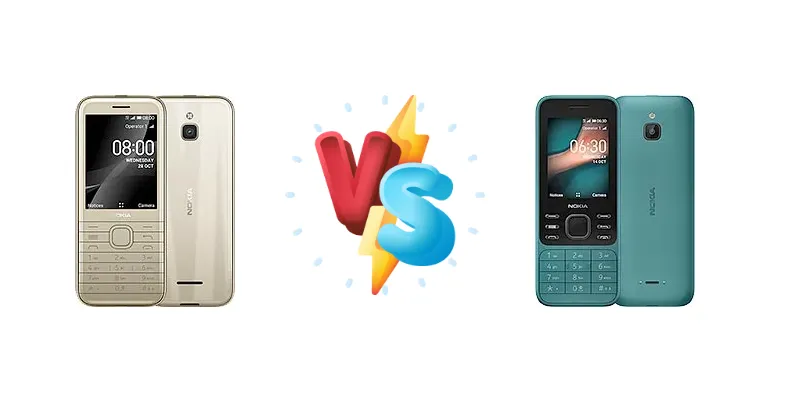
Nokia's resurgence in the feature phone market continues with the 8000 4G and 6300 4G, both offering a modern take on classic designs with the added benefit of 4G connectivity. While appearing nearly identical on paper, a closer examination reveals nuanced differences that cater to slightly different user priorities. This comparison dissects these phones, moving beyond the shared specifications to highlight where each excels.
🏆 Quick Verdict
For the average user prioritizing a slightly more refined aesthetic and potentially better software support, the Nokia 8000 4G emerges as the winner. Both phones deliver comparable performance thanks to the identical Snapdragon 210 chipset, but the 8000 4G’s design and potential for future software updates give it a slight edge.
| Network |
|---|
| 2G bands | GSM 850 / 900 / 1800 / 1900 | GSM 850 / 900 / 1800 / 1900 |
| 3G bands | HSDPA 850 / 900 / 2100 | HSDPA 850 / 900 / 2100 - International |
| 4G bands | 1, 3, 5, 7, 8, 20, 28, 38, 40 - ROW | 1, 3, 5, 7, 8, 20, 28, 38, 40 - ROW |
| Speed | HSPA, LTE Cat4 150/50 Mbps | HSPA, LTE Cat4 150/50 Mbps |
| Technology | GSM / HSPA / LTE | GSM / HSPA / LTE |
| | 1, 3, 5, 7, 8, 20, 28, 38, 39, 40, 41 - MENA, GCR | 2, 3, 4, 5, 7, 12, 17, 28, 66, 71 - Americas |
| Launch |
|---|
| Announced | 2020, November 13. Released 2021, January 06 | 2020, November 13. Released 2021, January 06 |
| Status | Discontinued | Discontinued |
| Body |
|---|
| Build | Plastic frame, plastic back | Plastic frame, plastic back |
| Dimensions | 132.2 x 56.5 x 12.3 mm (5.20 x 2.22 x 0.48 in) | 131.4 x 53 x 13.7 mm (5.17 x 2.09 x 0.54 in) |
| SIM | · Nano-SIM· Nano-SIM + Nano-SIM | · Nano-SIM· Nano-SIM + Nano-SIM |
| Weight | 110.2 g (3.88 oz) | 104.7 g (3.70 oz) |
| Display |
|---|
| Resolution | 240 x 320 pixels, 4:3 ratio (~143 ppi density) | 240 x 320 pixels, 4:3 ratio (~167 ppi density) |
| Size | 2.8 inches, 24.3 cm2 (~32.5% screen-to-body ratio) | 2.4 inches, 17.8 cm2 (~25.6% screen-to-body ratio) |
| Type | TFT LCD, 16M colors | TFT LCD, 16M colors |
| Platform |
|---|
| CPU | Quad-core 1.1 GHz Cortex-A7 | Quad-core 1.1 GHz Cortex-A7 |
| Chipset | Qualcomm MSM8909 Snapdragon 210 (28 nm) | Qualcomm QC8909 Snapdragon 210 (28 nm) |
| GPU | Adreno 304 | Adreno 304 |
| OS | KaiOS 2.5 | KaiOS 2.5 |
| Memory |
|---|
| Card slot | microSDHC | microSDHC |
| Internal | 4GB 512MB RAM | 4GB 512MB RAM |
| Main Camera |
|---|
| Features | LED flash | LED flash |
| Single | 2 MP | VGA |
| Sound |
|---|
| 3.5mm jack | Yes | Yes |
| 35mm jack | Yes | Yes |
| Loudspeaker | Yes | Yes |
| Comms |
|---|
| Bluetooth | Yes | 4.0, A2DP |
| Positioning | GPS | GPS, GLONASS |
| Radio | FM radio | FM radio |
| USB | microUSB | microUSB 2.0 |
| WLAN | Yes, hotspot | Wi-Fi 802.11 b/g/n, hotspot |
| Battery |
|---|
| Type | Removable Li-Ion 1500 mAh battery | Removable Li-Ion 1500 mAh battery |
| Misc |
|---|
| Colors | Onyx/Black, Opal/White, Topaz/Blue, Cintrine/Gold | Light Charcoal, White, Cyan Green |
| Models | TA-1303, TA-1311, TA-1305, TA-1300 | TA-1294, TA-1291, TA-1287, TA-1286 |
| Price | About 110 EUR | About 80 EUR |
| SAR EU | 0.99 W/kg (head) 1.56 W/kg (body) | 1.09 W/kg (head) 1.77 W/kg (body) |
Nokia 8000 4G
- More refined design aesthetic
- Potential for longer software support
- Slightly more premium feel
- Potentially higher price point
- Identical performance to the 6300 4G
Nokia 6300 4G
- More affordable price
- Classic Nokia design
- Identical performance to the 8000 4G
- Less premium build quality
- Potentially shorter software support lifecycle
Display Comparison
Both the Nokia 8000 4G and 6300 4G feature 2.4-inch displays, but detailed specifications regarding panel type (TFT, IPS) and resolution are not provided. Given the market segment, it’s safe to assume both utilize basic TFT panels. The real difference lies in the design surrounding the display; the 8000 4G boasts a more sculpted, glass-like finish, potentially offering slightly better viewing angles and a more visually appealing experience. Bezels are likely comparable, focusing on durability rather than minimizing screen-to-body ratio.
Camera Comparison
Both phones feature a rear camera, but detailed specifications are scarce. Given the feature phone category, image quality will be basic, suitable for quick snapshots rather than detailed photography. The absence of detailed sensor information suggests both cameras likely utilize low-resolution sensors (2MP or 5MP is probable). Image processing will be minimal, focusing on basic functionality. The lack of OIS or advanced features is expected.
Performance
The core of both devices is the Qualcomm MSM8909 Snapdragon 210 chipset, a quad-core 1.1 GHz Cortex-A7 processor fabricated on a 28nm process. This means performance will be virtually identical for everyday tasks like calls, texts, and basic feature phone apps. The 28nm node, while older, is sufficient for the low-power demands of these devices. Neither phone is intended for demanding applications, so the chipset’s limitations won’t be a significant bottleneck for the target user. RAM capacity is not specified, but is likely limited to 512MB or 1GB, sufficient for the intended use case.
Battery Life
Battery capacity is not explicitly stated for either device. However, feature phones with these specifications typically offer excellent battery life – several days on a single charge – due to the low power consumption of the Snapdragon 210 and the basic display technology. Charging wattage is also unspecified, but likely utilizes a standard micro-USB connection with slow charging speeds. The focus is on longevity rather than rapid charging.
Buying Guide
Buy the Nokia 8000 4G if you need a feature phone with a more premium feel, a slightly more modern design, and potentially longer software support. Buy the Nokia 6300 4G if you prefer a more classic Nokia aesthetic and are seeking the most affordable 4G feature phone option without compromising core functionality.
Frequently Asked Questions
❓ Will the Snapdragon 210 struggle with WhatsApp or Facebook Lite on these phones?
No, the Snapdragon 210 is perfectly capable of running lightweight apps like WhatsApp and Facebook Lite. These feature phones are designed for basic communication and functionality, and the chipset has sufficient processing power for these tasks. However, don't expect a fluid experience with more demanding applications.
❓ How long will the battery last on a single charge with typical usage (calls, texts, occasional radio)?
Given the low power consumption of the Snapdragon 210 and the basic display technology, you can realistically expect several days – potentially up to a week – of battery life with typical usage. Heavy use of the radio or frequent calls will reduce battery life, but it will still outperform most smartphones in longevity.
❓ Do these phones support VoLTE and Wi-Fi calling?
Support for VoLTE (Voice over LTE) and Wi-Fi calling will vary depending on the carrier and region. It's crucial to check with your mobile provider to confirm compatibility before purchasing, as these features are essential for maintaining 4G connectivity as older networks are phased out.