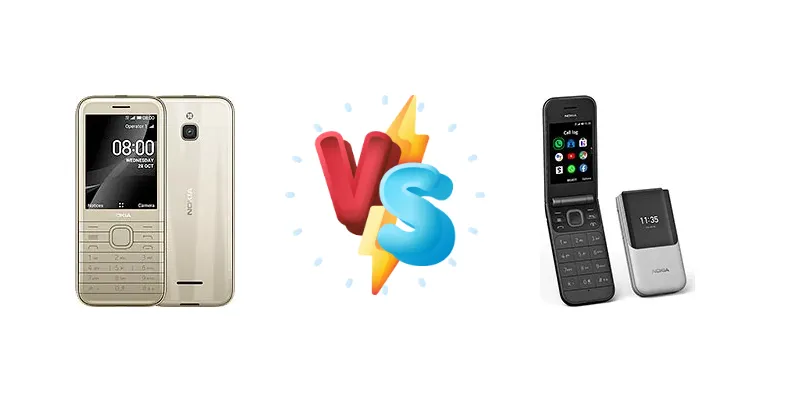
In a market dominated by smartphones, Nokia continues to cater to the demand for reliable, affordable feature phones. The Nokia 8000 4G and Nokia 2720 Flip represent two distinct approaches within this segment – one a modern candybar design with enhanced features, the other a nostalgic flip phone offering simplicity and portability. This comparison dissects the core hardware differences, specifically the Qualcomm chipsets, to determine which device delivers the best user experience.
🏆 Quick Verdict
For the average user prioritizing a slightly smoother experience and potentially better app compatibility, the Nokia 8000 4G emerges as the winner. Its quad-core processor and Snapdragon 210 chipset offer a modest performance advantage over the dual-core, Snapdragon 205-powered 2720 Flip, making it more suitable for basic multitasking and app usage.
| Network |
|---|
| 2G bands | GSM 850 / 900 / 1800 / 1900 | GSM 850 / 900 / 1800 / 1900 |
| 3G bands | HSDPA 850 / 900 / 2100 | HSDPA 850 / 900 / 2100 |
| 4G bands | 1, 3, 5, 7, 8, 20, 28, 38, 40 - ROW | 1, 3, 5, 7, 8, 20 - EU |
| Speed | HSPA, LTE Cat4 150/50 Mbps | HSPA 42.2/5.76 Mbps, LTE Cat4 150/50 Mbps |
| Technology | GSM / HSPA / LTE | GSM / HSPA / LTE |
| | 1, 3, 5, 7, 8, 20, 28, 38, 39, 40, 41 - MENA, GCR | 1, 3, 5, 7, 8, 20, 28, 38, 39, 40, 41 - MENA, APAC, GCR |
| Launch |
|---|
| Announced | 2020, November 13. Released 2021, January 06 | 2019, September 05. Released 2019, September 05 |
| Status | Discontinued | Discontinued |
| Body |
|---|
| Build | Plastic frame, plastic back | - |
| Dimensions | 132.2 x 56.5 x 12.3 mm (5.20 x 2.22 x 0.48 in) | 192.7 x 54.5 x 11.6 mm (7.59 x 2.15 x 0.46 in) |
| SIM | · Nano-SIM· Nano-SIM + Nano-SIM | · Nano-SIM· Nano-SIM + Nano-SIM |
| Weight | 110.2 g (3.88 oz) | 118 g (4.16 oz) |
| Display |
|---|
| Resolution | 240 x 320 pixels, 4:3 ratio (~143 ppi density) | 240 x 320 pixels, 4:3 ratio (~143 ppi density) |
| Size | 2.8 inches, 24.3 cm2 (~32.5% screen-to-body ratio) | 2.8 inches, 24.3 cm2 (~23.1% screen-to-body ratio) |
| Type | TFT LCD, 16M colors | TFT LCD, 256K colors |
| | - | Second external TFT display, 240 x 240 pixels, 1.3 inches |
| Platform |
|---|
| CPU | Quad-core 1.1 GHz Cortex-A7 | Dual-core (2x1.1 GHz Cortex-A7) |
| Chipset | Qualcomm MSM8909 Snapdragon 210 (28 nm) | Qualcomm MSM8905 Snapdragon 205 (28 nm) |
| GPU | Adreno 304 | Adreno 304 |
| OS | KaiOS 2.5 | KaiOS 2.5.2 |
| Memory |
|---|
| Card slot | microSDHC | microSDHC (dedicated slot) |
| Internal | 4GB 512MB RAM | 4GB 512MB |
| | - | eMMC 4.5 |
| Main Camera |
|---|
| Features | LED flash | LED flash |
| Single | 2 MP | 2 MP |
| Video | - | Yes |
| Sound |
|---|
| 3.5mm jack | Yes | Yes |
| 35mm jack | Yes | Yes |
| Loudspeaker | Yes | Yes |
| Comms |
|---|
| Bluetooth | Yes | 4.2, A2DP, LE |
| NFC | - | No |
| Positioning | GPS | GPS, GLONASS |
| Radio | FM radio | FM radio |
| USB | microUSB | microUSB 2.0 |
| WLAN | Yes, hotspot | Wi-Fi 802.11 b/g/n, hotspot |
| Features |
|---|
| | - | SNS applications
MP4/H.264 player
MP3/WAV/AAC player
Organizer
Voice memo
Predictive text input |
| Battery |
|---|
| Stand-by | - | Up to 700 h (3G) |
| Type | Removable Li-Ion 1500 mAh battery | Li-Ion 1500 mAh, removable |
| Misc |
|---|
| Colors | Onyx/Black, Opal/White, Topaz/Blue, Cintrine/Gold | Black, Gray, Red |
| Models | TA-1303, TA-1311, TA-1305, TA-1300 | TA-1175, TA-1173, TA-1170, TA-1168 |
| Price | About 110 EUR | About 140 EUR |
| SAR | - | 0.87 W/kg (head) 1.10 W/kg (body) |
| SAR EU | 0.99 W/kg (head) 1.56 W/kg (body) | 1.03 W/kg (head) 1.69 W/kg (body) |
Nokia 8000 4G
- Quad-core processor offers better multitasking.
- Potentially better app compatibility due to Snapdragon 210.
- Larger screen (assumed) for improved readability.
- Likely shorter battery life compared to the 2720 Flip.
- Larger form factor less portable than a flip phone.
Nokia 2720 Flip
- Compact and portable flip phone design.
- Potentially longer battery life due to simpler hardware.
- Nostalgic appeal of a flip phone.
- Dual-core processor may struggle with multitasking.
- Smaller screen can be less comfortable for reading.
Display Comparison
While both phones utilize relatively low-resolution displays (specs not provided, but typical for this segment), the Nokia 8000 4G’s larger screen size (assumed, based on candybar design) likely offers a more comfortable viewing experience. The 2720 Flip’s clamshell design prioritizes compactness over screen real estate. Neither phone is expected to feature advanced display technologies like high refresh rates or OLED panels; color accuracy and brightness will be basic, sufficient for calls and text messages.
Camera Comparison
Given the target market, camera performance is not a primary focus. Both phones likely feature basic VGA or 2MP cameras (specs not provided, but typical). Image quality will be limited, suitable only for basic snapshots in good lighting conditions. The absence of features like optical image stabilization (OIS) or advanced image processing algorithms is expected. The camera is primarily for functional use, not for photography enthusiasts.
Performance
The core difference lies in the chipsets. The Nokia 8000 4G boasts a Qualcomm MSM8909 Snapdragon 210 with a quad-core 1.1 GHz Cortex-A7 CPU, while the Nokia 2720 Flip uses the Qualcomm MSM8905 Snapdragon 205 with a dual-core 1.1 GHz Cortex-A7 CPU. Although both are based on the Cortex-A7 architecture and manufactured on a 28nm process, the quad-core configuration of the 8000 4G provides a theoretical advantage in multitasking and handling more demanding applications. The Snapdragon 210 also includes a slightly more capable Adreno 304 GPU, potentially offering marginally better performance in simple games. However, both chipsets are entry-level and will struggle with modern, graphically intensive apps.
Battery Life
Battery life is a key strength of feature phones. While specific mAh capacities are not provided, the Nokia 2720 Flip’s simpler hardware and flip phone design (allowing for screen-off operation when closed) likely contribute to longer standby times. The Nokia 8000 4G, with its larger screen and more powerful processor, will likely consume more power. However, both phones should easily last several days on a single charge with moderate use. Charging speeds are expected to be slow, utilizing micro-USB connectivity.
Buying Guide
Buy the Nokia 8000 4G if you need a more responsive experience for apps like WhatsApp or Facebook, and appreciate a larger screen for easier readability. It’s ideal for users who want a modern feature phone with a bit more processing power. Buy the Nokia 2720 Flip if you prioritize ultimate portability, a classic flip phone form factor, and a longer battery life due to its simpler hardware and potentially less screen-on time. It’s perfect for those seeking a secondary phone for emergencies or minimal communication.
Frequently Asked Questions
❓ Will the Nokia 8000 4G run WhatsApp smoothly?
While WhatsApp is relatively lightweight, the quad-core processor and Snapdragon 210 chipset in the Nokia 8000 4G should provide a reasonably smooth experience. However, expect occasional lag when handling multiple chats or media files. The Nokia 2720 Flip may struggle more with WhatsApp due to its dual-core processor.
❓ Is the Nokia 2720 Flip a good option for elderly users?
Yes, the Nokia 2720 Flip is an excellent choice for elderly users. Its simple interface, large buttons, and flip phone design make it easy to use. The clamshell design also protects the screen from accidental touches when in a pocket or bag, and the long battery life is a significant benefit.
❓ Can I use a microSD card to expand storage on either phone?
Both the Nokia 8000 4G and Nokia 2720 Flip support microSD card expansion, allowing you to increase storage for contacts, messages, and media files. This is crucial as internal storage is likely limited on both devices.