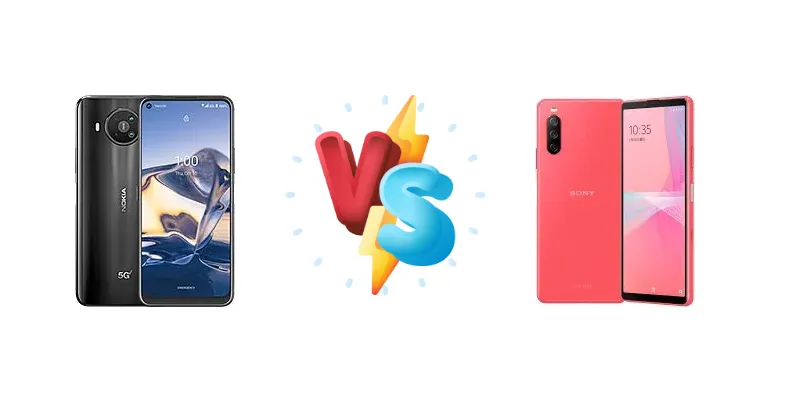
Both the Nokia 8 V 5G UW and the Sony Xperia 10 III Lite represent attempts to bring 5G connectivity to a more accessible price point. However, they take different approaches. The Nokia prioritizes processing power with the Snapdragon 765G, while the Sony focuses on efficiency and faster charging with the Snapdragon 690. This comparison will dissect their key differences to determine which phone best suits your needs.
🏆 Quick Verdict
For users prioritizing raw performance and sustained multitasking, the Nokia 8 V 5G UW is the better choice. Its Snapdragon 765G offers a noticeable advantage. However, the Sony Xperia 10 III Lite wins for those who value faster charging speeds and potentially better battery optimization, despite a less powerful chipset.
| Network |
|---|
| 2G bands | GSM 850 / 900 / 1800 / 1900 | GSM 850 / 900 / 1800 / 1900 |
| 3G bands | HSDPA 850 / 900 / 1700(AWS) / 1900 / 2100 | HSDPA 850 / 1900 |
| 4G bands | 1, 2, 3, 4, 5, 7, 12, 13, 17, 20, 28, 46, 66 | 1, 3, 4, 12, 18, 19, 38, 41 |
| 5G bands | 2, 5, 66, 260, 261 Sub6/mmWave | 77, 78 SA/NSA |
| Speed | HSPA 42.2/5.76 Mbps, LTE (4CA) Cat18 1200/150 Mbps, 5G 2.4/1.2 Gbps | HSPA, LTE, 5G |
| Technology | GSM / HSPA / LTE / 5G | GSM / HSPA / LTE / 5G |
| Launch |
|---|
| Announced | 2020, November 09. Released 2020, November 12 | 2021, August 20 |
| Status | Discontinued | Available. Released 2021, August 27 |
| Body |
|---|
| Build | - | Glass front (Gorilla Glass 6), glass back (Gorilla Glass 6), plastic frame |
| Dimensions | 171.9 x 78.6 x 9 mm (6.77 x 3.09 x 0.35 in) | 154 x 68 x 8.3 mm (6.06 x 2.68 x 0.33 in) |
| SIM | Nano-SIM (pre-installed) | Nano-SIM + eSIM |
| Weight | 230 g (8.11 oz) | 169 g (5.96 oz) |
| Display |
|---|
| Protection | Corning Gorilla Glass | Corning Gorilla Glass 6 |
| Resolution | 1080 x 2400 pixels, 20:9 ratio (~386 ppi density) | 1080 x 2520 pixels, 21:9 ratio (~457 ppi density) |
| Size | 6.81 inches, 112.0 cm2 (~82.9% screen-to-body ratio) | 6.0 inches, 84.1 cm2 (~80.3% screen-to-body ratio) |
| Type | IPS LCD | OLED, 1B colors, HDR |
| Platform |
|---|
| CPU | Octa-core (1x2.4 GHz Kryo 475 Prime & 1x2.2 GHz Kryo 475 Gold & 6x1.8 GHz Kryo 475 Silver) | Octa-core (2x2.0 GHz Kryo 560 Gold & 6x1.7 GHz Kryo 560 Silver) |
| Chipset | Qualcomm SM7250 Snapdragon 765G 5G (7 nm) | Qualcomm SM6350 Snapdragon 690 5G (8 nm) |
| GPU | Adreno 620 | Adreno 619 |
| OS | Android 10 | Android 11 |
| Memory |
|---|
| Card slot | microSDXC | microSDXC (uses shared SIM slot) |
| Internal | 64GB 6GB RAM | 64GB 6GB RAM |
| | eMMC 5.1 | - |
| Main Camera |
|---|
| Features | Zeiss optics, Dual-LED flash, panorama, HDR | LED flash, HDR, panorama |
| Quad | 64 MP, f/1.8, (wide), 1/1.72", 0.8µm, PDAF
12 MP, f/2.2, 120˚ (ultrawide), 1/2.43", 1.4µm, AF
2 MP (macro)
Auxiliary lens | - |
| Triple | - | 12 MP, f/1.8, 27mm (wide), 1/2.8", PDAF
8 MP, f/2.4, 54mm (telephoto), 1/4.0", PDAF, 2x optical zoom
8 MP, f/2.2, 16mm, 120˚ (ultrawide), 1/4.0" |
| Video | 4K@30/60fps, 1080p@30/240fps, 720p@960fps, gyro-EIS | 4K@30fps, 1080p@30fps |
| Selfie camera |
|---|
| Features | Zeiss optics, HDR | HDR |
| Single | 24 MP, f/2.0, (wide), 1/2.8", 0.9µm | 8 MP, f/2.0, 24mm (wide), 1/4.0" |
| Video | 1080p@30fps | 1080p@30fps |
| Sound |
|---|
| 3.5mm jack | Yes | Yes |
| 35mm jack | Yes | Yes |
| Loudspeaker | Yes | Yes |
| Comms |
|---|
| Bluetooth | 5.0, A2DP, EDR, LE | 5.1, A2DP, LE, aptX HD |
| NFC | Yes | Yes |
| Positioning | GPS, GLONASS, BDS | GPS, GLONASS, GALILEO, BDS, QZSS |
| Radio | FM radio | No |
| USB | USB Type-C 2.0, OTG | USB Type-C 3.1, OTG, video output |
| WLAN | Wi-Fi 802.11 a/b/g/n/ac, dual-band, Wi-Fi Direct | Wi-Fi 802.11 a/b/g/n/ac, dual-band, Wi-Fi Direct |
| Features |
|---|
| Sensors | Fingerprint (side-mounted), accelerometer, gyro, proximity, compass | Fingerprint (side-mounted), accelerometer, proximity, compass |
| Battery |
|---|
| Charging | 18W wired | 30W wired, PD, QC |
| Type | Li-Po 4500 mAh | Li-Po 4500 mAh |
| Misc |
|---|
| Colors | Meteor Gray | Black, White, Blue, Pink |
| Models | - | XQ-BT44 |
| Price | About 590 EUR | About 370 EUR |
Nokia 8 V 5G UW
- More powerful Snapdragon 765G processor
- Potentially better camera performance
- Likely larger display size
- Slower 18W charging
- Potentially less optimized battery life
Sony Xperia 10 III Lite
- Faster 30W charging with PD/QC
- Potentially better battery optimization
- More efficient Snapdragon 690
- Less powerful processor for demanding tasks
- Potentially lower camera quality
Display Comparison
Neither device is known for a standout display. Given the context data lacks display specifics, we can infer both likely utilize LCD panels common in this price bracket. The Sony, being a newer model, *may* benefit from slight improvements in color calibration. However, the Nokia's larger size (likely, given the chipset's target market) could offer a more immersive viewing experience. Bezels are expected to be comparable, typical of mid-range devices.
Camera Comparison
Without detailed camera specs, a direct comparison is difficult. However, the Nokia 8 V 5G UW, targeting a slightly higher market segment, likely features a more capable main sensor. The Snapdragon 765G also includes a more advanced Image Signal Processor (ISP) than the 690, potentially leading to better image processing, especially in low-light conditions. We can assume both phones will include a standard suite of camera modes, but the Nokia is expected to deliver superior image quality and dynamic range. The presence of OIS (Optical Image Stabilization) is unknown for both, but would be a significant advantage if present on either.
Performance
The Nokia 8 V 5G UW’s Qualcomm SM7250 Snapdragon 765G, built on a 7nm process, demonstrably outperforms the Sony Xperia 10 III Lite’s Snapdragon 690 (8nm). The 765G’s octa-core CPU, with its Kryo 475 Prime and Gold cores clocked at 2.4GHz and 2.2GHz respectively, provides a significant boost in single-core and multi-core performance compared to the 690’s 2x2.0 GHz Kryo 560 Gold cores. This translates to faster app loading times and smoother multitasking. The 7nm node also contributes to better thermal efficiency, potentially reducing throttling during prolonged use. While the 690 is still a capable chip, the 765G is geared towards a more demanding user.
Battery Life
The Sony Xperia 10 III Lite’s 30W wired charging, supporting Power Delivery (PD) and Quick Charge (QC), is a clear advantage over the Nokia 8 V 5G UW’s 18W charging. This means significantly faster top-up times. While the Nokia might have a slightly larger battery capacity (speculation based on typical Nokia designs), the Sony’s faster charging mitigates the impact of a potentially smaller battery. Users who frequently find themselves needing to quickly recharge will strongly benefit from the Xperia 10 III Lite.
Buying Guide
Buy the Nokia 8 V 5G UW if you frequently engage in demanding tasks like mobile gaming, video editing, or running multiple apps simultaneously. Its Snapdragon 765G provides the headroom needed for these workloads. Buy the Sony Xperia 10 III Lite if you prioritize all-day battery life, quick top-ups with its 30W charging, and a generally smoother experience for everyday tasks like browsing, social media, and communication.
Frequently Asked Questions
❓ Will the Snapdragon 690 in the Xperia 10 III Lite struggle with graphically intensive games?
The Snapdragon 690 is capable of handling many mobile games, but it will likely require lower graphics settings for demanding titles like Genshin Impact or Call of Duty: Mobile. The Nokia 8 V 5G UW’s Snapdragon 765G offers a more comfortable gaming experience with higher frame rates and visual fidelity.
❓ How long will it take to fully charge the Nokia 8 V 5G UW with its 18W charger?
Given its 18W charging, expect a full charge from 0% to 100% to take approximately 2.5 to 3 hours, depending on battery capacity. This is considerably slower than the Sony Xperia 10 III Lite’s 30W charging.
❓ Does the Nokia 8 V 5G UW support carrier aggregation for faster 5G speeds?
The Snapdragon 765G does support carrier aggregation, allowing it to combine multiple 5G channels for potentially faster download and upload speeds, provided your carrier supports it. This is a key advantage for maximizing 5G performance.
❓ Is the Sony Xperia 10 III Lite a good choice for someone who primarily uses their phone for social media and web browsing?
Absolutely. The Snapdragon 690 is perfectly adequate for everyday tasks like social media, web browsing, and streaming video. The faster charging and potentially better battery optimization make it an excellent choice for users who prioritize convenience and longevity.