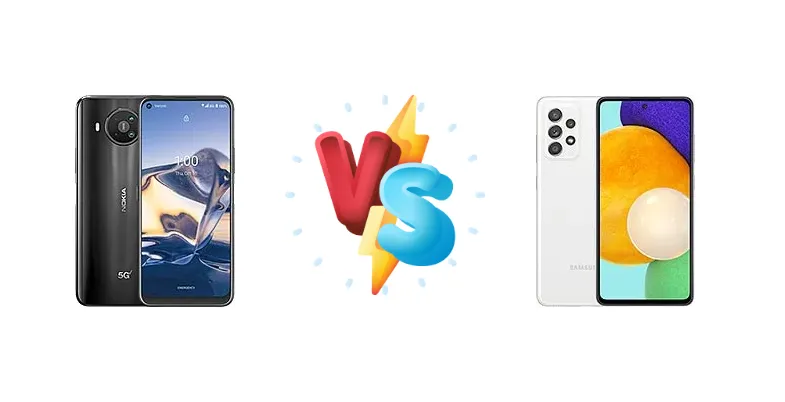
Both the Nokia 8 V 5G UW and the Samsung Galaxy A52 5G represent compelling options in the mid-range 5G smartphone market. However, they cater to slightly different priorities. The Nokia, with its focus on millimeter wave (mmWave) 5G support, aims for maximum network speeds where available, while the A52 5G prioritizes a well-rounded experience with a brighter display and faster charging.
🏆 Quick Verdict
For the average user prioritizing a vibrant display and quicker charging, the Samsung Galaxy A52 5G is the better choice. Its 787 nits of brightness and 25W charging offer a more immediately noticeable benefit. However, users in areas with robust 5G UW coverage will find the Nokia 8 V 5G UW’s specialized connectivity a significant advantage.
| Network |
|---|
| 2G bands | GSM 850 / 900 / 1800 / 1900 | GSM 850 / 900 / 1800 / 1900 |
| 3G bands | HSDPA 850 / 900 / 1700(AWS) / 1900 / 2100 | HSDPA 850 / 900 / 1700(AWS) / 1900 / 2100 |
| 4G bands | 1, 2, 3, 4, 5, 7, 12, 13, 17, 20, 28, 46, 66 | 1, 2, 3, 4, 5, 7, 8, 12, 17, 20, 26, 28, 32, 38, 40, 41, 66 |
| 5G bands | 2, 5, 66, 260, 261 Sub6/mmWave | 1, 3, 5, 7, 8, 20, 28, 38, 40, 41, 66, 78 SA/NSA/Sub6 |
| Speed | HSPA 42.2/5.76 Mbps, LTE (4CA) Cat18 1200/150 Mbps, 5G 2.4/1.2 Gbps | HSPA, LTE, 5G |
| Technology | GSM / HSPA / LTE / 5G | GSM / HSPA / LTE / 5G |
| Launch |
|---|
| Announced | 2020, November 09. Released 2020, November 12 | 2021, March 17 |
| Status | Discontinued | Available. Released 2021, March 19 |
| Body |
|---|
| Build | - | Glass front (Gorilla Glass 5), plastic back |
| Dimensions | 171.9 x 78.6 x 9 mm (6.77 x 3.09 x 0.35 in) | 159.9 x 75.1 x 8.4 mm (6.30 x 2.96 x 0.33 in) |
| SIM | Nano-SIM (pre-installed) | · Nano-SIM· Nano-SIM + Nano-SIM |
| Weight | 230 g (8.11 oz) | 189 g (6.67 oz) |
| | - | IP67 dust/water resistant (up to 1m for 30 min) |
| Display |
|---|
| Protection | Corning Gorilla Glass | Corning Gorilla Glass 5 |
| Resolution | 1080 x 2400 pixels, 20:9 ratio (~386 ppi density) | 1080 x 2400 pixels, 20:9 ratio (~407 ppi density) |
| Size | 6.81 inches, 112.0 cm2 (~82.9% screen-to-body ratio) | 6.5 inches, 101.0 cm2 (~84.1% screen-to-body ratio) |
| Type | IPS LCD | Super AMOLED, 120Hz, HDR10+, 800 nits (HBM) |
| | - | Always-on display |
| Platform |
|---|
| CPU | Octa-core (1x2.4 GHz Kryo 475 Prime & 1x2.2 GHz Kryo 475 Gold & 6x1.8 GHz Kryo 475 Silver) | Octa-core (2x2.2 GHz Kryo 570 & 6x1.8 GHz Kryo 570) |
| Chipset | Qualcomm SM7250 Snapdragon 765G 5G (7 nm) | Qualcomm SM7225 Snapdragon 750G 5G (8 nm) |
| GPU | Adreno 620 | Adreno 619 |
| OS | Android 10 | Android 11, upgradable to Android 14, One UI 6.1 |
| Memory |
|---|
| Card slot | microSDXC | microSDXC (uses shared SIM slot) |
| Internal | 64GB 6GB RAM | 128GB 4GB RAM, 128GB 6GB RAM, 128GB 8GB RAM, 256GB 4GB RAM, 256GB 8GB RAM |
| | eMMC 5.1 | - |
| Main Camera |
|---|
| Features | Zeiss optics, Dual-LED flash, panorama, HDR | LED flash, panorama, HDR |
| Quad | 64 MP, f/1.8, (wide), 1/1.72", 0.8µm, PDAF
12 MP, f/2.2, 120˚ (ultrawide), 1/2.43", 1.4µm, AF
2 MP (macro)
Auxiliary lens | 64 MP, f/1.8, 26mm (wide), 1/1.7X", 0.8µm, PDAF, OIS
12 MP, f/2.2, 123˚ (ultrawide), 1.12µm
5 MP (macro)
Auxiliary lens |
| Video | 4K@30/60fps, 1080p@30/240fps, 720p@960fps, gyro-EIS | 4K@30fps, 1080p@30/60fps; gyro-EIS |
| Selfie camera |
|---|
| Features | Zeiss optics, HDR | HDR |
| Single | 24 MP, f/2.0, (wide), 1/2.8", 0.9µm | 32 MP, f/2.2, 26mm (wide), 1/2.8", 0.8µm |
| Video | 1080p@30fps | 4K@30fps, 1080p@30fps |
| Sound |
|---|
| 3.5mm jack | Yes | Yes |
| 35mm jack | Yes | Yes |
| Loudspeaker | Yes | Yes, with stereo speakers |
| Comms |
|---|
| Bluetooth | 5.0, A2DP, EDR, LE | 5.0, A2DP, LE |
| NFC | Yes | Yes (market/region dependent) |
| Positioning | GPS, GLONASS, BDS | GPS, GLONASS, GALILEO, BDS |
| Radio | FM radio | FM radio (market/region dependent) |
| USB | USB Type-C 2.0, OTG | USB Type-C 2.0, OTG |
| WLAN | Wi-Fi 802.11 a/b/g/n/ac, dual-band, Wi-Fi Direct | Wi-Fi 802.11 a/b/g/n/ac, dual-band, Wi-Fi Direct |
| Features |
|---|
| Sensors | Fingerprint (side-mounted), accelerometer, gyro, proximity, compass | Fingerprint (under display, optical), accelerometer, gyro, compass |
| | - | Virtual proximity sensing |
| Battery |
|---|
| Charging | 18W wired | 25W wired, 50% in 30 min |
| Type | Li-Po 4500 mAh | Li-Po 4500 mAh |
| Misc |
|---|
| Colors | Meteor Gray | Awesome Black, Awesome White, Awesome Violet, Awesome Blue |
| Models | - | SM-A526B, SM-A526B/DS, SM-A5260, SM-A526W, SM-A526U, SM-A526U1 |
| Price | About 590 EUR | $ 137.39 / £ 280.00 / € 115.49 |
| SAR | - | 0.74 W/kg (head) 0.53 W/kg (body) |
| SAR EU | - | 1.05 W/kg (head) 1.42 W/kg (body) |
| Tests |
|---|
| Battery life | - |
Endurance rating 111h
|
| Camera | - |
Photo / Video |
| Display | - |
Contrast ratio: Infinite (nominal) |
| Loudspeaker | - |
-27.5 LUFS (Good)
|
| Performance | - |
AnTuTu: 334981 (v8), 386474 (v9)
GeekBench: 1820 (v5.1)
GFXBench: 16fps (ES 3.1 onscreen) |
Nokia 8 V 5G UW
- Supports 5G UW for maximum speeds (where available)
- Snapdragon 765G offers strong single-core performance
- Clean Android experience (typically Nokia's strength)
- Slower 18W charging
- Display brightness likely lower than A52 5G
- Less readily available user reviews and camera samples
Samsung Galaxy A52 5G
- Brighter 787 nit display for excellent outdoor visibility
- Faster 25W charging with 30-minute 50% boost
- More widely available and reviewed
- Snapdragon 750G may offer slightly less peak performance
- Software experience may include Samsung's One UI customizations
- No mmWave 5G support
Display Comparison
The Samsung Galaxy A52 5G boasts a significant advantage in display quality, achieving a measured peak brightness of 787 nits. This is a crucial difference for outdoor visibility, where the Nokia 8 V 5G UW’s display specifications are not provided, suggesting a lower peak brightness. While the A52 5G’s contrast ratio is listed as ‘Infinite (nominal)’ – typical for AMOLED panels – the Nokia’s panel type is unknown, potentially impacting color accuracy and contrast. The A52 5G’s larger user base also means more readily available calibration profiles for color-critical work.
Camera Comparison
Both devices are listed as having Photo/Video capabilities, but detailed sensor information is lacking. The absence of specific details necessitates caution; relying on megapixel counts alone is misleading. The A52 5G’s widespread availability means more user-generated samples and reviews are available for assessing image quality. The Nokia 8 V 5G UW’s camera performance is less documented, making a direct comparison difficult. We can assume both phones will offer acceptable image quality in good lighting conditions, but low-light performance will likely be a differentiating factor.
Performance
Both phones utilize Qualcomm Snapdragon chipsets, but differ in their generation and target. The Nokia 8 V 5G UW features the Snapdragon 765G (7nm), while the A52 5G uses the Snapdragon 750G (8nm). The 8nm process of the 750G *should* offer slightly improved power efficiency, but the 765G’s Kryo 475 Prime core, clocked at 2.4 GHz, suggests a potential edge in single-core performance. The A52 5G’s Kryo 570 cores (2x2.2 GHz) represent an architectural improvement, potentially leading to better sustained performance. However, without detailed benchmarks, the real-world difference remains nuanced. Both share 6x1.8 GHz efficiency cores.
Battery Life
Both the Nokia 8 V 5G UW and the Samsung Galaxy A52 5G achieve an Endurance rating of 111 hours, indicating similar overall battery life. However, the charging speeds differ significantly. The A52 5G supports 25W wired charging, capable of reaching 50% charge in just 30 minutes. The Nokia 8 V 5G UW is limited to 18W charging, implying a slower charging time. This difference is substantial for users who prioritize quick top-ups.
Buying Guide
Buy the Nokia 8 V 5G UW if you live in an area with extensive 5G UW coverage and want to maximize your 5G speeds. This phone is ideal for users who frequently stream high-bandwidth content or rely on low-latency connections. Buy the Samsung Galaxy A52 5G if you prioritize a brighter, more visually appealing display, faster charging, and a generally more polished software experience. It’s the better all-rounder for everyday use.
Frequently Asked Questions
❓ Does the Nokia 8 V 5G UW's 5G UW support actually make a difference in real-world speeds?
Yes, if you are in an area with deployed 5G UW infrastructure. Millimeter wave 5G offers significantly faster speeds than sub-6GHz 5G, potentially exceeding 1 Gbps. However, mmWave has limited range and is susceptible to obstructions, so coverage is currently limited to dense urban areas and specific venues.
❓ Is the Snapdragon 750G in the Galaxy A52 5G powerful enough for demanding games like PUBG or Call of Duty Mobile?
The Snapdragon 750G is capable of running PUBG and Call of Duty Mobile, but you may need to lower graphics settings for a consistently smooth experience. The chipset is optimized for efficiency, so prolonged gaming sessions may result in some thermal throttling. The A52 5G's cooling solution is adequate, but not exceptional.
❓ How does the software experience differ between the Nokia 8 V 5G UW and the Samsung Galaxy A52 5G?
The Nokia 8 V 5G UW typically runs a near-stock version of Android, offering a clean and uncluttered interface. Samsung's Galaxy A52 5G features One UI, which includes additional features and customizations. One UI can be polarizing; some users appreciate the added functionality, while others prefer the simplicity of stock Android.