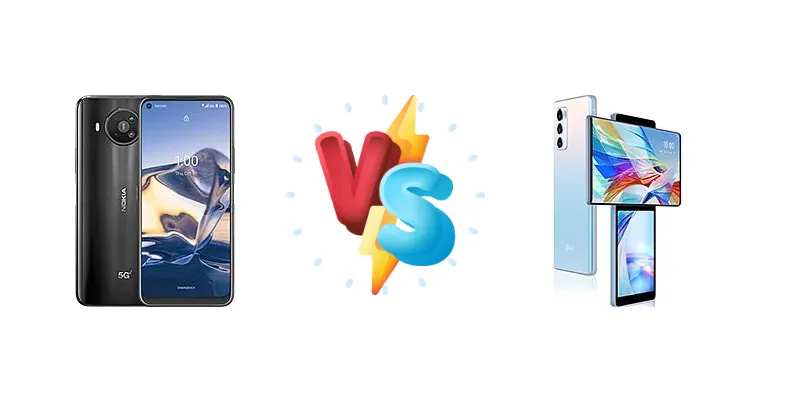
The Nokia 8 V 5G UW and LG Wing 5G represent divergent approaches to the 5G mid-range. The Nokia offers a straightforward, value-focused experience, while the LG Wing attempts to redefine the smartphone with its innovative, dual-screen swiveling design. This comparison dissects their core components to determine which device best suits your needs.
🏆 Quick Verdict
For the average user prioritizing reliable performance and value, the Nokia 8 V 5G UW emerges as the stronger choice. While the LG Wing’s unique form factor is eye-catching, the Nokia delivers comparable performance with a more predictable software experience and a potentially lower price point.
| Network |
|---|
| 2G bands | GSM 850 / 900 / 1800 / 1900 | GSM 850 / 900 / 1800 / 1900 |
| 3G bands | HSDPA 850 / 900 / 1700(AWS) / 1900 / 2100 | HSDPA 850 / 900 / 1900 / 2100 |
| 4G bands | 1, 2, 3, 4, 5, 7, 12, 13, 17, 20, 28, 46, 66 | 2, 3, 4, 5, 7, 12, 13, 20, 28, 46, 48, 66 - USA |
| 5G bands | 2, 5, 66, 260, 261 Sub6/mmWave | 2, 5, 66, 260, 261 Sub6, mmWave - USA |
| Speed | HSPA 42.2/5.76 Mbps, LTE (4CA) Cat18 1200/150 Mbps, 5G 2.4/1.2 Gbps | HSPA, LTE, 5G |
| Technology | GSM / HSPA / LTE / 5G | GSM / CDMA / HSPA / LTE / 5G |
| | - | CDMA 800 / 1900 |
| Launch |
|---|
| Announced | 2020, November 09. Released 2020, November 12 | 2020, September 14. Released 2020, October 15 |
| Status | Discontinued | Discontinued |
| Body |
|---|
| Build | - | Glass front (Gorilla Glass 5), glass back (Gorilla Glass 5), aluminum frame |
| Dimensions | 171.9 x 78.6 x 9 mm (6.77 x 3.09 x 0.35 in) | 169.5 x 74.5 x 10.9 mm (6.67 x 2.93 x 0.43 in) |
| SIM | Nano-SIM (pre-installed) | Nano-SIM + Nano-SIM |
| Weight | 230 g (8.11 oz) | 260 g (9.17 oz) |
| | - | IP54, dust and water resistant
Water-repellent coating
MIL-STD-810G compliant*
*does not guarantee ruggedness or use in extreme conditions |
| Display |
|---|
| Protection | Corning Gorilla Glass | Corning Gorilla Glass 5 |
| Resolution | 1080 x 2400 pixels, 20:9 ratio (~386 ppi density) | 1080 x 2460 pixels (~395 ppi density) |
| Size | 6.81 inches, 112.0 cm2 (~82.9% screen-to-body ratio) | 6.8 inches, 109.8 cm2 (~87.0% screen-to-body ratio) |
| Type | IPS LCD | Rotating P-OLED |
| | - | Always-on display
Secondary display: G-OLED, 1080 x 1240 pixels, 3.9 inches |
| Platform |
|---|
| CPU | Octa-core (1x2.4 GHz Kryo 475 Prime & 1x2.2 GHz Kryo 475 Gold & 6x1.8 GHz Kryo 475 Silver) | Octa-core (1x2.4 GHz Kryo 475 Prime & 1x2.2 GHz Kryo 475 Gold & 6x1.8 GHz Kryo 475 Silver) |
| Chipset | Qualcomm SM7250 Snapdragon 765G 5G (7 nm) | Qualcomm SM7250 Snapdragon 765G 5G (7 nm) |
| GPU | Adreno 620 | Adreno 620 |
| OS | Android 10 | Android 10, upgradable to Android 12 |
| Memory |
|---|
| Card slot | microSDXC | microSDXC (uses shared SIM slot) |
| Internal | 64GB 6GB RAM | 128GB 8GB RAM, 256GB 8GB RAM |
| | eMMC 5.1 | UFS 2.1 |
| Main Camera |
|---|
| Features | Zeiss optics, Dual-LED flash, panorama, HDR | LED flash, panorama, HDR |
| Quad | 64 MP, f/1.8, (wide), 1/1.72", 0.8µm, PDAF
12 MP, f/2.2, 120˚ (ultrawide), 1/2.43", 1.4µm, AF
2 MP (macro)
Auxiliary lens | - |
| Triple | - | 64 MP, f/1.8, 25mm (wide), 1/1.72", 0.8µm, PDAF, OIS
13 MP, f/1.9, 117˚, (ultrawide), 1/3.4", 1.0µm
12 MP, f/2.2, 120˚, (ultrawide), 1/2.55", 1.4µm |
| Video | 4K@30/60fps, 1080p@30/240fps, 720p@960fps, gyro-EIS | 4K@30/60fps, 1080p@30/60fps, gyro-EIS |
| Selfie camera |
|---|
| Features | Zeiss optics, HDR | HDR |
| Single | 24 MP, f/2.0, (wide), 1/2.8", 0.9µm | Motorized pop-up 32 MP, f/1.9, 26mm (wide), 1/2.8", 0.8µm |
| Video | 1080p@30fps | 1080p@30fps |
| Sound |
|---|
| 3.5mm jack | Yes | No |
| 35mm jack | Yes | No |
| Loudspeaker | Yes | Yes |
| Comms |
|---|
| Bluetooth | 5.0, A2DP, EDR, LE | 5.1, A2DP, LE, aptX |
| NFC | Yes | Yes |
| Positioning | GPS, GLONASS, BDS | GPS (L1+L5), GLONASS, BDS, GALILEO, QZSS |
| Radio | FM radio | FM radio |
| USB | USB Type-C 2.0, OTG | USB Type-C 3.1, OTG |
| WLAN | Wi-Fi 802.11 a/b/g/n/ac, dual-band, Wi-Fi Direct | Wi-Fi 802.11 a/b/g/n/ac, dual-band, Wi-Fi Direct, DLNA |
| Features |
|---|
| Sensors | Fingerprint (side-mounted), accelerometer, gyro, proximity, compass | Fingerprint (under display, optical), accelerometer, gyro, proximity, compass |
| Battery |
|---|
| Charging | 18W wired | Wired, QC4
13W wireless |
| Type | Li-Po 4500 mAh | Li-Po 4000 mAh |
| Misc |
|---|
| Colors | Meteor Gray | Aurora Gray, Illusion Sky |
| Models | - | LMF100N, LM-F100N, LM-F100V, LM-F100 |
| Price | About 590 EUR | About 850 EUR |
| SAR | - | 1.13 W/kg (head) 1.06 W/kg (body) |
| Tests |
|---|
| Battery life | - | Endurance rating 87h |
| Camera | - |
Photo / Video |
| Display | - |
Contrast ratio: Infinite (nominal) |
| Loudspeaker | - |
-30.9 LUFS (Below average) |
| Performance | - |
AnTuTu: 315688 (v8)
GeekBench: 7898 (v4.4), 1952 (v5.1)
GFXBench: 17fps (ES 3.1 onscreen) |
Nokia 8 V 5G UW
- Reliable Snapdragon 765G performance
- Potentially better thermal management
- Clean Android experience
- Limited display specifications
- Slower charging speed (18W)
LG Wing 5G
- Unique dual-screen swiveling design
- Excellent battery life (87h endurance)
- QC4 and wireless charging support
- Complex design may impact durability
- Potentially higher price
Display Comparison
Both devices utilize the Qualcomm Snapdragon 765G, but diverge significantly in display implementation. The LG Wing boasts a measured peak brightness of 586 nits, suggesting a more visible outdoor experience compared to the Nokia 8 V 5G UW (brightness data unavailable). The LG Wing’s ‘Infinite’ contrast ratio, while a nominal specification, hints at a strong OLED panel, likely offering deeper blacks and more vibrant colors. The Nokia’s display specifications are less detailed, suggesting a standard LCD panel. The LG Wing’s dual-screen design, while innovative, introduces potential durability concerns and adds to the device’s overall bulk.
Camera Comparison
Both phones feature photo and video capabilities, but detailed camera specifications are limited. Without sensor size or aperture information, a direct comparison is difficult. The LG Wing’s dual-screen design *could* be leveraged for unique camera features, such as using the secondary screen as a viewfinder for more creative angles. However, image processing algorithms and software optimization will ultimately determine image quality. The absence of detailed camera specs suggests neither phone is positioned as a photography powerhouse.
Performance
Both the Nokia 8 V 5G UW and the LG Wing 5G are powered by the Qualcomm SM7250 Snapdragon 765G 5G (7 nm) chipset, featuring an octa-core CPU configuration (1x2.4 GHz Kryo 475 Prime, 1x2.2 GHz Kryo 475 Gold, and 6x1.8 GHz Kryo 475 Silver). This means raw processing power will be nearly identical for most tasks. However, the LG Wing’s more complex thermal design, necessitated by the dual-screen form factor, *could* impact sustained performance under heavy load. The Nokia, with a simpler internal layout, may benefit from slightly better thermal management. RAM specifications are not provided for either device, but are crucial for multitasking performance.
Battery Life
The LG Wing 5G boasts an endurance rating of 87 hours, indicating excellent battery life. This is likely due to a combination of battery capacity and efficient power management. The Nokia 8 V 5G UW’s battery capacity is not specified, making a direct comparison challenging. The LG Wing supports both 13W wireless charging and Qualcomm Quick Charge 4 (QC4) wired charging, offering flexibility. The Nokia 8 V 5G UW is limited to 18W wired charging. While QC4 is faster, the LG Wing’s lower wireless charging wattage may be a drawback for some users.
Buying Guide
Buy the Nokia 8 V 5G UW if you need a dependable 5G phone with solid performance for everyday tasks and streaming, and value a clean Android experience. Buy the LG Wing 5G if you prioritize a truly unique smartphone experience, enjoy multitasking on multiple screens, and are willing to accept potential software quirks and a potentially higher price.
Frequently Asked Questions
❓ Does the LG Wing 5G's swiveling mechanism feel durable in long-term use?
The LG Wing’s swiveling mechanism is a key concern for long-term durability. While LG claims rigorous testing, the moving parts introduce potential points of failure not present in traditional smartphone designs. User reports and long-term reviews are crucial to assess its real-world reliability.
❓ Is the Snapdragon 765G in either phone capable of handling demanding 5G applications like cloud gaming?
The Snapdragon 765G is a capable mid-range chipset, but its performance in demanding 5G applications like cloud gaming will depend on network conditions and game optimization. Expect playable frame rates at medium settings, but don't anticipate flagship-level performance. Thermal throttling could also become a factor during extended gaming sessions.
❓ What kind of software updates can Nokia 8 V 5G UW users expect?
Nokia is known for providing relatively timely Android updates and security patches, even on its mid-range devices. However, the exact number of major Android version updates guaranteed for the 8 V 5G UW is not explicitly stated. Users can generally expect at least two major Android updates and several years of security patches.