
Nokia 8 V 5G UW vs Google Pixel 5a 5G: A Detailed Comparison
| Phones Images | |||||
|---|---|---|---|---|---|
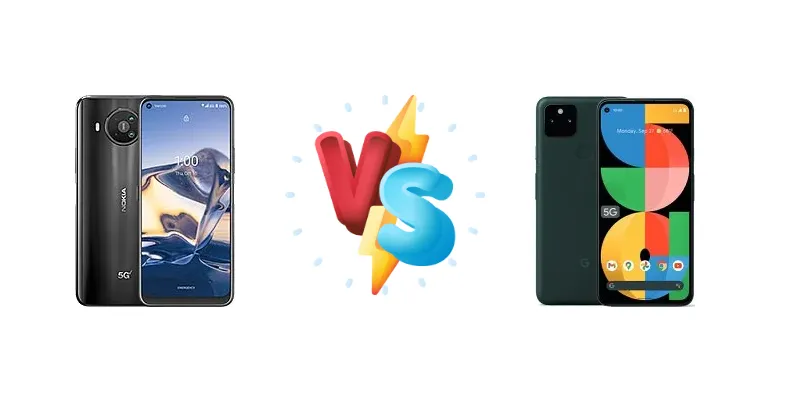
|
🏆 Quick Verdict
For the average user prioritizing camera quality and software experience, the Google Pixel 5a 5G is the clear winner. While both phones share the same Snapdragon 765G chipset and 18W charging, the Pixel 5a’s superior display brightness and Google’s image processing algorithms provide a more polished and enjoyable user experience.
| PHONES | ||
|---|---|---|
| Phone Names | Nokia 8 V 5G UW | Google Pixel 5a 5G |
| Network | ||
|---|---|---|
| 2G bands | GSM 850 / 900 / 1800 / 1900 | GSM 850 / 900 / 1800 / 1900 |
| 3G bands | HSDPA 850 / 900 / 1700(AWS) / 1900 / 2100 | HSDPA 850 / 900 / 1700(AWS) / 1900 / 2100 |
| 4G bands | 1, 2, 3, 4, 5, 7, 12, 13, 17, 20, 28, 46, 66 | 1, 2, 3, 4, 5, 7, 8, 12, 13, 14, 17, 18, 19, 20, 25, 26, 28, 29, 30, 32, 38, 39, 40, 41, 42, 46, 48, 66, 71 |
| 5G bands | 2, 5, 66, 260, 261 Sub6/mmWave | 1, 2, 5, 12, 25, 28, 41, 66, 71, 77, 78 SA/NSA/Sub6 |
| Speed | HSPA 42.2/5.76 Mbps, LTE (4CA) Cat18 1200/150 Mbps, 5G 2.4/1.2 Gbps | HSPA, LTE, 5G |
| Technology | GSM / HSPA / LTE / 5G | GSM / HSPA / EVDO / LTE / 5G |
| - | CDMA2000 1xEV-DO | |
| Launch | ||
|---|---|---|
| Announced | 2020, November 09. Released 2020, November 12 | 2021, August 17 |
| Status | Discontinued | Available. Released 2021, August 26 |
| Body | ||
|---|---|---|
| Build | - | Glass front (Gorilla Glass 3), aluminum frame, aluminum back |
| Dimensions | 171.9 x 78.6 x 9 mm (6.77 x 3.09 x 0.35 in) | 156.2 x 73.2 x 8.8 mm (6.15 x 2.88 x 0.35 in) |
| SIM | Nano-SIM (pre-installed) | Nano-SIM + eSIM |
| Weight | 230 g (8.11 oz) | 183 g (6.46 oz) |
| - | IP67 dust/water resistant (up to 1m for 30 min) | |
| Display | ||
|---|---|---|
| Protection | Corning Gorilla Glass | Corning Gorilla Glass 3 |
| Resolution | 1080 x 2400 pixels, 20:9 ratio (~386 ppi density) | 1080 x 2400 pixels, 20:9 ratio (~415 ppi density) |
| Size | 6.81 inches, 112.0 cm2 (~82.9% screen-to-body ratio) | 6.34 inches, 97.0 cm2 (~84.9% screen-to-body ratio) |
| Type | IPS LCD | OLED, HDR |
| - | Always-on display | |
| Platform | ||
|---|---|---|
| CPU | Octa-core (1x2.4 GHz Kryo 475 Prime & 1x2.2 GHz Kryo 475 Gold & 6x1.8 GHz Kryo 475 Silver) | Octa-core (1x2.4 GHz Kryo 475 Prime & 1x2.2 GHz Kryo 475 Gold & 6x1.8 GHz Kryo 475 Silver) |
| Chipset | Qualcomm SM7250 Snapdragon 765G 5G (7 nm) | Qualcomm SM7250 Snapdragon 765G 5G (7 nm) |
| GPU | Adreno 620 | Adreno 620 |
| OS | Android 10 | Android 11, upgradable to Android 14 |
| Memory | ||
|---|---|---|
| Card slot | microSDXC | No |
| Internal | 64GB 6GB RAM | 128GB 6GB RAM |
| eMMC 5.1 | - | |
| Main Camera | ||
|---|---|---|
| Dual | - | 12.2 MP, f/1.7, 27mm, (wide), 1/2.55", 1.4µm, dual pixel PDAF, OIS 16 MP, f/2.2, 119˚ (ultrawide), 1.0µm |
| Features | Zeiss optics, Dual-LED flash, panorama, HDR | LED flash, Pixel Shift, Auto-HDR, panorama |
| Quad | 64 MP, f/1.8, (wide), 1/1.72", 0.8µm, PDAF 12 MP, f/2.2, 120˚ (ultrawide), 1/2.43", 1.4µm, AF 2 MP (macro) Auxiliary lens | - |
| Single | - | 8 MP, f/2.0, 24mm (wide), 1.12µm |
| Video | 4K@30/60fps, 1080p@30/240fps, 720p@960fps, gyro-EIS | 4K@30/60fps, 1080p@30/60/120/240fps; gyro-EIS |
| Selfie camera | ||
|---|---|---|
| Features | Zeiss optics, HDR | HDR |
| Single | 24 MP, f/2.0, (wide), 1/2.8", 0.9µm | 8 MP, f/2.0, 24mm (wide), 1.12µm |
| Video | 1080p@30fps | 1080p@30fps |
| Sound | ||
|---|---|---|
| 3.5mm jack | Yes | Yes |
| 35mm jack | Yes | Yes |
| Loudspeaker | Yes | Yes, with stereo speakers |
| Comms | ||
|---|---|---|
| Bluetooth | 5.0, A2DP, EDR, LE | 5.0, A2DP, LE, aptX HD |
| NFC | Yes | Yes |
| Positioning | GPS, GLONASS, BDS | GPS, GLONASS, GALILEO, QZSS, BDS |
| Radio | FM radio | No |
| USB | USB Type-C 2.0, OTG | USB Type-C 3.1 |
| WLAN | Wi-Fi 802.11 a/b/g/n/ac, dual-band, Wi-Fi Direct | Wi-Fi 802.11 a/b/g/n/ac, dual-band, Wi-Fi Direct |
| Features | ||
|---|---|---|
| Sensors | Fingerprint (side-mounted), accelerometer, gyro, proximity, compass | Fingerprint (rear-mounted), accelerometer, gyro, proximity, compass, barometer |
| Battery | ||
|---|---|---|
| Charging | 18W wired | 18W wired, PD2.0 |
| Type | Li-Po 4500 mAh | Li-Po 4680 mAh |
| Misc | ||
|---|---|---|
| Colors | Meteor Gray | Mostly Black |
| Models | - | G1F8F, G4S1M |
| Price | About 590 EUR | $ 189.00 / C$ 249.99 |
| Tests | ||
|---|---|---|
| Battery life | - | Endurance rating 122h |
| Display | - | Contrast ratio: Infinite (nominal) |
| Performance | - | AnTuTu: 291303 (v8) GeekBench: 1337 (v5.1) GFXBench: 19fps (ES 3.1 onscreen) |
Nokia 8 V 5G UW
- Potentially lower price point
- Wideband 5G support
- Clean Android experience
- Likely inferior camera performance
- Display brightness is unknown and potentially lower
Google Pixel 5a 5G
- Superior camera quality with Google’s software
- Brighter display for better outdoor visibility
- Guaranteed software updates from Google
- May be slightly more expensive
- Charging speed is limited to 18W
Display Comparison
The Google Pixel 5a 5G boasts a significantly brighter display, reaching 861 nits measured, compared to an unspecified brightness for the Nokia 8 V 5G UW. This higher peak brightness translates to better visibility outdoors under direct sunlight. Both displays feature an infinite (nominal) contrast ratio, suggesting excellent black levels. While panel technology isn’t specified for either, the Pixel 5a’s brightness advantage makes it the more comfortable option for extended use in various lighting conditions.
Camera Comparison
While both phones utilize the Snapdragon 765G’s image signal processor, the Pixel 5a 5G distinguishes itself through Google’s renowned computational photography. Although specific sensor details are missing for both, the Pixel’s software algorithms excel at dynamic range, noise reduction, and detail preservation. The Nokia 8 V 5G UW likely offers a more standard camera experience, potentially lacking the Pixel’s signature image processing prowess. The absence of details regarding OIS or lens apertures makes a definitive hardware comparison difficult, but the Pixel’s software advantage is a significant differentiator.
Performance
Both the Nokia 8 V 5G UW and the Google Pixel 5a 5G are powered by the Qualcomm SM7250 Snapdragon 765G 5G (7 nm) chipset, featuring an octa-core CPU configuration with the same Kryo 475 core arrangement (1x2.4 GHz Prime, 1x2.2 GHz Gold, and 6x1.8 GHz Silver). This means raw processing power will be nearly identical for most tasks. However, the Pixel 5a benefits from Google’s software optimizations, potentially leading to smoother animations and more efficient resource management. RAM specifications are not provided for either device, but performance should be comparable for typical smartphone usage.
Battery Life
Both the Nokia 8 V 5G UW and the Google Pixel 5a 5G share an endurance rating of 122 hours, indicating similar battery life under moderate usage. Both support 18W wired charging, but the Pixel 5a 5G adds support for PD2.0 (Power Delivery 2.0), potentially allowing for slightly faster and more efficient charging with compatible chargers. The identical endurance rating suggests that despite potential differences in battery capacity (not specified), software optimization and power efficiency are comparable between the two devices.
Buying Guide
Buy the Nokia 8 V 5G UW if you need a reliable 5G connection on a tight budget and prioritize wideband 5G support. It’s a solid choice for users who primarily use their phone for basic tasks and don’t heavily rely on advanced camera features. Buy the Google Pixel 5a 5G if you prefer a superior camera experience, a brighter and more vibrant display, and guaranteed software updates directly from Google, even if it means paying a slight premium.