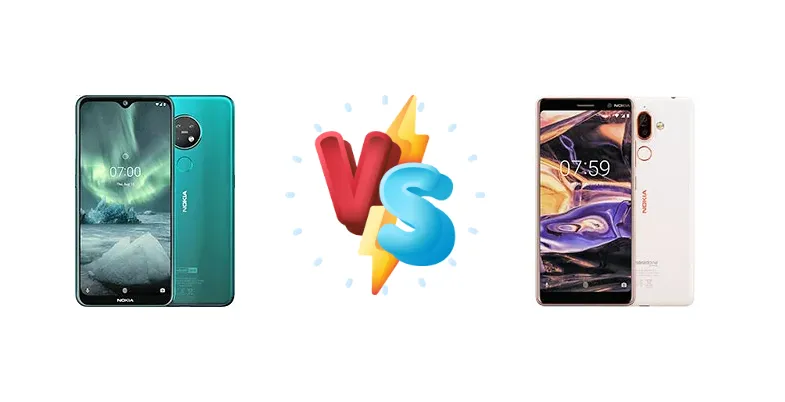
Nokia's 7 series has always offered a compelling blend of features and affordability. The Nokia 7.2 and 7 Plus are two popular contenders, but which one delivers the better experience? This comprehensive comparison will delve into their key differences to help you make an informed decision.
🏆 Quick Verdict
The Nokia 7 Plus edges out the 7.2 thanks to its superior battery life, brighter display visibility in sunlight, and faster charging. While both share the same processor, the 7 Plus's overall package provides a more premium and user-friendly experience, especially for those prioritizing longevity and outdoor usability.
| Network |
|---|
| 2G bands | GSM 850 / 900 / 1800 / 1900 | GSM 850 / 900 / 1800 / 1900 |
| 3G bands | HSDPA 850 / 900 / 2100 - ROW | HSDPA 850 / 900 / 1900 / 2100 |
| 4G bands | 1, 3, 5, 7, 8, 20, 28, 38, 40, 41 - ROW | 1, 3, 5, 7, 8, 20, 28, 38, 40, 41 - Global |
| Speed | HSPA 42.2/5.76 Mbps, LTE (2CA) Cat6 300/50 Mbps or LTE Cat4 150/50 Mbps | HSPA 42.2/5.76 Mbps, LTE (2CA) Cat6 300/50 Mbps |
| Technology | GSM / HSPA / LTE | GSM / CDMA / HSPA / EVDO / LTE |
| | 1, 3, 5, 8, 40, 41 - IN | 1, 3, 4, 5, 7, 8, 20, 28, 34, 38, 39, 40, 41 - China |
| Launch |
|---|
| Announced | 2019, September 05. Released 2019, September 23 | 2018, February 25. Released 2018, April 30 |
| Status | Discontinued | Discontinued |
| Body |
|---|
| Build | Glass front (Gorilla Glass 3), glass back (Gorilla Glass 3), plastic frame | Glass front (Gorilla Glass 3), aluminum back, aluminum frame (6000 series) |
| Dimensions | 159.9 x 75.2 x 8.3 mm (6.30 x 2.96 x 0.33 in) | 158.4 x 75.6 x 8 mm (6.24 x 2.98 x 0.31 in) |
| SIM | · Nano-SIM· Nano-SIM + Nano-SIM | Nano-SIM + Nano-SIM |
| Weight | 180 g (6.35 oz) | 183 g (6.46 oz) |
| Display |
|---|
| Protection | Corning Gorilla Glass 3 | Corning Gorilla Glass 3 |
| Resolution | 1080 x 2280 pixels, 19:9 ratio (~400 ppi density) | 1080 x 2160 pixels, 18:9 ratio (~403 ppi density) |
| Size | 6.3 inches, 99.1 cm2 (~82.4% screen-to-body ratio) | 6.0 inches, 92.4 cm2 (~77.2% screen-to-body ratio) |
| Type | IPS LCD, HDR10 | IPS LCD |
| Platform |
|---|
| CPU | Octa-core (4x2.2 GHz Kryo 260 Gold & 4x1.8 GHz Kryo 260 Silver) | Octa-core (4x2.2 GHz Kryo 260 Gold & 4x1.8 GHz Kryo 260 Silver) |
| Chipset | Qualcomm SDM660 Snapdragon 660 (14 nm) | Qualcomm SDM660 Snapdragon 660 (14 nm) |
| GPU | Adreno 512 | Adreno 512 |
| OS | Android 9.0 (Pie), upgradable to Android 11, Android One | Android 8.1 (Oreo), upgradable to Android 10, Android One |
| Memory |
|---|
| Card slot | microSDXC (dedicated slot) | microSDXC (uses shared SIM slot) |
| Internal | 64GB 4GB RAM, 64GB 6GB RAM, 128GB 4GB RAM, 128GB 6GB RAM | 64GB 4GB RAM, 64GB 6GB RAM |
| | eMMC 5.1 | eMMC 5.1 |
| Main Camera |
|---|
| Dual | - | 12 MP, f/1.8, 25mm (wide), 1/2.55", 1.4µm, dual pixel PDAF
13 MP, f/2.6, (telephoto), 1/3.4", 1.0µm, AF, 2x optical zoom |
| Features | Zeiss optics, LED flash, panorama, HDR | Zeiss optics, dual-LED dual-tone flash, panorama, HDR |
| Triple | 48 MP, f/1.8, (wide), 1/2.0", 0.8µm, PDAF
8 MP, f/2.2, 13mm (ultrawide), 1/4.0", 1.12µm
Auxiliary lens | - |
| Video | 4K@30fps, 1080p@30fps (gyro-EIS) | 4K@30fps, 1080p@30fps (gyro-EIS) |
| Selfie camera |
|---|
| Features | Zeiss optics, HDR | Zeiss optics |
| Single | 20 MP, f/2.0, (wide), 1/3", 0.9µm | 16 MP, f/2.0, 1/3.06", 1.0µm |
| Video | 1080p@30fps | 1080p@30fps |
| Sound |
|---|
| 3.5mm jack | Yes | Yes |
| 35mm jack | Yes | Yes |
| Loudspeaker | Yes | Yes |
| Comms |
|---|
| Bluetooth | 5.0, A2DP, EDR, LE, aptX | 5.0, A2DP, LE |
| NFC | Yes (excl. India) | Yes |
| Positioning | GPS, GLONASS, GALILEO, BDS | GPS, GLONASS, BDS |
| Radio | FM radio | No |
| USB | USB Type-C 2.0, OTG | USB Type-C 2.0, OTG |
| WLAN | Wi-Fi 802.11 b/g/n/ac, dual-band, Wi-Fi Direct | Wi-Fi 802.11 a/b/g/n/ac, dual-band, Wi-Fi Direct |
| Features |
|---|
| Sensors | Fingerprint (rear-mounted), accelerometer, gyro, proximity, compass | Fingerprint (rear-mounted), accelerometer, gyro, proximity, compass |
| Battery |
|---|
| Charging | 10W wired | 18W wired |
| Music play | - | Up to 126 h |
| Stand-by | - | Up to 723 h (3G) |
| Talk time | - | Up to 19 h (3G) |
| Type | Li-Po 3500 mAh, non-removable | Li-Ion 3800 mAh, non-removable |
| Misc |
|---|
| Colors | Cyan Green, Charcoal, Ice | Black/Copper, White/Copper |
| Models | TA-1193, TA-1178, TA-1196, TA-1181 | TA-1041, TA-1062, TA-1046 |
| Price | About 240 EUR | About 490 EUR |
| SAR | 1.15 W/kg (head) 0.90 W/kg (body) | - |
| SAR EU | 0.99 W/kg (head) 1.44 W/kg (body) | 0.36 W/kg (head) 1.78 W/kg (body) |
| Tests |
|---|
| Audio quality |
Noise -93.0dB / Crosstalk -93.4dB |
Noise -38.8dB / Crosstalk -95.9dB |
| Battery life |
Endurance rating 69h
|
Endurance rating 87h
|
| Camera |
Photo / Video |
Photo / Video |
| Display |
Contrast ratio: 1342:1 (nominal) |
Contrast ratio: 1701:1 (nominal), 3.479 (sunlight) |
| Loudspeaker |
-29.6 LUFS (Average)
|
Voice 67dB / Noise 71dB / Ring 79dB
|
| Performance |
AnTuTu: 139495 (v7), 164484 (v8)
GeekBench: 5440 (v4.4), 1398 (v5.1)
GFXBench: 8.1fps (ES 3.1 onscreen) |
AnTuTu: 140820 (v7)
GeekBench: 5893 (v4.4)
GFXBench: 8.6fps (ES 3.1 onscreen) |
Nokia 7.2
- Sleek design
- Good value for money
- Decent performance for everyday tasks
- Shorter battery life
- Slower charging
- Less bright display
Nokia 7 plus
- Excellent battery life
- Brighter display (especially outdoors)
- Faster charging
- Generally better camera performance
- Slightly older design
- Performance similar to 7.2
Display Comparison
The Nokia 7 Plus boasts a slightly better display with a nominal contrast ratio of 1701:1 compared to the 7.2's 1342:1. More importantly, the 7 Plus shines in direct sunlight with a measured brightness of 3.479, making it significantly more usable outdoors. Both phones feature similar display technology (likely IPS LCD) and resolution, but the 7 Plus's brightness advantage is noticeable.
Camera Comparison
While both phones have 'Photo / Video' capabilities listed, the Nokia 7 Plus generally received better reviews for its camera performance, particularly in low-light conditions. It likely benefits from slightly better image processing algorithms. Both phones feature a dual-camera setup, but the 7 Plus's camera system is considered more refined. Specific camera specs (megapixels, aperture) are missing from the provided data, making a precise comparison difficult.
Performance
Both devices are powered by the same Qualcomm SDM660 Snapdragon 660 chipset and CPU, meaning performance will be largely similar for everyday tasks, app usage, and light gaming. Don't expect flagship-level performance from either phone, but they are capable of handling most common workloads without significant issues. Software optimization will play a larger role in perceived speed.
Battery Life
The Nokia 7 Plus clearly wins in the battery department, offering an endurance rating of 87 hours compared to the 7.2's 69 hours. This translates to significantly longer battery life on a single charge. The 7 Plus also supports 18W fast charging, while the 7.2 is limited to 10W, further enhancing its advantage.
Buying Guide
The Nokia 7.2 is a good choice for budget-conscious users who prioritize a sleek design and don't mind slightly shorter battery life. The Nokia 7 Plus is ideal for users who need all-day battery life, appreciate a brighter display for outdoor use, and value faster charging speeds. Both are suitable for everyday tasks and moderate photography.
Frequently Asked Questions
❓ Is the Nokia 7 Plus worth the extra cost over the 7.2?
If battery life and outdoor visibility are important to you, then yes. The 7 Plus offers a noticeable improvement in these areas. However, if you're on a tight budget and don't mind the compromises, the 7.2 is still a capable phone.
❓ What software experience can I expect on these phones?
Both phones originally launched with Android One, promising a clean and near-stock Android experience with guaranteed updates. However, update support may vary depending on the region and carrier.