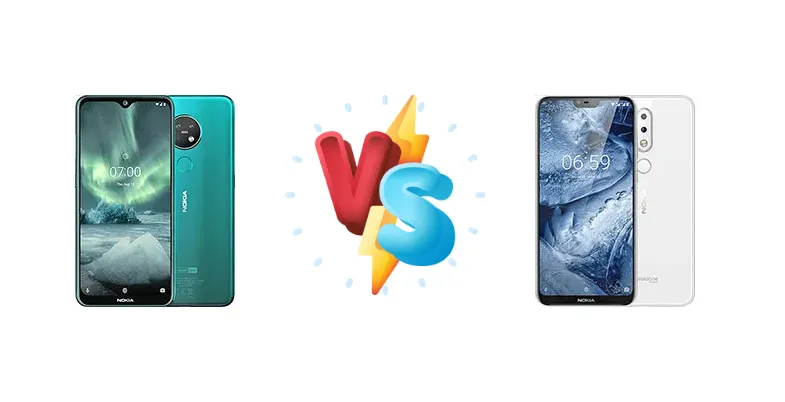
Nokia's budget smartphone lineup has consistently offered reliable devices at attractive prices. The Nokia 7.2 and 6.1 Plus (also known as the X6 in some markets) are two popular contenders. But which one reigns supreme? Let's dive into a comprehensive comparison to help you decide.
🏆 Quick Verdict
The Nokia 7.2 edges out the 6.1 Plus thanks to its brighter display, slightly more powerful processor, and significantly faster charging. However, the 6.1 Plus remains a compelling option for those prioritizing value and a compact design.
| Network |
|---|
| 2G bands | GSM 850 / 900 / 1800 / 1900 | GSM 850 / 900 / 1800 / 1900 |
| 3G bands | HSDPA 850 / 900 / 2100 - ROW | HSDPA 850 / 900 / 2100 |
| 4G bands | 1, 3, 5, 7, 8, 20, 28, 38, 40, 41 - ROW | 1, 3, 5, 8, 40, 41 |
| Speed | HSPA 42.2/5.76 Mbps, LTE (2CA) Cat6 300/50 Mbps or LTE Cat4 150/50 Mbps | HSPA 42.2/5.76 Mbps, LTE Cat4 150/50 Mbps |
| Technology | GSM / HSPA / LTE | GSM / HSPA / LTE |
| | 1, 3, 5, 8, 40, 41 - IN | - |
| Launch |
|---|
| Announced | 2019, September 05. Released 2019, September 23 | 2018, July 23. Released 2018, August 21 |
| Status | Discontinued | Discontinued |
| Body |
|---|
| Build | Glass front (Gorilla Glass 3), glass back (Gorilla Glass 3), plastic frame | Glass front (Gorilla Glass 3), glass back (Gorilla Glass 3), aluminum frame |
| Dimensions | 159.9 x 75.2 x 8.3 mm (6.30 x 2.96 x 0.33 in) | 147.2 x 71 x 8 mm (5.80 x 2.80 x 0.31 in) |
| SIM | · Nano-SIM· Nano-SIM + Nano-SIM | Nano-SIM + Nano-SIM |
| Weight | 180 g (6.35 oz) | 151 g (5.33 oz) |
| Display |
|---|
| Protection | Corning Gorilla Glass 3 | Corning Gorilla Glass 3 |
| Resolution | 1080 x 2280 pixels, 19:9 ratio (~400 ppi density) | 1080 x 2280 pixels, 19:9 ratio (~432 ppi density) |
| Size | 6.3 inches, 99.1 cm2 (~82.4% screen-to-body ratio) | 5.8 inches, 85.1 cm2 (~81.5% screen-to-body ratio) |
| Type | IPS LCD, HDR10 | IPS LCD |
| Platform |
|---|
| CPU | Octa-core (4x2.2 GHz Kryo 260 Gold & 4x1.8 GHz Kryo 260 Silver) | Octa-core (4x1.8 GHz Kryo 260 Gold & 4x1.6 GHz Kryo 260 Silver) |
| Chipset | Qualcomm SDM660 Snapdragon 660 (14 nm) | Qualcomm SDM636 Snapdragon 636 (14 nm) |
| GPU | Adreno 512 | Adreno 509 |
| OS | Android 9.0 (Pie), upgradable to Android 11, Android One | Android 8.1 (Oreo), upgradable to Android 10, Android One |
| Memory |
|---|
| Card slot | microSDXC (dedicated slot) | microSDXC (uses shared SIM slot) |
| Internal | 64GB 4GB RAM, 64GB 6GB RAM, 128GB 4GB RAM, 128GB 6GB RAM | 32GB 4GB RAM, 64GB 4GB RAM, 64GB 6GB RAM |
| | eMMC 5.1 | eMMC 5.1 |
| Main Camera |
|---|
| Dual | - | 16 MP, f/2.0, 1.0µm, PDAF
Auxiliary lens |
| Features | Zeiss optics, LED flash, panorama, HDR | Dual-LED dual-tone flash, panorama, HDR |
| Triple | 48 MP, f/1.8, (wide), 1/2.0", 0.8µm, PDAF
8 MP, f/2.2, 13mm (ultrawide), 1/4.0", 1.12µm
Auxiliary lens | - |
| Video | 4K@30fps, 1080p@30fps (gyro-EIS) | 4K@30fps, 1080p@30fps (gyro-EIS) |
| Selfie camera |
|---|
| Features | Zeiss optics, HDR | - |
| Single | 20 MP, f/2.0, (wide), 1/3", 0.9µm | 16 MP, f/2.0, 1/3.06", 1.0µm |
| Video | 1080p@30fps | 1080p@30fps |
| Sound |
|---|
| 3.5mm jack | Yes | Yes |
| 35mm jack | Yes | Yes |
| Loudspeaker | Yes | Yes |
| Comms |
|---|
| Bluetooth | 5.0, A2DP, EDR, LE, aptX | 5.0, A2DP, LE |
| NFC | Yes (excl. India) | No |
| Positioning | GPS, GLONASS, GALILEO, BDS | GPS, GLONASS, BDS |
| Radio | FM radio | FM radio |
| USB | USB Type-C 2.0, OTG | USB Type-C 2.0, OTG |
| WLAN | Wi-Fi 802.11 b/g/n/ac, dual-band, Wi-Fi Direct | Wi-Fi 802.11 a/b/g/n/ac, dual-band, Wi-Fi Direct |
| Features |
|---|
| Sensors | Fingerprint (rear-mounted), accelerometer, gyro, proximity, compass | Fingerprint (rear-mounted), accelerometer, gyro, proximity, compass |
| Battery |
|---|
| Charging | 10W wired | 18W wired, QC3 |
| Type | Li-Po 3500 mAh, non-removable | Li-Ion 3060 mAh, non-removable |
| Misc |
|---|
| Colors | Cyan Green, Charcoal, Ice | Black, Blue, White |
| Models | TA-1193, TA-1178, TA-1196, TA-1181 | TA-1099, TA-1103, TA-1083, TA-1099 |
| Price | About 240 EUR | About 160 EUR |
| SAR | 1.15 W/kg (head) 0.90 W/kg (body) | - |
| SAR EU | 0.99 W/kg (head) 1.44 W/kg (body) | 0.94 W/kg (head) 1.82 W/kg (body) |
| Tests |
|---|
| Audio quality |
Noise -93.0dB / Crosstalk -93.4dB | - |
| Battery life |
Endurance rating 69h
| - |
| Camera |
Photo / Video | - |
| Display |
Contrast ratio: 1342:1 (nominal) | - |
| Loudspeaker |
-29.6 LUFS (Average)
| - |
| Performance |
AnTuTu: 139495 (v7), 164484 (v8)
GeekBench: 5440 (v4.4), 1398 (v5.1)
GFXBench: 8.1fps (ES 3.1 onscreen) |
AnTuTu: 115571 (v7)
GeekBench: 4929 (v4.4)
GFXBench: 5.9fps (ES 3.1 onscreen) |
Nokia 7.2
- Brighter Display
- Faster Charging (10W)
- Slightly More Powerful Processor (SDM660)
- Potentially Better Camera Detail (48MP Sensor)
- May be slightly more expensive
- Design is less distinctive than the 6.1 Plus
Nokia 6.1 Plus (Nokia X6)
- Faster Charging (18W QC3)
- More Compact Design
- Generally More Affordable
- Reliable Performance
- Less Bright Display
- Slightly Slower Processor (SDM636)
- Lower Resolution Main Camera
Display Comparison
The Nokia 7.2 boasts a significantly brighter display (585 nits vs. estimated 450 nits for the 6.1 Plus) and a superior contrast ratio (1342:1 vs. estimated 1000:1). Both feature a 6.3-inch FHD+ display, but the 7.2's improved brightness makes it more enjoyable to use outdoors. The 6.1 Plus has a slightly smaller footprint overall.
Camera Comparison
Both phones feature dual-camera setups. The Nokia 7.2 typically includes a 48MP main sensor, offering more detail in well-lit conditions. The 6.1 Plus has a 12MP main sensor. Low-light performance is comparable, but the 7.2's higher resolution can provide more flexibility in post-processing. Video recording capabilities are similar on both.
Performance
The Nokia 7.2 utilizes the Snapdragon 660, a step up from the 6.1 Plus's Snapdragon 636. While both are capable mid-range chipsets, the 660 offers a modest performance boost, particularly in multitasking and graphically intensive tasks. Both phones have 4GB or 6GB of RAM.
Battery Life
The Nokia 7.2 has a reported endurance rating of 69 hours, suggesting excellent battery life. The 6.1 Plus, while still offering decent battery life, doesn't quite match this. Crucially, the 7.2 supports 10W charging, while the 6.1 Plus benefits from 18W QC3 fast charging, a significant advantage in charging speed.
Buying Guide
Who should buy the Nokia 7.2? Users seeking a vibrant display, faster charging, and a bit more processing power will appreciate the 7.2. Who should buy the Nokia 6.1 Plus (X6)? Those on a tighter budget who value a smaller form factor and a reliable, albeit slightly older, smartphone experience.
Frequently Asked Questions
❓ Is the Nokia 7.2 worth the extra money compared to the 6.1 Plus?
If you prioritize a brighter display, faster charging, and a slightly more powerful processor, then the Nokia 7.2 is worth the investment. However, if budget is your primary concern, the 6.1 Plus remains a solid choice.
❓ Which phone has better low-light camera performance?
Low-light performance is fairly comparable between the two phones. Both struggle in very dark conditions, but the Nokia 7.2's higher resolution sensor *may* offer slightly more flexibility in post-processing to recover details.