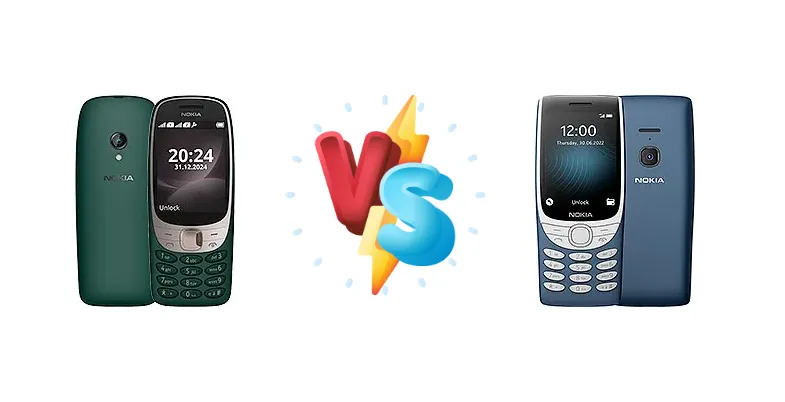
Nokia's revival of classic feature phones continues with the 6310 (2024) and 8210 4G. While both aim to provide reliable communication and long battery life, they differ significantly under the hood. This comparison dissects the core hardware – specifically the chipsets – to determine which phone delivers the best experience for users prioritizing simplicity and affordability.
🏆 Quick Verdict
For the average user seeking a dependable, no-frills feature phone, the Nokia 6310 (2024) emerges as the slightly better choice. Its newer Unisoc 6531F chipset, while not a performance powerhouse, represents a more modern architecture than the 8210 4G’s Unisoc T107, potentially offering improved efficiency and future-proofing.
| Network |
|---|
| 2G bands | GSM 900 / 1800 | GSM 850 / 900 / 1800 / 1900 |
| 3G bands | - | HSDPA 850 / 900 / 2100 - International |
| 4G bands | - | 1, 3, 5, 7, 8, 20 - APAC, EU, RUCIS |
| EDGE | Yes | - |
| GPRS | Yes | - |
| Speed | - | HSPA, LTE |
| Technology | GSM | GSM / HSPA / LTE |
| | - | 1, 2, 3, 4, 5, 7, 8, 28, 40 - LATAM |
| Launch |
|---|
| Announced | 2024, April 11 | 2022, July 12 |
| Status | Available. Released 2024, April 26 | Available. Released 2022, July 28 |
| Body |
|---|
| Dimensions | 135.5 x 56 x 14.1 mm, 44.8 cc (5.33 x 2.20 x 0.56 in) | 131.3 x 56.2 x 13.8 mm (5.17 x 2.21 x 0.54 in) |
| SIM | Nano-SIM + Nano-SIM | · Nano-SIM· Nano-SIM + Nano-SIM |
| Weight | - | 107 g (3.77 oz) |
| Display |
|---|
| Resolution | 240 x 320 pixels, 4:3 ratio (~143 ppi density) | 240 x 320 pixels, 4:3 ratio (~143 ppi density) |
| Size | 2.8 inches, 24.3 cm2 (~32.0% screen-to-body ratio) | 2.8 inches, 24.3 cm2 (~32.9% screen-to-body ratio) |
| Type | TFT LCD | TFT LCD |
| Platform |
|---|
| CPU | - | 1.0 GHz Cortex-A7 |
| Chipset | Unisoc 6531F | Unisoc T107 (22 nm) |
| Memory |
|---|
| Call records | Yes | Yes |
| Card slot | microSDHC | microSDHC |
| Internal | 16MB 8MB RAM | 128MB 48MB RAM |
| Phonebook | Yes | Yes |
| Main Camera |
|---|
| Features | LED flash | LED flash |
| Single | VGA | 0.3 MP |
| Video | Unspecified | Unspecified |
| Sound |
|---|
| 3.5mm jack | - | Yes |
| 35mm jack | Yes | Yes |
| Loudspeaker | Yes | Yes |
| Comms |
|---|
| Bluetooth | 5.0, A2DP, LE | 5.0, A2DP, LE |
| NFC | No | No |
| Positioning | No | No |
| Radio | Wireless FM radio | Wireless FM radio |
| USB | USB Type-C | microUSB 2.0 |
| WLAN | No | No |
| Features |
|---|
| Games | Yes | Yes |
| Java | No | No |
| Messaging | SMS, MMS | SMS, MMS |
| Battery |
|---|
| Type | Li-Ion 1450 mAh, removable | Li-Ion 1450 mAh, removable |
| Misc |
|---|
| Colors | Black, Green | Sand, Blue, Red |
| Models | - | TA-1507, TA-1494, TA-1489, TA-1485, TA-1483 |
| Price | About 70 EUR | About 170 EUR |
| SAR | - | 0.98 W/kg (head) 1.34 W/kg (body) |
| SAR EU | - | 0.98 W/kg (head) 1.43 W/kg (body) |
Nokia 6310 (2024)
- Potentially more efficient chipset (Unisoc 6531F)
- Likely to receive longer software support
- Modernized design elements
- Limited detailed specifications available
- Higher price point compared to the 8210 4G
Nokia 8210 4G
- Proven and reliable Unisoc T107 platform
- Lower price point
- 4G connectivity for basic data access
- Older 22nm chipset architecture
- Potentially shorter software support lifespan
- Less efficient power consumption
Display Comparison
Both phones likely feature similar low-resolution color displays typical of feature phones, prioritizing legibility over visual fidelity. Detailed display specs (brightness, resolution, panel type) are unavailable, but the focus is on functional clarity rather than immersive viewing. Bezels are expected to be substantial on both models, consistent with their design philosophy.
Camera Comparison
Both phones are equipped with basic cameras, primarily intended for occasional snapshots. Detailed camera specifications are not available, and image quality should be considered secondary to the phone's core communication functions. Expect limited low-light performance and minimal image processing capabilities on both devices. The focus is on capturing memories, not creating high-quality photographs.
Performance
The core difference lies in the chipsets. The Nokia 6310 (2024) utilizes the Unisoc 6531F, while the 8210 4G employs the Unisoc T107 (22nm). The T107, with its 1.0 GHz Cortex-A7 CPU, is a relatively older architecture. The 6531F, while details are scarce, likely benefits from a more recent fabrication process, potentially leading to better power efficiency. This translates to potentially longer standby times for the 6310 (2024). RAM details are unavailable for either device, but are likely limited to the bare minimum required for basic feature phone operation.
Battery Life
Battery capacity details are unavailable for both devices. However, feature phones are renowned for exceptional battery life. The Unisoc 6531F in the 6310 (2024) *may* offer slightly improved power efficiency due to its potentially newer architecture, translating to longer standby and talk times. Charging times will likely be similar, utilizing micro-USB connectivity on both models.
Buying Guide
Buy the Nokia 6310 (2024) if you need a modern feature phone with a slightly more efficient chipset and are looking for a device that might receive software updates for a longer period. Buy the Nokia 8210 4G if you prioritize a proven, albeit older, platform and can find it at a significantly lower price point, accepting that its chipset is based on a 22nm process.
Frequently Asked Questions
❓ Does the Unisoc T107 chipset in the Nokia 8210 4G struggle with modern web browsing, even with 4G connectivity?
The Unisoc T107 is a basic chipset designed for simple tasks. While 4G connectivity allows for data access, the processor's limited power and older architecture will result in slow page loading times and a generally sluggish browsing experience. It's best suited for text-based websites and minimal data usage.
❓ How does the software experience differ between the Nokia 6310 (2024) and the Nokia 8210 4G, and which is likely to receive more updates?
Both phones run on a feature phone operating system, likely a simplified version of Series 30+. However, the Nokia 6310 (2024), with its newer chipset, is more likely to receive software updates and security patches for a longer period. The 8210 4G, based on an older platform, may have limited future software support.
❓ Can either of these phones run any third-party applications, like WhatsApp or Facebook?
While some feature phones support limited versions of apps like WhatsApp, the Nokia 6310 (2024) and 8210 4G are unlikely to offer a robust app ecosystem. Any available apps will be heavily stripped-down versions designed for low-resource devices, and compatibility is not guaranteed.