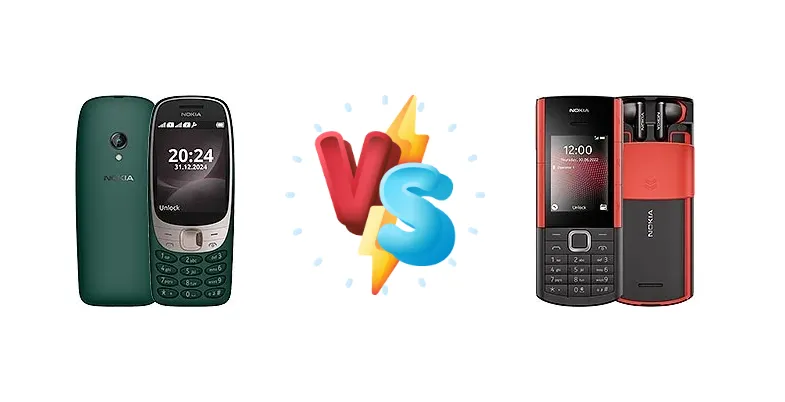
Nokia's resurgence in the feature phone market continues with the 6310 (2024) and 5710 XpressAudio. Both target users seeking simplicity and reliability, but diverge in key areas – notably audio capabilities and underlying chipset architecture. This comparison dissects these differences to determine which phone best suits your needs.
🏆 Quick Verdict
For the average user prioritizing audio playback and a slightly more refined experience, the Nokia 5710 XpressAudio is the better choice. Its integrated speaker and marginally more powerful chipset, despite being older, provide a tangible benefit. However, the 6310 (2024) remains a solid option for those seeking a basic, no-frills device.
| Network |
|---|
| 2G bands | GSM 900 / 1800 | GSM 850 / 900 / 1800 / 1900 |
| 3G bands | - | HSDPA 850 / 900 / 2100 - International |
| 4G bands | - | 1, 3, 5, 7, 8, 20 - APAC, EU, RUCIS |
| EDGE | Yes | - |
| GPRS | Yes | - |
| Speed | - | HSPA, LTE |
| Technology | GSM | GSM / HSPA / LTE |
| | - | 1, 2, 3, 4, 5, 7, 8, 28, 40 - LATAM |
| Launch |
|---|
| Announced | 2024, April 11 | 2022, July 12 |
| Status | Available. Released 2024, April 26 | Available. Released 2022, July 28 |
| Body |
|---|
| Dimensions | 135.5 x 56 x 14.1 mm, 44.8 cc (5.33 x 2.20 x 0.56 in) | 138.9 x 57.7 x 16.2 mm (5.47 x 2.27 x 0.64 in) |
| SIM | Nano-SIM + Nano-SIM | · Nano-SIM· Nano-SIM + Nano-SIM |
| Weight | - | 129.1 g (4.55 oz) |
| | - | Built-in wireless earbuds housed beneath a slider; charging from the phone |
| Display |
|---|
| Resolution | 240 x 320 pixels, 4:3 ratio (~143 ppi density) | 240 x 320 pixels, 4:3 ratio (~167 ppi density) |
| Size | 2.8 inches, 24.3 cm2 (~32.0% screen-to-body ratio) | 2.4 inches, 17.8 cm2 (~22.3% screen-to-body ratio) |
| Type | TFT LCD | TFT LCD |
| Platform |
|---|
| CPU | - | 1.0 GHz Cortex-A7 |
| Chipset | Unisoc 6531F | Unisoc T107 (22 nm) |
| Memory |
|---|
| Call records | Yes | Yes |
| Card slot | microSDHC | microSDHC |
| Internal | 16MB 8MB RAM | 128MB 48MB RAM |
| Phonebook | Yes | Yes |
| Main Camera |
|---|
| Features | LED flash | LED flash |
| Single | VGA | 0.3 MP |
| Video | Unspecified | Unspecified |
| Sound |
|---|
| 3.5mm jack | - | No |
| 35mm jack | Yes | No |
| Loudspeaker | Yes | Yes, with dual speakers |
| Comms |
|---|
| Bluetooth | 5.0, A2DP, LE | 5.0, A2DP, LE |
| NFC | No | No |
| Positioning | No | No |
| Radio | Wireless FM radio | Wireless FM radio |
| USB | USB Type-C | microUSB 2.0 |
| WLAN | No | No |
| Features |
|---|
| Games | Yes | Yes |
| Java | No | No |
| Messaging | SMS, MMS | SMS, MMS |
| Battery |
|---|
| Type | Li-Ion 1450 mAh, removable | Li-Ion 1450 mAh, removable |
| Misc |
|---|
| Colors | Black, Green | Black/White, Red/White |
| Models | - | TA-1504, TA-1498, TA-1496, TA-1488 |
| Price | About 70 EUR | About 70 EUR |
| SAR | - | 0.88 W/kg (head) 0.64 W/kg (body) |
| SAR EU | - | 1.28 W/kg (head) 1.41 W/kg (body) |
Nokia 6310 (2024)
- Potentially longer standby time due to newer chipset efficiency (though unconfirmed)
- Simple and straightforward user interface
- Durable build quality typical of Nokia feature phones
- Less powerful chipset compared to the 5710 XpressAudio
- Lacks integrated speaker for audio playback
Nokia 5710 XpressAudio
- Integrated speaker for music playback and hands-free calls
- More mature chipset architecture (Unisoc T107)
- Slightly more responsive user interface
- Older chipset technology (22nm process)
- Potentially shorter battery life compared to the 6310 (2024) under heavy audio use
Display Comparison
Both phones likely feature similar low-resolution color displays typical of feature phones, prioritizing legibility over visual fidelity. Detailed display specs (resolution, panel type, brightness) are unavailable, but the focus is on functionality rather than immersive viewing. Bezels are expected to be substantial on both models, consistent with their design language.
Camera Comparison
Both phones are equipped with basic cameras, likely 0.3MP or 2MP sensors. Image quality will be limited, suitable only for basic documentation. Detailed camera specs are unavailable, and image processing capabilities are minimal. The camera is not a primary selling point for either device.
Performance
The Nokia 5710 XpressAudio utilizes the Unisoc T107 (22nm), featuring a 1.0 GHz Cortex-A7 CPU. While older, the T107's architecture is designed for basic smartphone tasks and offers a more mature software ecosystem for feature phones. The Nokia 6310 (2024) employs the Unisoc 6531F, a newer but less detailed chipset. The 22nm process of the T107, while less efficient than modern nodes, provides a stable platform for the phone's intended functions. The Cortex-A7 core in the 5710 XpressAudio will likely deliver a slightly smoother user experience when navigating menus and accessing basic features compared to the 6531F.
Battery Life
Battery life is a key strength of both devices. While specific mAh ratings are not provided, feature phones with these chipsets typically offer days, even weeks, of standby time. The Unisoc T107's slightly higher power draw is likely offset by optimized software and a focus on essential functions. Charging times will be slow, utilizing micro-USB, and are not a significant differentiating factor.
Buying Guide
Buy the Nokia 6310 (2024) if you need a supremely simple, durable phone with a focus on core communication features and extended standby time. Buy the Nokia 5710 XpressAudio if you prefer integrated audio playback, a built-in speaker for sharing music, and a slightly more responsive user interface thanks to its older, but architecturally different chipset.
Frequently Asked Questions
❓ Does the Nokia 5710 XpressAudio's speaker sound good for music?
While not comparable to dedicated Bluetooth speakers, the integrated speaker on the Nokia 5710 XpressAudio provides surprisingly decent audio quality for casual listening. It's loud enough for personal enjoyment and sharing music with a small group, making it a key differentiator.
❓ Is the Unisoc 6531F chipset in the Nokia 6310 (2024) a significant upgrade over the T107?
Not necessarily. While newer, the Unisoc 6531F lacks the architectural maturity of the T107, which has been refined for feature phone applications. The T107's Cortex-A7 core likely provides a smoother experience for basic tasks despite its older manufacturing process.
❓ Can I use WhatsApp on either of these phones?
Limited WhatsApp functionality is possible on both phones, but it's not a seamless experience. Older versions of WhatsApp may be compatible, but full feature parity with smartphones is not expected. Expect a basic messaging experience.