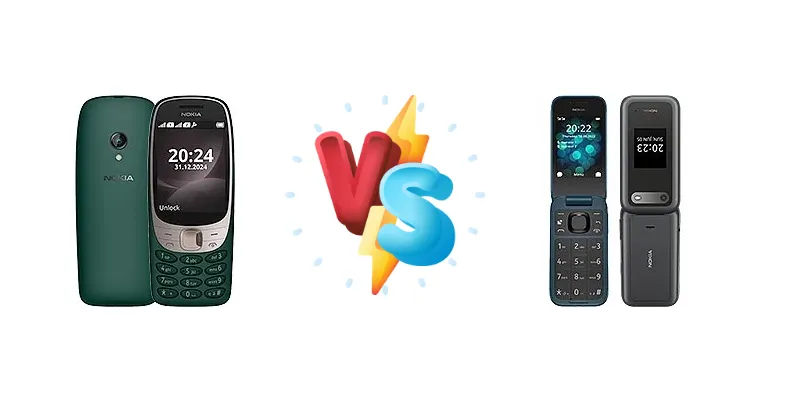
In a market dominated by smartphones, Nokia continues to cater to the demand for simple, reliable communication with the 6310 (2024) and 2660 Flip. While both represent a return to basic functionality, they differ significantly in their internal hardware and target user. This comparison dissects these differences to determine which device offers the best value for those seeking a no-frills mobile experience.
🏆 Quick Verdict
For the average user prioritizing a slightly more modern experience and potentially longer software support, the Nokia 6310 (2024) is the better choice. Its Unisoc 6531F chipset, while still basic, offers a more contemporary architecture than the 2660 Flip’s T107, suggesting better future-proofing and responsiveness for simple tasks.
| Network |
|---|
| 2G bands | GSM 900 / 1800 | GSM 850 / 900 / 1800 / 1900 |
| 3G bands | - | HSDPA 850 / 900 / 2100 - International |
| 4G bands | - | 1, 3, 5, 7, 8, 20 - EU, RUCIS |
| EDGE | Yes | - |
| GPRS | Yes | - |
| Speed | - | HSPA, LTE |
| Technology | GSM | GSM / HSPA / LTE |
| | - | 1, 2, 3, 4, 5, 7, 8, 28 - LATAM, BR |
| Launch |
|---|
| Announced | 2024, April 11 | 2022, July 12 |
| Status | Available. Released 2024, April 26 | Available. Released 2022, July 28 |
| Body |
|---|
| Dimensions | 135.5 x 56 x 14.1 mm, 44.8 cc (5.33 x 2.20 x 0.56 in) | - |
| SIM | Nano-SIM + Nano-SIM | · Nano-SIM· Nano-SIM + Nano-SIM |
| Weight | - | 123 g (4.34 oz) |
| Display |
|---|
| Resolution | 240 x 320 pixels, 4:3 ratio (~143 ppi density) | 240 x 320 pixels, 4:3 ratio (~143 ppi density) |
| Size | 2.8 inches, 24.3 cm2 (~32.0% screen-to-body ratio) | 2.8 inches, 24.3 cm2 |
| Type | TFT LCD | TFT LCD |
| | - | Secondary external 1.77" display |
| Platform |
|---|
| CPU | - | 1.0 GHz Cortex-A7 |
| Chipset | Unisoc 6531F | Unisoc T107 (22 nm) |
| Memory |
|---|
| Call records | Yes | Yes |
| Card slot | microSDHC | microSDHC |
| Internal | 16MB 8MB RAM | 128MB 48MB RAM |
| Phonebook | Yes | Yes |
| Main Camera |
|---|
| Features | LED flash | LED flash |
| Single | VGA | 0.3 MP |
| Video | Unspecified | Yes |
| Sound |
|---|
| 3.5mm jack | - | Yes |
| 35mm jack | Yes | Yes |
| Loudspeaker | Yes | Yes |
| Comms |
|---|
| Bluetooth | 5.0, A2DP, LE | 4.2, A2DP |
| NFC | No | No |
| Positioning | No | No |
| Radio | Wireless FM radio | Wireless FM radio |
| USB | USB Type-C | microUSB 2.0 |
| WLAN | No | No |
| Features |
|---|
| Games | Yes | Yes |
| Java | No | No |
| Messaging | SMS, MMS | SMS, MMS |
| Battery |
|---|
| Charging | - | Compatible with a charging cradle |
| Type | Li-Ion 1450 mAh, removable | Li-Ion 1450 mAh, removable |
| Misc |
|---|
| Colors | Black, Green | Gray, Blue, Red, Lush Green, Pop Pink |
| Models | - | TA-1480, TA-1474, TA-1469 |
| Price | About 70 EUR | € 59.99 / $ 190.00 / £ 69.00 / ₹ 4,499 |
| SAR | - | 0.47 W/kg (head) 1.16 W/kg (body) |
| SAR EU | - | 0.36 W/kg (head) 1.48 W/kg (body) |
Nokia 6310 (2024)
- More modern chipset (Unisoc 6531F) for potentially better performance.
- Candybar form factor is more universally preferred.
- Likely to receive longer software support due to newer hardware.
- May not have the nostalgic appeal of a flip phone.
- No charging cradle included.
Nokia 2660 Flip
- Classic flip phone design.
- Convenient charging cradle included.
- Extremely simple and easy to use.
- Older chipset (Unisoc T107) with less processing power.
- Smaller internal display.
- Potentially shorter software support lifecycle.
Display Comparison
Neither device boasts a high-resolution or particularly vibrant display; both are functional for basic text and call information. However, the Nokia 6310 (2024) likely benefits from a more modern display driver integrated into the Unisoc 6531F, potentially offering slightly improved color reproduction. The 2660 Flip’s smaller internal display, typical of flip phones, prioritizes compactness over viewing area. Bezels are substantial on both, a common characteristic of feature phones.
Camera Comparison
Both devices are equipped with basic cameras primarily intended for occasional snapshots. Detailed camera specifications are unavailable, but given the target market, image quality is not a primary focus. Expect low-resolution images suitable for simple sharing or personal records. The absence of detailed specs suggests neither phone offers advanced camera features like image stabilization or high dynamic range.
Performance
The core difference lies in the chipsets. The Nokia 6310 (2024) utilizes the Unisoc 6531F, while the 2660 Flip employs the Unisoc T107 (22nm). The T107, featuring a 1.0 GHz Cortex-A7 CPU, is an older architecture. While both are designed for basic tasks, the 6531F’s newer design likely translates to snappier menu navigation and faster app loading times for pre-installed features. The 22nm process of the T107 suggests potentially higher power consumption compared to a more modern node, though both phones prioritize battery life. RAM specifications are not provided, but are likely minimal on both, sufficient only for the limited functionality offered.
Battery Life
Battery capacity details are not provided for either device. However, feature phones are renowned for exceptional battery life. The Nokia 2660 Flip’s inclusion of a charging cradle offers a convenient charging solution, potentially extending battery longevity by reducing strain on the charging port. The Unisoc T107’s 22nm process in the 2660 Flip *could* lead to slightly faster battery drain compared to the 6310 (2024), but this difference is likely minimal in real-world usage.
Buying Guide
Buy the Nokia 6310 (2024) if you need a phone with a slightly more responsive interface, potential for future feature updates, and a more standard candybar form factor. Buy the Nokia 2660 Flip if you specifically prefer the nostalgic flip phone design, value the convenience of a charging cradle, and prioritize simplicity above all else.
Frequently Asked Questions
❓ Does the Nokia 2660 Flip's charging cradle offer any benefits beyond convenience?
Yes, using the charging cradle can help prolong the battery's lifespan by minimizing stress on the micro-USB port. Repeatedly plugging and unplugging a cable can wear out the port over time, and the cradle avoids this issue.
❓ Is the Unisoc 6531F in the Nokia 6310 (2024) powerful enough to run any modern apps?
No. The Unisoc 6531F is designed for basic feature phone functionality – calls, texts, and simple pre-installed apps like a calculator or FM radio. It lacks the processing power and memory to run modern smartphone applications like WhatsApp or Facebook.
❓ Which phone is easier to use for someone unfamiliar with technology?
The Nokia 2660 Flip is arguably easier to use for a technophobe. The flip phone design is instantly recognizable, and the simplified interface minimizes complexity. The physical buttons are also more intuitive for some users than navigating a menu on a small screen.
❓ How does the size and weight of these phones compare?
The Nokia 2660 Flip, being a flip phone, is significantly more compact when closed. However, the 6310 (2024) is more pocketable when open. Weight differences are likely minimal, but the 2660 Flip's smaller form factor makes it feel lighter in hand.