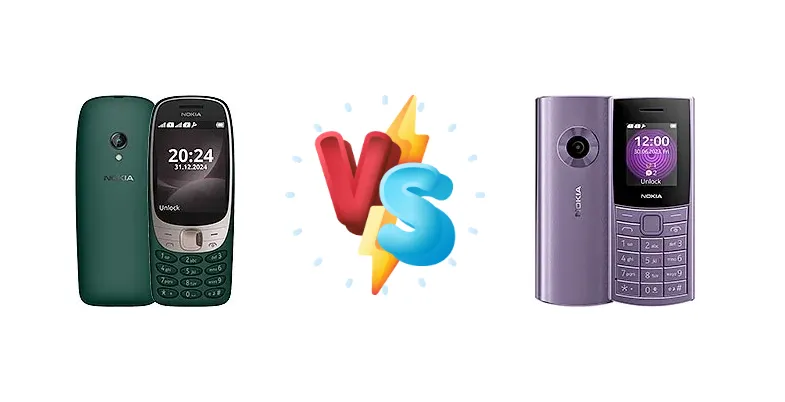
The feature phone isn't dead, and Nokia is proving it. We're pitting the newly released Nokia 6310 (2024) against the Nokia 110 4G (2023) to determine which offers the best blend of functionality, reliability, and affordability for users seeking a simple, distraction-free mobile experience. The key differentiator lies in the 6310's inclusion of a modern chipset, a feature absent from detailed specifications of the 110 4G.
🏆 Quick Verdict
For the average user prioritizing even basic responsiveness and potential future software updates, the Nokia 6310 (2024) is the clear winner. Its Unisoc 6531F chipset provides a noticeable performance advantage over the likely older architecture of the 110 4G, justifying the potential price difference.
| Network |
|---|
| 2G bands | GSM 900 / 1800 | GSM 900 / 1800 |
| 3G bands | - | HSDPA 850 / 900 / 1700(AWS) / 1900 / 2100 |
| 4G bands | - | LTE |
| EDGE | Yes | - |
| GPRS | Yes | - |
| Speed | - | HSPA, LTE |
| Technology | GSM | GSM / HSPA / LTE |
| Launch |
|---|
| Announced | 2024, April 11 | 2023, May 18 |
| Status | Available. Released 2024, April 26 | Available. Released 2023, June |
| Body |
|---|
| Dimensions | 135.5 x 56 x 14.1 mm, 44.8 cc (5.33 x 2.20 x 0.56 in) | 121.5 x 50 x 14.4 mm (4.78 x 1.97 x 0.57 in) |
| SIM | Nano-SIM + Nano-SIM | · Nano-SIM· Nano-SIM + Nano-SIM |
| Weight | - | 94.5 g (3.35 oz) |
| | - | Flashlight
Splash resistant |
| Display |
|---|
| Resolution | 240 x 320 pixels, 4:3 ratio (~143 ppi density) | 120 x 160 pixels, 4:3 ratio (~111 ppi density) |
| Size | 2.8 inches, 24.3 cm2 (~32.0% screen-to-body ratio) | 1.8 inches, 10.0 cm2 (~16.5% screen-to-body ratio) |
| Type | TFT LCD | TFT LCD, 65K colors |
| Platform |
|---|
| Chipset | Unisoc 6531F | - |
| Memory |
|---|
| Call records | Yes | Yes |
| Card slot | microSDHC | microSDHC |
| Internal | 16MB 8MB RAM | Unspecified |
| Phonebook | Yes | Yes |
| Main Camera |
|---|
| Features | LED flash | - |
| Single | VGA | QVGA |
| Video | Unspecified | - |
| Sound |
|---|
| 3.5mm jack | - | Yes |
| 35mm jack | Yes | Yes |
| Loudspeaker | Yes | Yes |
| Comms |
|---|
| Bluetooth | 5.0, A2DP, LE | 5.0, A2DP |
| NFC | No | No |
| Positioning | No | No |
| Radio | Wireless FM radio | Wireless FM radio |
| USB | USB Type-C | microUSB 2.0 |
| WLAN | No | No |
| Features |
|---|
| Games | Yes | Yes |
| Java | No | No |
| Messaging | SMS, MMS | SMS |
| | - | MP3 player |
| Battery |
|---|
| Type | Li-Ion 1450 mAh, removable | Li-Ion 1450 mAh |
| Misc |
|---|
| Colors | Black, Green | Midnight Blue, Arctic Purple |
| Price | About 70 EUR | About 40 EUR |
Nokia 6310 (2024)
- More powerful Unisoc 6531F chipset for improved performance.
- Potentially better software support and future updates.
- Slightly larger battery capacity (1500mAh).
- Likely a higher price point than the Nokia 110 4G.
- Still a basic feature phone with limited functionality.
Nokia 110 4G (2023)
- Extremely affordable price point.
- Long battery life due to low-power components.
- 4G connectivity for basic data access.
- Likely a significantly slower and less responsive user experience.
- Limited software support and potential for obsolescence.
Display Comparison
Detailed display specifications are unavailable for the Nokia 110 4G. However, given its market positioning, it likely features a basic 2.4-inch TFT display with a resolution of 320x240. The Nokia 6310 (2024) also utilizes a similar 2.4-inch display, but the inclusion of a more powerful chipset suggests potential for improved graphics rendering and smoother animations, even on this basic panel. Both devices will likely suffer from limited viewing angles and low peak brightness, making outdoor visibility a challenge.
Camera Comparison
Both devices feature basic cameras, likely 0.3MP or similar. Image quality will be extremely limited on both, suitable only for very basic snapshots. The focus here isn't on photography; it's on core communication features. Any differences in image processing capabilities are likely negligible given the low resolution of the sensors.
Performance
The Nokia 6310 (2024) is powered by the Unisoc 6531F chipset, a significant upgrade over the likely older, unspecified chipset in the Nokia 110 4G. While neither chip is designed for demanding tasks, the Unisoc 6531F's ARM Cortex-A55 cores offer a substantial improvement in processing power and efficiency. This translates to faster app loading times (for the limited apps available), smoother menu navigation, and a more responsive overall user experience. The 110 4G, lacking detailed specs, likely relies on a significantly less capable processor, resulting in noticeable lag and slower performance.
Battery Life
Both the Nokia 6310 (2024) and Nokia 110 4G (2023) boast impressive battery life due to their low-power chipsets and basic displays. The 6310 (2024) has a 1500mAh battery, while the 110 4G has a 1450mAh battery. While the 6310 has a slightly larger capacity, the more efficient Unisoc 6531F chipset could potentially offset the smaller battery of the 110 4G, resulting in comparable real-world usage times. Both phones should easily last several days on a single charge with moderate use.
Buying Guide
Buy the Nokia 6310 (2024) if you need a feature phone that feels slightly more modern, offers a smoother user experience, and potentially benefits from future software enhancements. Buy the Nokia 110 4G (2023) if you are strictly seeking the absolute lowest price point for a 4G-enabled feature phone and are comfortable with a potentially slower, less refined experience.
Frequently Asked Questions
❓ Will the Nokia 6310 (2024) run WhatsApp smoothly?
While the Unisoc 6531F chipset is a step up, WhatsApp's performance will still be basic. Expect slower loading times and occasional lag compared to a smartphone. It will be usable for text-based communication, but don't expect a fluid experience with media sharing.
❓ Does the Nokia 110 4G support VoLTE calling?
VoLTE (Voice over LTE) support is crucial for maintaining voice call quality on 4G networks as older networks are phased out. While not explicitly stated, the Nokia 110 4G's 4G connectivity suggests it *likely* supports VoLTE, but this should be verified with your carrier before purchase to ensure compatibility.
❓ Can I expand the storage on either the Nokia 6310 (2024) or Nokia 110 4G (2023)?
Both devices support microSD card expansion, allowing you to increase storage for contacts, messages, and limited media. The maximum supported microSD card capacity is likely 32GB for both models, providing ample space for their intended use cases.