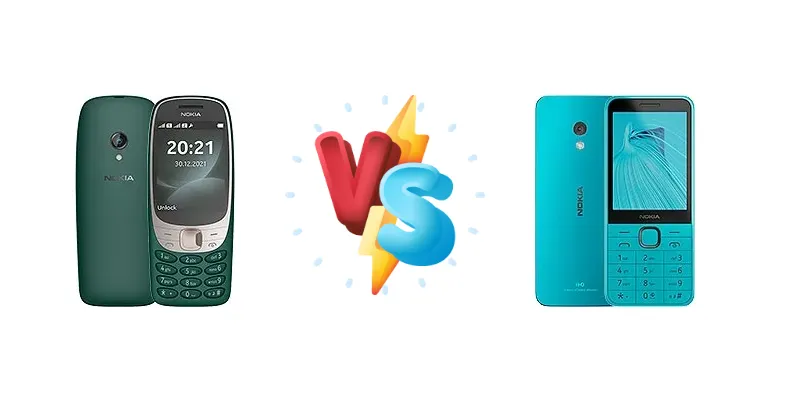
Nokia continues to cater to the demand for reliable, basic mobile phones. The Nokia 6310 (2021) revitalized a classic design, while the Nokia 235 4G (2024) represents a more recent iteration with a focus on 4G connectivity. This comparison dissects the key differences between these two devices, focusing on their internal hardware and target user.
🏆 Quick Verdict
For the average user prioritizing basic communication and extended battery life, the Nokia 235 4G (2024) is the better choice. Its Unisoc T107 chipset, built on a 22nm process, offers a modest performance improvement and 4G connectivity, making it more future-proof than the older 6310.
| Network |
|---|
| 2G bands | GSM 900 / 1800 | GSM 850 / 900 / 1800 / 1900 |
| 3G bands | - | HSDPA 850 / 900 / 2100 |
| 4G bands | - | 1, 3, 5, 7, 8, 20, 28, 38, 40, 41 - EU, EMEA, APAC |
| EDGE | Yes | - |
| GPRS | Yes | - |
| Speed | - | HSPA, LTE |
| Technology | GSM | GSM / HSPA / LTE |
| Launch |
|---|
| Announced | 2021, July 27 | 2024, April 30 |
| Status | Available. Released 2021, August 27 | Available. Released 2024, May |
| Body |
|---|
| Dimensions | 135.5 x 56 x 14.1 mm, 44.8 cc (5.33 x 2.20 x 0.56 in) | 127.3 x 54.2 x 11.6 mm (5.01 x 2.13 x 0.46 in) |
| SIM | Mini-SIM + Nano-SIM | Nano-SIM + Nano-SIM |
| Weight | 98 g (3.46 oz) | - |
| Display |
|---|
| Resolution | 240 x 320 pixels, 4:3 ratio (~143 ppi density) | 240 x 320 pixels, 4:3 ratio (~143 ppi density) |
| Size | 2.8 inches, 24.3 cm2 (~32.0% screen-to-body ratio) | 2.8 inches, 24.3 cm2 (~35.2% screen-to-body ratio) |
| Type | TFT LCD | TFT LCD |
| Platform |
|---|
| CPU | - | 1.0 GHz Cortex-A7 |
| Chipset | Unisoc 6531F | Unisoc T107 (22 nm) |
| Memory |
|---|
| Call records | Yes | Yes |
| Card slot | microSDHC | microSDHC |
| Internal | 16MB 8MB RAM | 128MB 64MB RAM |
| Phonebook | Yes | Yes |
| Main Camera |
|---|
| Features | LED flash | LED flash |
| Single | VGA | 2 MP |
| Video | Unspecified | Yes |
| Sound |
|---|
| 3.5mm jack | Yes | - |
| 35mm jack | Yes | Yes |
| Loudspeaker | Yes | Yes |
| Comms |
|---|
| Bluetooth | 5.0, A2DP, LE | 5.0, A2DP, LE |
| NFC | No | No |
| Positioning | No | No |
| Radio | Wireless FM radio | Wireless FM radio |
| USB | microUSB | USB Type-C |
| WLAN | No | No |
| Features |
|---|
| Games | Yes | Yes |
| Java | No | No |
| Messaging | SMS, MMS | SMS |
| Sensors | - | No |
| Battery |
|---|
| Type | Li-Ion 1150 mAh, removable | Li-Ion 1450 mAh, removable |
| Misc |
|---|
| Colors | Yellow, Black, Dark Green | Black, Blue, Purple |
| Models | TA-1400 | - |
| Price | About 60 EUR | - |
| SAR EU | 0.97 W/kg (head) 1.26 W/kg (body) | - |
Nokia 6310 (2021)
- Classic Nokia 6310 design
- Extremely durable build quality
- Long standby time
- Limited to 2G connectivity
- Older Unisoc 6531F chipset
Nokia 235 4G (2024)
- 4G connectivity for faster data speeds
- More efficient Unisoc T107 chipset (22nm)
- Improved responsiveness
- Less iconic design than the 6310
- Potentially slightly shorter battery life under heavy 4G use
Display Comparison
Both phones feature displays geared towards basic visibility rather than immersive experiences. Specifics regarding panel type, resolution, or brightness are not provided in the context data, suggesting both utilize simple LCDs. The focus is on legibility for calls and text messages, not media consumption. Bezels are likely substantial on both models, consistent with their budget-focused design.
Camera Comparison
Given the nature of these devices, camera performance is not a primary consideration. Details regarding camera sensors are absent, implying both phones feature basic cameras suitable for simple snapshots. Image quality will be limited by the sensors and processing capabilities of the respective chipsets. Users should not expect high-resolution photos or advanced features.
Performance
The core difference lies in the chipsets. The Nokia 6310 (2021) utilizes the Unisoc 6531F, while the Nokia 235 4G (2024) boasts the Unisoc T107, fabricated on a 22nm process. This process node shrink is significant; 22nm generally translates to improved power efficiency and potentially higher clock speeds. The T107’s 1.0 GHz Cortex-A7 CPU represents a modest upgrade over the 6531F, offering a smoother experience for basic tasks like making calls, sending texts, and using the built-in radio. While neither chipset is designed for demanding applications, the T107 provides a more responsive user experience.
Battery Life
Battery life is a key strength of feature phones, and both the 6310 and 235 4G excel in this area. While specific mAh ratings are not provided, the more efficient Unisoc T107 in the 235 4G, due to its 22nm fabrication, likely contributes to slightly longer standby and talk times. The 4G connectivity of the 235 4G will consume more power when actively used, but the chipset's efficiency may offset this during idle periods. Both phones are designed for days of use on a single charge.
Buying Guide
Buy the Nokia 6310 (2021) if you need an exceptionally durable, no-frills phone with a classic aesthetic and are content with 2G connectivity. Buy the Nokia 235 4G (2024) if you prefer faster data speeds with 4G, a slightly more modern chipset, and a phone that will remain compatible with evolving network standards for longer.
Frequently Asked Questions
❓ Will the Nokia 235 4G work with my current carrier if they are phasing out 3G?
Yes, the Nokia 235 4G's primary advantage is its 4G connectivity. As carriers globally sunset their 3G networks, the 235 4G ensures continued compatibility and access to data services, unlike the 6310 which is limited to 2G.
❓ Is the performance difference between the Unisoc 6531F and T107 noticeable in everyday use?
While neither chipset is powerful, the Unisoc T107 in the Nokia 235 4G offers a smoother experience for basic tasks like navigating menus, making calls, and sending texts. The 22nm process node contributes to improved efficiency and responsiveness compared to the older 6531F.
❓ Can I use WhatsApp or Facebook on the Nokia 235 4G?
The Nokia 235 4G supports basic internet connectivity via 4G. Whether you can use WhatsApp or Facebook depends on whether those apps have feature phone versions compatible with the phone's operating system and limited processing power. Compatibility is not guaranteed.