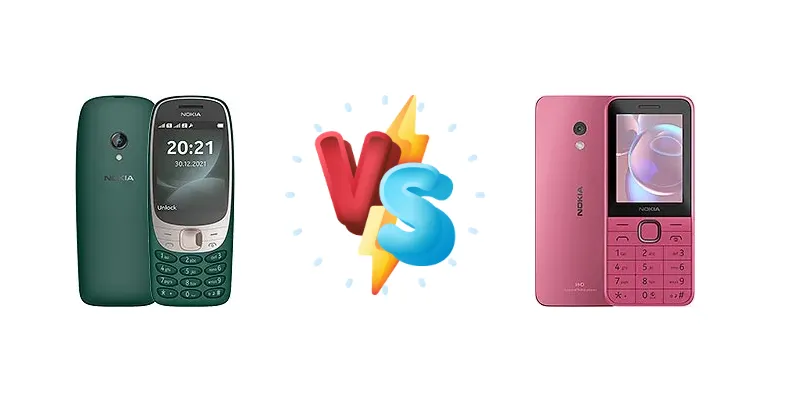
Nokia continues to cater to the demand for reliable, basic mobile phones with the 6310 (2021) and the newer 225 4G (2024). While both offer core calling and texting functionality, the 225 4G introduces a more modern chipset and aims to provide a slightly improved user experience. This comparison dives deep into the hardware differences to determine which phone best suits your needs.
🏆 Quick Verdict
For most users seeking a dependable, no-frills phone, the Nokia 225 4G (2024) is the better choice. The Unisoc T107 chipset, fabricated on a 22nm process, offers a modest performance uplift and potentially improved power efficiency compared to the 6310’s Unisoc 6531F, making it a more future-proof option within the feature phone segment.
| Network |
|---|
| 2G bands | GSM 900 / 1800 | GSM 850 / 900 / 1800 / 1900 |
| 3G bands | - | HSDPA 850 / 900 / 2100 |
| 4G bands | - | 1, 3, 5, 7, 8, 20, 28, 38, 40, 41 - EU, EMEA, APAC |
| EDGE | Yes | - |
| GPRS | Yes | - |
| Speed | - | HSPA, LTE |
| Technology | GSM | GSM / HSPA / LTE |
| Launch |
|---|
| Announced | 2021, July 27 | 2024, April 30 |
| Status | Available. Released 2021, August 27 | Available. Released 2024, May |
| Body |
|---|
| Dimensions | 135.5 x 56 x 14.1 mm, 44.8 cc (5.33 x 2.20 x 0.56 in) | 121.5 x 52 x 11.6 mm (4.78 x 2.05 x 0.46 in) |
| SIM | Mini-SIM + Nano-SIM | Nano-SIM + Nano-SIM |
| Weight | 98 g (3.46 oz) | - |
| Display |
|---|
| Resolution | 240 x 320 pixels, 4:3 ratio (~143 ppi density) | 240 x 320 pixels, 4:3 ratio (~167 ppi density) |
| Size | 2.8 inches, 24.3 cm2 (~32.0% screen-to-body ratio) | 2.4 inches, 17.8 cm2 (~28.2% screen-to-body ratio) |
| Type | TFT LCD | TFT LCD |
| Platform |
|---|
| CPU | - | 1.0 GHz Cortex-A7 |
| Chipset | Unisoc 6531F | Unisoc T107 (22 nm) |
| Memory |
|---|
| Call records | Yes | Yes |
| Card slot | microSDHC | microSDHC |
| Internal | 16MB 8MB RAM | 128MB 64MB RAM |
| Phonebook | Yes | Yes |
| Main Camera |
|---|
| Features | LED flash | LED flash |
| Single | VGA | 0.3 MP |
| Video | Unspecified | Yes |
| Sound |
|---|
| 3.5mm jack | Yes | - |
| 35mm jack | Yes | Yes |
| Loudspeaker | Yes | Yes |
| Comms |
|---|
| Bluetooth | 5.0, A2DP, LE | 5.0, A2DP, LE |
| NFC | No | No |
| Positioning | No | No |
| Radio | Wireless FM radio | Wireless FM radio |
| USB | microUSB | USB Type-C |
| WLAN | No | No |
| Features |
|---|
| Games | Yes | Yes |
| Java | No | No |
| Messaging | SMS, MMS | SMS |
| Sensors | - | No |
| Battery |
|---|
| Type | Li-Ion 1150 mAh, removable | Li-Ion 1450 mAh, removable |
| Misc |
|---|
| Colors | Yellow, Black, Dark Green | Pink, Dark Blue |
| Models | TA-1400 | - |
| Price | About 60 EUR | - |
| SAR EU | 0.97 W/kg (head) 1.26 W/kg (body) | - |
Nokia 6310 (2021)
- Extremely affordable
- Simple and easy to use
- Long standby time (potentially)
- Older chipset (Unisoc 6531F)
- Limited features
- Potentially shorter software support
Nokia 225 4G (2024)
- More modern chipset (Unisoc T107)
- 4G connectivity for clearer calls and data
- Improved user interface responsiveness
- Slightly higher price point
- Still a basic feature phone
- Battery life may be marginally lower due to 4G usage
Display Comparison
Both phones likely feature basic color displays with resolutions appropriate for their intended use. Specific details like screen size and pixel density are not provided, but the focus isn't on multimedia consumption. The key difference lies in the underlying processing power to drive the UI, not display quality itself. Expect similar viewing experiences in direct sunlight.
Camera Comparison
Both devices are feature phones and likely include very basic cameras, primarily for occasional snapshots. Detailed camera specifications are not available, and image quality should not be a primary consideration for either device. The focus is on core communication features, not photography.
Performance
The Nokia 225 4G’s Unisoc T107 chipset, built on a 22nm process, represents a significant architectural upgrade over the 6310’s Unisoc 6531F. The T107 includes a 1.0 GHz Cortex-A7 CPU, offering a noticeable performance boost for navigating menus and handling basic applications. While neither phone is designed for demanding tasks, the T107 will result in a smoother, more responsive user experience, particularly when accessing online services via 4G. The 22nm fabrication process also suggests potentially better thermal management and power efficiency.
Battery Life
Battery life is a key strength of feature phones. While specific mAh ratings are unavailable, the more efficient Unisoc T107 in the Nokia 225 4G, coupled with the 22nm process, suggests it may offer slightly longer standby and talk times compared to the 6310. However, actual battery performance will heavily depend on network conditions and usage patterns (e.g., 4G usage).
Buying Guide
Buy the Nokia 6310 (2021) if you prioritize extreme simplicity and are looking for the absolute lowest price point. It’s a solid option for emergency use or as a secondary device. Buy the Nokia 225 4G (2024) if you want a slightly more responsive user interface, the benefit of 4G connectivity for clearer calls and basic data access, and a phone that’s more likely to remain supported for longer.
Frequently Asked Questions
❓ Will the Nokia 225 4G (2024) work with my existing carrier?
The Nokia 225 4G (2024) supports 4G LTE bands commonly used by major carriers. However, compatibility can vary depending on your specific carrier and region. It's recommended to check your carrier's website or contact them directly to confirm compatibility before purchasing.
❓ Is the Nokia 225 4G (2024) suitable for elderly users?
Yes, the Nokia 225 4G (2024) is well-suited for elderly users due to its simple interface, large buttons, and clear call quality. The 4G connectivity ensures clearer voice calls, and the phone's durability makes it a reliable option.
❓ Can I use WhatsApp or Facebook on the Nokia 225 4G (2024)?
The Nokia 225 4G (2024) supports a limited selection of apps, including versions of Facebook and WhatsApp designed for feature phones. These versions offer basic functionality compared to the smartphone apps, but allow for essential communication.