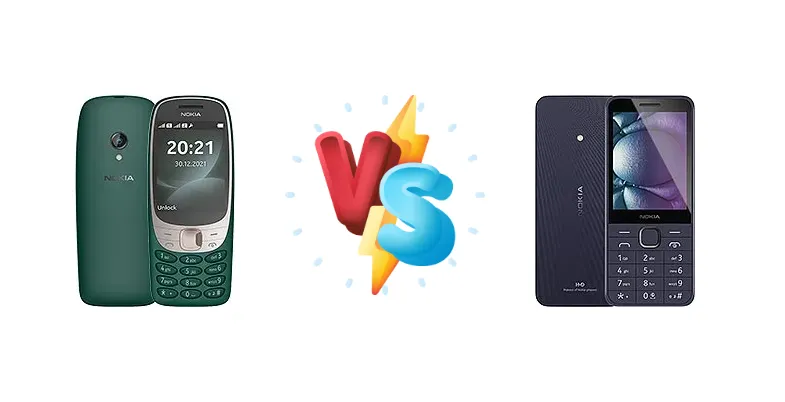
Nokia has revitalized the classic feature phone, offering modern connectivity in a familiar form factor. We're pitting the Nokia 6310 (2021), a popular revival, against the newer Nokia 215 4G (2024) to determine which provides the best blend of affordability, usability, and essential features for today's user. The key difference lies in their chipsets, impacting performance and efficiency.
🏆 Quick Verdict
For the average user prioritizing basic connectivity and a slightly more responsive experience, the Nokia 215 4G (2024) is the better choice. Its Unisoc T107 chipset, built on a 22nm process, offers a modest performance uplift over the 6310's Unisoc 6531F, translating to smoother menu navigation and app loading.
| Network |
|---|
| 2G bands | GSM 900 / 1800 | GSM 850 / 900 / 1800 / 1900 |
| 3G bands | - | HSDPA 850 / 900 / 2100 |
| 4G bands | - | 1, 3, 5, 7, 8, 20, 28, 38, 40, 41 - EU, EMEA, APAC |
| EDGE | Yes | - |
| GPRS | Yes | - |
| Speed | - | HSPA, LTE |
| Technology | GSM | GSM / HSPA / LTE |
| Launch |
|---|
| Announced | 2021, July 27 | 2024, April 30 |
| Status | Available. Released 2021, August 27 | Available. Released 2024, May |
| Body |
|---|
| Dimensions | 135.5 x 56 x 14.1 mm, 44.8 cc (5.33 x 2.20 x 0.56 in) | 127.3 x 54.2 x 11.6 mm (5.01 x 2.13 x 0.46 in) |
| SIM | Mini-SIM + Nano-SIM | Nano-SIM + Nano-SIM |
| Weight | 98 g (3.46 oz) | - |
| Display |
|---|
| Resolution | 240 x 320 pixels, 4:3 ratio (~143 ppi density) | 240 x 320 pixels, 4:3 ratio (~143 ppi density) |
| Size | 2.8 inches, 24.3 cm2 (~32.0% screen-to-body ratio) | 2.8 inches, 24.3 cm2 (~35.2% screen-to-body ratio) |
| Type | TFT LCD | TFT LCD |
| Platform |
|---|
| CPU | - | 1.0 GHz Cortex-A7 |
| Chipset | Unisoc 6531F | Unisoc T107 (22 nm) |
| Memory |
|---|
| Call records | Yes | Yes |
| Card slot | microSDHC | microSDHC |
| Internal | 16MB 8MB RAM | 128MB 64MB RAM |
| Phonebook | Yes | Yes |
| Main Camera |
|---|
| Features | LED flash | - |
| Single | VGA | - |
| Video | Unspecified | - |
| Sound |
|---|
| 3.5mm jack | Yes | - |
| 35mm jack | Yes | Yes |
| Loudspeaker | Yes | Yes |
| Comms |
|---|
| Bluetooth | 5.0, A2DP, LE | 5.0, A2DP, LE |
| NFC | No | No |
| Positioning | No | No |
| Radio | Wireless FM radio | Wireless FM radio |
| USB | microUSB | USB Type-C |
| WLAN | No | No |
| Features |
|---|
| Games | Yes | Yes |
| Java | No | No |
| Messaging | SMS, MMS | SMS |
| Sensors | - | No |
| Battery |
|---|
| Type | Li-Ion 1150 mAh, removable | Li-Ion 1450 mAh, removable |
| Misc |
|---|
| Colors | Yellow, Black, Dark Green | Peach, Black, Dark Blue |
| Models | TA-1400 | - |
| Price | About 60 EUR | - |
| SAR EU | 0.97 W/kg (head) 1.26 W/kg (body) | - |
Nokia 6310 (2021)
- Extremely affordable price point.
- Classic Nokia design and build quality.
- Long battery life (typical of feature phones).
- Older Unisoc 6531F chipset offers limited performance.
- Potentially slower app loading and menu navigation.
Nokia 215 4G (2024)
- More efficient Unisoc T107 chipset (22nm).
- Slightly improved performance and responsiveness.
- Modern 4G connectivity.
- May be slightly more expensive than the 6310.
- Still limited in terms of advanced features.
Display Comparison
Both phones feature relatively small displays, prioritizing battery life over visual immersion. Specific display specs (resolution, size, panel type) are not provided, but given the market segment, both likely utilize basic TFT LCD panels. The focus here isn't on image quality, but on readability and power consumption. Bezels are expected to be substantial on both devices, consistent with their design philosophy.
Camera Comparison
Both phones are likely equipped with basic cameras primarily for capturing simple snapshots. Given the feature phone category, image quality is not a primary consideration. Detailed camera specs are unavailable, but it's safe to assume both cameras will perform adequately in well-lit conditions. Focusing on megapixel counts would be misleading; the image signal processor (ISP) within the chipset is the limiting factor here.
Performance
The core difference lies in the chipsets. The Nokia 215 4G (2024) utilizes the Unisoc T107, a 22nm processor with a 1.0 GHz Cortex-A7 CPU. This represents a generational improvement over the Nokia 6310 (2021)'s Unisoc 6531F. While neither chipset is designed for demanding tasks, the T107's newer architecture and smaller manufacturing process should result in better power efficiency and slightly faster processing speeds for basic operations like making calls, sending messages, and running pre-installed apps. The Cortex-A7 core in the T107, while older, benefits from the process node improvement.
Battery Life
Battery life is a key strength of feature phones. While specific mAh ratings are not provided, both the Nokia 6310 (2021) and Nokia 215 4G (2024) are designed for multi-day battery life on a single charge. The Unisoc T107's 22nm process in the 215 4G should contribute to slightly improved power efficiency, potentially extending standby time. Charging wattage is likely minimal on both devices, prioritizing slow, consistent charging over rapid replenishment.
Buying Guide
Buy the Nokia 6310 (2021) if you need a supremely affordable, no-frills phone primarily for calls and texts, and aren't concerned with slightly slower performance. Buy the Nokia 215 4G (2024) if you prefer a more responsive user experience, benefit from the efficiency of a newer 22nm chipset, and want a phone that feels a bit more modern without sacrificing simplicity.
Frequently Asked Questions
❓ Will the Nokia 215 4G (2024) handle WhatsApp reliably?
Yes, the Nokia 215 4G (2024) supports WhatsApp, but expect a basic experience. The Unisoc T107 chipset provides enough processing power for text-based messaging and occasional image sharing, but don't expect smooth video calls or rapid media loading. It's suitable for staying connected, but not for heavy WhatsApp usage.
❓ Is the Nokia 6310 (2021) a good choice for someone who primarily needs a phone for emergency calls?
Absolutely. The Nokia 6310 (2021)'s exceptional battery life makes it an ideal emergency phone. It can remain on standby for days or even weeks on a single charge, ensuring it's ready when you need it most. Its simplicity and durability are also key advantages in such scenarios.
❓ Does the Nokia 215 4G (2024) support VoLTE calling?
Yes, the Nokia 215 4G (2024) supports VoLTE (Voice over LTE). This means you can make and receive calls over the 4G network, resulting in clearer call quality and faster connection times, provided your carrier supports VoLTE.