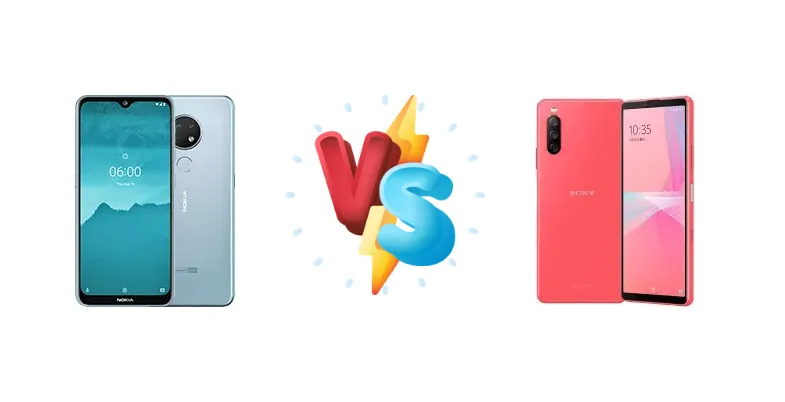
The Nokia 6.2 and Sony Xperia 10 III Lite represent different approaches to the mid-range smartphone market. The Nokia 6.2, released earlier, focuses on endurance and a familiar Android experience, while the Sony Xperia 10 III Lite brings 5G connectivity and faster charging to the table, albeit with a slightly different chipset generation. This comparison dissects their key differences to determine which device best suits your needs.
🏆 Quick Verdict
For the average user prioritizing future-proofing and faster charging, the Sony Xperia 10 III Lite is the better choice. Its Snapdragon 690 5G chipset offers a noticeable performance uplift and supports 30W charging, overcoming the Nokia 6.2’s superior endurance rating. However, those on a strict budget and valuing long battery life may still find the Nokia 6.2 a viable option.
| Network |
|---|
| 2G bands | GSM 850 / 900 / 1800 / 1900 | GSM 850 / 900 / 1800 / 1900 |
| 3G bands | HSDPA 850 / 900 / 2100 - ROW | HSDPA 850 / 1900 |
| 4G bands | 1, 3, 5, 7, 8, 20, 28, 38, 40, 41 - ROW | 1, 3, 4, 12, 18, 19, 38, 41 |
| 5G bands | - | 77, 78 SA/NSA |
| Speed | HSPA 42.2/5.76 Mbps, LTE Cat4 150/50 Mbps | HSPA, LTE, 5G |
| Technology | GSM / HSPA / LTE | GSM / HSPA / LTE / 5G |
| | 1, 3, 5, 8, 40, 41 - IN | - |
| Launch |
|---|
| Announced | 2019, September 05. Released 2019, October 17 | 2021, August 20 |
| Status | Discontinued | Available. Released 2021, August 27 |
| Body |
|---|
| Build | Glass front (Gorilla Glass 3), glass back (Gorilla Glass 3), plastic frame | Glass front (Gorilla Glass 6), glass back (Gorilla Glass 6), plastic frame |
| Dimensions | 159.9 x 75.1 x 8.3 mm (6.30 x 2.96 x 0.33 in) | 154 x 68 x 8.3 mm (6.06 x 2.68 x 0.33 in) |
| SIM | · Nano-SIM· Nano-SIM + Nano-SIM | Nano-SIM + eSIM |
| Weight | 180 g (6.35 oz) | 169 g (5.96 oz) |
| Display |
|---|
| Protection | Corning Gorilla Glass 3 | Corning Gorilla Glass 6 |
| Resolution | 1080 x 2280 pixels, 19:9 ratio (~400 ppi density) | 1080 x 2520 pixels, 21:9 ratio (~457 ppi density) |
| Size | 6.3 inches, 99.1 cm2 (~82.5% screen-to-body ratio) | 6.0 inches, 84.1 cm2 (~80.3% screen-to-body ratio) |
| Type | IPS LCD, HDR10 | OLED, 1B colors, HDR |
| | Always-on display | - |
| Platform |
|---|
| CPU | Octa-core (4x1.8 GHz Kryo 260 Gold & 4x1.6 GHz Kryo 260 Silver) | Octa-core (2x2.0 GHz Kryo 560 Gold & 6x1.7 GHz Kryo 560 Silver) |
| Chipset | Qualcomm SDM636 Snapdragon 636 (14 nm) | Qualcomm SM6350 Snapdragon 690 5G (8 nm) |
| GPU | Adreno 509 | Adreno 619 |
| OS | Android 9.0 (Pie), upgradable to Android 10, Android One | Android 11 |
| Memory |
|---|
| Card slot | microSDXC (dedicated slot) | microSDXC (uses shared SIM slot) |
| Internal | 32GB 3GB RAM, 64GB 3GB RAM, 64GB 4GB RAM, 128GB 4GB RAM | 64GB 6GB RAM |
| | eMMC 5.1 | - |
| Main Camera |
|---|
| Features | LED flash, panorama, HDR | LED flash, HDR, panorama |
| Triple | 16 MP, f/1.8, 27mm (wide), 1.0µm, PDAF
8 MP, f/2.2, 13mm (ultrawide), 1/4.0", 1.12µm
Auxiliary lens | 12 MP, f/1.8, 27mm (wide), 1/2.8", PDAF
8 MP, f/2.4, 54mm (telephoto), 1/4.0", PDAF, 2x optical zoom
8 MP, f/2.2, 16mm, 120˚ (ultrawide), 1/4.0" |
| Video | 4K@30fps, 1080p@30fps | 4K@30fps, 1080p@30fps |
| Selfie camera |
|---|
| Features | HDR | HDR |
| Single | 8 MP, f/2.0, 1/4.0", 1.12µm | 8 MP, f/2.0, 24mm (wide), 1/4.0" |
| Video | 1080p@30fps | 1080p@30fps |
| Sound |
|---|
| 3.5mm jack | Yes | Yes |
| 35mm jack | Yes | Yes |
| Loudspeaker | Yes | Yes |
| Comms |
|---|
| Bluetooth | 5.0, A2DP, EDR, LE, aptX | 5.1, A2DP, LE, aptX HD |
| NFC | Yes (excl. India) | Yes |
| Positioning | GPS, GLONASS, GALILEO, BDS | GPS, GLONASS, GALILEO, BDS, QZSS |
| Radio | FM radio | No |
| USB | USB Type-C 2.0, OTG | USB Type-C 3.1, OTG, video output |
| WLAN | Wi-Fi 802.11 b/g/n/ac, dual-band, Wi-Fi Direct | Wi-Fi 802.11 a/b/g/n/ac, dual-band, Wi-Fi Direct |
| Features |
|---|
| Sensors | Fingerprint (rear-mounted), accelerometer, gyro, proximity, compass | Fingerprint (side-mounted), accelerometer, proximity, compass |
| Battery |
|---|
| Charging | 10W wired | 30W wired, PD, QC |
| Type | Li-Po 3500 mAh, non-removable | Li-Po 4500 mAh |
| Misc |
|---|
| Colors | Ceramic Black, Ice | Black, White, Blue, Pink |
| Models | TA-1200, TA-1198, TA-1201, TA-1187 | XQ-BT44 |
| Price | About 180 EUR | About 370 EUR |
| SAR | 1.04 W/kg (head) 1.05 W/kg (body) | - |
| SAR EU | 0.97 W/kg (head) 1.42 W/kg (body) | - |
| Tests |
|---|
| Audio quality |
Noise -91.0dB / Crosstalk -94.8dB | - |
| Battery life |
Endurance rating 73h
| - |
| Camera |
Photo / Video | - |
| Display |
Contrast ratio: 1525:1 (nominal) | - |
| Loudspeaker |
Voice 65dB / Noise 70dB / Ring 79dB
| - |
| Performance |
AnTuTu: 114947 (v7), 140736 (v8)
GeekBench: 4882 (v4.4)
GFXBench: 5.7fps (ES 3.1 onscreen) | - |
Nokia 6.2
- Exceptional battery life (73h endurance)
- Solid display contrast ratio (1525:1)
- Potentially lower price point
- Slower Snapdragon 636 chipset
- Slow 10W charging
- Lacks 5G connectivity
Sony Xperia 10 III Lite
- Faster Snapdragon 690 5G chipset
- 30W fast charging with PD/QC
- 5G connectivity for future-proofing
- Battery life likely lower than Nokia 6.2
- Display specifications unknown
- Potentially higher price
Display Comparison
The Nokia 6.2 boasts a display capable of reaching 580 nits of peak brightness and a 1525:1 contrast ratio, providing a reasonably vibrant viewing experience. However, the Xperia 10 III Lite’s display specifications are not provided, leaving a gap in direct comparison. Given Sony’s history with OLED panels in their flagship devices, it’s likely the 10 III Lite utilizes an LCD panel, potentially with similar or slightly lower peak brightness. The Nokia 6.2’s contrast ratio is a known quantity, offering a solid baseline for visual clarity, while the Sony’s display quality remains an unknown factor.
Camera Comparison
Both phones are listed as having 'Photo / Video' capabilities, offering minimal insight. Without specific sensor details or megapixel counts, a direct comparison is impossible. However, given Sony’s expertise in camera technology, the Xperia 10 III Lite likely benefits from more sophisticated image processing algorithms. The Nokia 6.2’s camera performance is likely adequate for casual photography, but the Sony is expected to deliver superior image quality, especially in challenging lighting conditions. The absence of details on OIS or aperture sizes hinders a more precise assessment.
Performance
The core difference lies in the chipsets: the Nokia 6.2 utilizes the Qualcomm Snapdragon 636 (14nm), while the Sony Xperia 10 III Lite features the Snapdragon 690 5G (8nm). This represents a significant architectural leap. The 8nm process of the 690 results in improved power efficiency and thermal performance compared to the 636’s 14nm node. The 690’s CPU configuration (2x2.0 GHz Kryo 560 Gold & 6x1.7 GHz Kryo 560 Silver) also offers a performance advantage over the 636’s (4x1.8 GHz Kryo 260 Gold & 4x1.6 GHz Kryo 260 Silver), particularly in multi-threaded tasks and 5G applications. The 690 also includes a more modern GPU, further widening the performance gap.
Battery Life
The Nokia 6.2 shines in battery endurance, achieving a measured 73-hour rating. The Xperia 10 III Lite’s battery capacity is unknown, but its 30W wired charging (with PD and QC support) is a significant advantage. While the Nokia 6.2 is limited to 10W charging, resulting in a much slower charge time, the Sony can likely achieve a substantial charge in a fraction of the time. This trade-off means the Nokia 6.2 is better for multi-day use without access to a charger, while the Sony prioritizes convenience with its rapid charging capabilities.
Buying Guide
Buy the Nokia 6.2 if you need a phone that prioritizes maximum battery life and a consistently stable, if less powerful, experience. It’s ideal for users who primarily use their phone for basic tasks like calls, texts, and light social media. Buy the Sony Xperia 10 III Lite if you prefer faster performance, 5G connectivity for future network compatibility, and significantly quicker charging times, making it better suited for users who stream media, play mobile games, or frequently travel.
Frequently Asked Questions
❓ Does the Snapdragon 690 in the Xperia 10 III Lite offer a noticeable performance improvement for gaming compared to the Snapdragon 636 in the Nokia 6.2?
Yes, the Snapdragon 690 provides a significant performance boost for gaming. Its more modern architecture and faster CPU/GPU cores allow for smoother frame rates and better handling of demanding mobile games. While neither phone is a dedicated gaming device, the Xperia 10 III Lite will offer a more enjoyable gaming experience.
❓ How long does it realistically take to fully charge the Nokia 6.2 with its 10W charging?
With its 10W charging, the Nokia 6.2 will take approximately 3-4 hours to fully charge from 0% to 100%. This is a considerable amount of time compared to the Sony Xperia 10 III Lite’s 30W fast charging, which can likely achieve a full charge in around 60-90 minutes.
❓ Is the 5G connectivity on the Sony Xperia 10 III Lite actually useful if 5G coverage is limited in my area?
Even with limited 5G coverage, the Xperia 10 III Lite’s 5G modem offers future-proofing. As 5G networks expand, you’ll be prepared to take advantage of faster speeds. Additionally, the 5G modem often includes improvements in 4G connectivity as well, potentially resulting in better performance even on older networks.