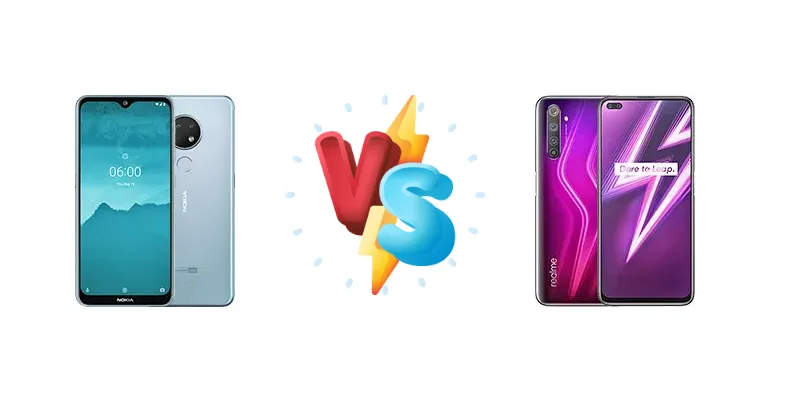
The Nokia 6.2 and Realme 6 Pro represent distinct approaches to the mid-range smartphone market. The Nokia 6.2 prioritizes a clean Android experience and long-term software support, while the Realme 6 Pro focuses on delivering maximum performance and fast charging at an aggressive price point. This comparison dissects their key differences to help you determine which device best suits your needs.
🏆 Quick Verdict
For most users, the Realme 6 Pro is the superior choice. Its Snapdragon 720G chipset provides a substantial performance boost over the Nokia 6.2’s Snapdragon 636, and the 30W fast charging dramatically reduces downtime. While the Nokia 6.2 offers respectable endurance, the Realme 6 Pro’s overall package is more compelling.
| Network |
|---|
| 2G bands | GSM 850 / 900 / 1800 / 1900 | GSM 850 / 900 / 1800 / 1900 |
| 3G bands | HSDPA 850 / 900 / 2100 - ROW | HSDPA 850 / 900 / 1700(AWS) / 1900 / 2100 - Global |
| 4G bands | 1, 3, 5, 7, 8, 20, 28, 38, 40, 41 - ROW | 1, 2, 3, 4, 5, 7, 8, 20, 28, 38, 40, 41 - Global |
| Speed | HSPA 42.2/5.76 Mbps, LTE Cat4 150/50 Mbps | HSPA 42.2/11.5 Mbps, LTE (2CA) Cat6 300/150 Mbps |
| Technology | GSM / HSPA / LTE | GSM / HSPA / LTE |
| | 1, 3, 5, 8, 40, 41 - IN | 1, 3, 5, 8, 38, 40, 41 - India |
| Launch |
|---|
| Announced | 2019, September 05. Released 2019, October 17 | 2020, March 05. Released 2020, March 13 |
| Status | Discontinued | Discontinued |
| Body |
|---|
| Build | Glass front (Gorilla Glass 3), glass back (Gorilla Glass 3), plastic frame | Glass front (Gorilla Glass 5), glass back, plastic frame |
| Dimensions | 159.9 x 75.1 x 8.3 mm (6.30 x 2.96 x 0.33 in) | 163.8 x 75.8 x 8.9 mm (6.45 x 2.98 x 0.35 in) |
| SIM | · Nano-SIM· Nano-SIM + Nano-SIM | Nano-SIM + Nano-SIM |
| Weight | 180 g (6.35 oz) | 202 g (7.13 oz) |
| Display |
|---|
| Protection | Corning Gorilla Glass 3 | Corning Gorilla Glass 5 |
| Resolution | 1080 x 2280 pixels, 19:9 ratio (~400 ppi density) | 1080 x 2400 pixels, 20:9 ratio (~399 ppi density) |
| Size | 6.3 inches, 99.1 cm2 (~82.5% screen-to-body ratio) | 6.6 inches, 105.2 cm2 (~84.7% screen-to-body ratio) |
| Type | IPS LCD, HDR10 | IPS LCD, 90Hz, 480 nits (typ) |
| | Always-on display | - |
| Platform |
|---|
| CPU | Octa-core (4x1.8 GHz Kryo 260 Gold & 4x1.6 GHz Kryo 260 Silver) | Octa-core (2x2.3 GHz Kryo 465 Gold & 6x1.8 GHz Kryo 465 Silver) |
| Chipset | Qualcomm SDM636 Snapdragon 636 (14 nm) | Qualcomm SM7125 Snapdragon 720G (8 nm) |
| GPU | Adreno 509 | Adreno 618 |
| OS | Android 9.0 (Pie), upgradable to Android 10, Android One | Android 10, upgradable to Android 11, Realme UI 2.0 |
| Memory |
|---|
| Card slot | microSDXC (dedicated slot) | microSDXC (dedicated slot) |
| Internal | 32GB 3GB RAM, 64GB 3GB RAM, 64GB 4GB RAM, 128GB 4GB RAM | 64GB 6GB RAM, 128GB 6GB RAM, 128GB 8GB RAM |
| | eMMC 5.1 | UFS 2.1 |
| Main Camera |
|---|
| Features | LED flash, panorama, HDR | LED flash, HDR, panorama |
| Quad | - | 64 MP, f/1.8, 26mm (wide), 1/1.72", 0.8µm, PDAF
12 MP, f/2.5, 54mm (telephoto), 1/3.4", 1.0µm, PDAF, 2x optical zoom
8 MP, f/2.3, 13mm (ultrawide), 1/4.0", 1.12µm
2 MP (macro) |
| Triple | 16 MP, f/1.8, 27mm (wide), 1.0µm, PDAF
8 MP, f/2.2, 13mm (ultrawide), 1/4.0", 1.12µm
Auxiliary lens | - |
| Video | 4K@30fps, 1080p@30fps | 4K@30fps, 1080p@30/60/120fps, gyro-EIS |
| Selfie camera |
|---|
| Dual | - | 16 MP, f/2.1, 26mm (wide), 1/3.06", 1.0µm
8 MP, f/2.2, 105˚ (ultrawide), 1/4.0", 1.12µm |
| Features | HDR | HDR, panorama |
| Single | 8 MP, f/2.0, 1/4.0", 1.12µm | - |
| Video | 1080p@30fps | 1080p@30fps |
| Sound |
|---|
| 3.5mm jack | Yes | Yes |
| 35mm jack | Yes | Yes |
| Loudspeaker | Yes | Yes |
| | - | 24-bit/192kHz audio |
| Comms |
|---|
| Bluetooth | 5.0, A2DP, EDR, LE, aptX | 5.1, A2DP, LE |
| NFC | Yes (excl. India) | Yes (market/region dependent) |
| Positioning | GPS, GLONASS, GALILEO, BDS | GPS (L1+L5), GLONASS, BDS, NavIC |
| Radio | FM radio | FM radio |
| USB | USB Type-C 2.0, OTG | USB Type-C 2.0, OTG |
| WLAN | Wi-Fi 802.11 b/g/n/ac, dual-band, Wi-Fi Direct | Wi-Fi 802.11 a/b/g/n/ac, dual-band, Wi-Fi Direct |
| Features |
|---|
| Sensors | Fingerprint (rear-mounted), accelerometer, gyro, proximity, compass | Fingerprint (side-mounted), accelerometer, gyro, proximity, compass |
| Battery |
|---|
| Charging | 10W wired | 30W wired, 100% in 57 min |
| Type | Li-Po 3500 mAh, non-removable | 4300 mAh |
| Misc |
|---|
| Colors | Ceramic Black, Ice | Lightning Blue, Lightning Orange, Lightning Red |
| Models | TA-1200, TA-1198, TA-1201, TA-1187 | RMX2061, RMX2063 |
| Price | About 180 EUR | About 540 EUR |
| SAR | 1.04 W/kg (head) 1.05 W/kg (body) | 1.19 W/kg (head) 0.92 W/kg (body) |
| SAR EU | 0.97 W/kg (head) 1.42 W/kg (body) | - |
| Tests |
|---|
| Audio quality |
Noise -91.0dB / Crosstalk -94.8dB | - |
| Battery life |
Endurance rating 73h
|
Endurance rating 107h
|
| Camera |
Photo / Video |
Photo / Video |
| Display |
Contrast ratio: 1525:1 (nominal) |
Contrast ratio: 1324:1 (nominal) |
| Loudspeaker |
Voice 65dB / Noise 70dB / Ring 79dB
|
-28.5 LUFS (Average)
|
| Performance |
AnTuTu: 114947 (v7), 140736 (v8)
GeekBench: 4882 (v4.4)
GFXBench: 5.7fps (ES 3.1 onscreen) |
AnTuTu: 268785 (v8)
GeekBench: 7027 (v4.4), 1666 (v5.1)
GFXBench: 19fps (ES 3.1 onscreen) |
Nokia 6.2
- Brighter display for outdoor visibility
- Clean, stock Android experience
- Long-term software support
- Slower processor
- Slow 10W charging
Realme 6 Pro
- Faster Snapdragon 720G processor
- 30W fast charging (57 min to full)
- Longer battery life (107h endurance)
- Dimmer display
- Realme UI may not appeal to all users
Display Comparison
The Realme 6 Pro and Nokia 6.2 both feature displays with similar nominal contrast ratios (1324:1 vs 1525:1), but diverge significantly in brightness. The Nokia 6.2 achieves a measured peak brightness of 580 nits, noticeably brighter than the Realme 6 Pro’s 421 nits. This translates to better outdoor visibility for the Nokia 6.2. However, the Realme 6 Pro’s 90Hz refresh rate (not specified for the Nokia 6.2, implying a standard 60Hz panel) provides a smoother scrolling experience, a benefit for users who frequently browse social media or play fast-paced games. The difference in contrast is less impactful in real-world use than the brightness disparity.
Camera Comparison
Both devices offer photo and video capabilities, but the context data lacks specifics to make a detailed comparison. Given Realme’s marketing focus on camera technology, it’s reasonable to assume the 6 Pro features a more advanced camera system, potentially with a larger main sensor and more sophisticated image processing algorithms. The Nokia 6.2 likely prioritizes a more natural color profile, consistent with the brand’s imaging philosophy. Without sensor size or aperture information, a definitive judgment is impossible, but the Realme 6 Pro likely offers greater versatility and image quality.
Performance
The Realme 6 Pro’s Snapdragon 720G, built on an 8nm process, represents a significant architectural leap over the Nokia 6.2’s 14nm Snapdragon 636. The 720G’s Kryo 465 cores (2x2.3 GHz Gold & 6x1.8 GHz Silver) deliver substantially improved CPU performance compared to the 636’s Kryo 260 cores (4x1.8 GHz Gold & 4x1.6 GHz Silver). This difference is particularly noticeable in demanding applications and multitasking. The 8nm process also contributes to better thermal efficiency, reducing the likelihood of performance throttling during extended gaming sessions. While both phones are capable of handling everyday tasks, the Realme 6 Pro is the clear winner for power users.
Battery Life
The Realme 6 Pro boasts a significantly faster charging speed at 30W, achieving a full charge in just 57 minutes, compared to the Nokia 6.2’s slow 10W charging. While the Nokia 6.2 offers an endurance rating of 73 hours, the Realme 6 Pro’s 107-hour rating indicates superior battery life, likely due to the more efficient Snapdragon 720G chipset. The faster charging of the Realme 6 Pro mitigates any concerns about battery capacity, allowing users to quickly top up their device when needed. The Nokia 6.2’s slower charging is a significant drawback in today’s fast-paced world.
Buying Guide
Buy the Nokia 6.2 if you prioritize a clean, stock Android experience with guaranteed updates and value long-term software support over raw performance. Buy the Realme 6 Pro if you demand faster processing speeds for gaming and multitasking, and if minimizing charging time is a critical factor in your daily usage.
Frequently Asked Questions
❓ Does the Snapdragon 720G in the Realme 6 Pro get hot during prolonged gaming sessions?
The Snapdragon 720G is built on an 8nm process, which offers improved thermal efficiency compared to the 14nm Snapdragon 636 in the Nokia 6.2. While some heat generation is inevitable during intensive gaming, the 720G is less prone to significant throttling, allowing for more sustained performance.
❓ How much faster is the 30W charging on the Realme 6 Pro compared to the 10W charging on the Nokia 6.2 in a real-world scenario?
The Realme 6 Pro can charge from 0% to 100% in approximately 57 minutes, while the Nokia 6.2 will take several hours. This means you can quickly top up the Realme 6 Pro during a short break, whereas the Nokia 6.2 requires overnight charging for a full battery.
❓ Is the difference in display brightness between the Realme 6 Pro and Nokia 6.2 noticeable in everyday use?
Yes, the Nokia 6.2’s 580 nits peak brightness is significantly higher than the Realme 6 Pro’s 421 nits. This difference is most apparent when using the phone outdoors in direct sunlight, where the Nokia 6.2 will remain more readable.
❓ Will the Realme 6 Pro receive as many software updates as the Nokia 6.2?
Nokia is known for its commitment to providing timely software updates and security patches. Realme’s update schedule is less predictable, though they have improved in recent years. If long-term software support is a top priority, the Nokia 6.2 is the safer bet.