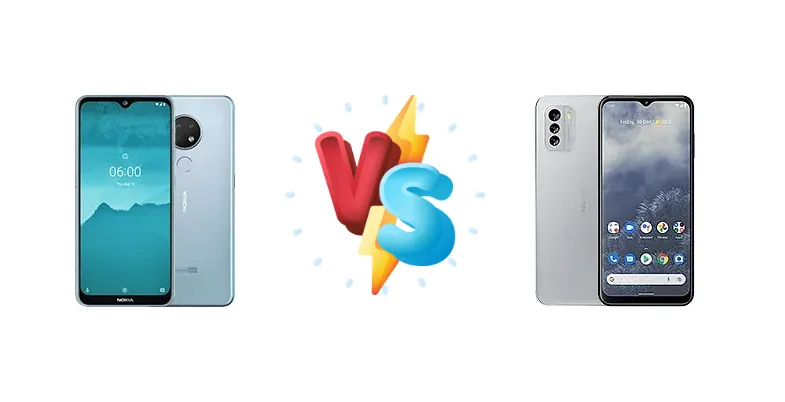
Nokia's reputation for reliable and affordable smartphones continues with the 6.2 and G60. But which one offers the best value in 2024? This comprehensive comparison dives deep into their specs, features, and performance to help you make an informed decision.
🏆 Quick Verdict
The Nokia G60 emerges as the clear winner, boasting a newer chipset, 5G connectivity, faster charging, and a more modern design. While the 6.2 still holds up, the G60's upgrades make it the better choice for most users seeking a contemporary smartphone experience.
| Network |
|---|
| 2G bands | GSM 850 / 900 / 1800 / 1900 | GSM 850 / 900 / 1800 / 1900 |
| 3G bands | HSDPA 850 / 900 / 2100 - ROW | HSDPA 850 / 900 / 1900 / 2100 - International |
| 4G bands | 1, 3, 5, 7, 8, 20, 28, 38, 40, 41 - ROW | 1, 3, 5, 7, 8, 20, 28, 38, 39, 40, 41 - International |
| 5G bands | - | 1, 3, 5, 7, 28, 38, 40, 41, 77, 78 SA/NSA/Sub6 - International |
| Speed | HSPA 42.2/5.76 Mbps, LTE Cat4 150/50 Mbps | HSPA, LTE, 5G |
| Technology | GSM / HSPA / LTE | GSM / HSPA / LTE / 5G |
| | 1, 3, 5, 8, 40, 41 - IN | 1, 3, 5, 7, 28, 38, 40, 41, 66, 78 SA/NSA/Sub6 - LATAM |
| Launch |
|---|
| Announced | 2019, September 05. Released 2019, October 17 | 2022, September 01 |
| Status | Discontinued | Available. Released 2022, September 01 |
| Body |
|---|
| Build | Glass front (Gorilla Glass 3), glass back (Gorilla Glass 3), plastic frame | Glass front (Gorilla Glass 5), plastic frame, plastic back |
| Dimensions | 159.9 x 75.1 x 8.3 mm (6.30 x 2.96 x 0.33 in) | 166 x 75.9 x 8.6 mm (6.54 x 2.99 x 0.34 in) |
| SIM | · Nano-SIM· Nano-SIM + Nano-SIM | · Nano-SIM + eSIM· Nano-SIM + Nano-SIM |
| Weight | 180 g (6.35 oz) | 190 g (6.70 oz) |
| | - | Splash resistant |
| Display |
|---|
| Protection | Corning Gorilla Glass 3 | Corning Gorilla Glass 5 |
| Resolution | 1080 x 2280 pixels, 19:9 ratio (~400 ppi density) | 1080 x 2408 pixels, 20:9 ratio (~401 ppi density) |
| Size | 6.3 inches, 99.1 cm2 (~82.5% screen-to-body ratio) | 6.58 inches, 104.3 cm2 (~82.8% screen-to-body ratio) |
| Type | IPS LCD, HDR10 | IPS LCD, 120Hz, 400 nits (typ) |
| | Always-on display | - |
| Platform |
|---|
| CPU | Octa-core (4x1.8 GHz Kryo 260 Gold & 4x1.6 GHz Kryo 260 Silver) | Octa-core (2x2.2 GHz Kryo 660 Gold & 6x1.7 GHz Kryo 660 Silver) |
| Chipset | Qualcomm SDM636 Snapdragon 636 (14 nm) | Qualcomm SM6375 Snapdragon 695 5G (6 nm) |
| GPU | Adreno 509 | Adreno 619 |
| OS | Android 9.0 (Pie), upgradable to Android 10, Android One | Android 12 |
| Memory |
|---|
| Card slot | microSDXC (dedicated slot) | microSDXC (uses shared SIM slot) |
| Internal | 32GB 3GB RAM, 64GB 3GB RAM, 64GB 4GB RAM, 128GB 4GB RAM | 64GB 4GB RAM, 128GB 4GB RAM, 128GB 6GB RAM |
| | eMMC 5.1 | - |
| Main Camera |
|---|
| Features | LED flash, panorama, HDR | LED flash, HDR, panorama |
| Single | - | 8 MP, f/2.0, (wide), 1/4.0", 1.12µm |
| Triple | 16 MP, f/1.8, 27mm (wide), 1.0µm, PDAF
8 MP, f/2.2, 13mm (ultrawide), 1/4.0", 1.12µm
Auxiliary lens | 50 MP, f/1.8, (wide), 1/2.5", 0.7µm, PDAF
5 MP, f/2.2, (ultrawide), 1/5.0"
Auxiliary lens |
| Video | 4K@30fps, 1080p@30fps | 1080p@30fps |
| Selfie camera |
|---|
| Features | HDR | - |
| Single | 8 MP, f/2.0, 1/4.0", 1.12µm | 8 MP, f/2.0, (wide), 1/4.0", 1.12µm |
| Video | 1080p@30fps | 1080p@30fps |
| Sound |
|---|
| 3.5mm jack | Yes | Yes |
| 35mm jack | Yes | Yes |
| Loudspeaker | Yes | Yes |
| Comms |
|---|
| Bluetooth | 5.0, A2DP, EDR, LE, aptX | 5.1, A2DP, LE, aptX HD, aptX Adaptive |
| NFC | Yes (excl. India) | Yes (market/region dependent) |
| Positioning | GPS, GLONASS, GALILEO, BDS | GPS, GALILEO, BDS |
| Radio | FM radio | FM radio |
| USB | USB Type-C 2.0, OTG | USB Type-C 2.0, OTG |
| WLAN | Wi-Fi 802.11 b/g/n/ac, dual-band, Wi-Fi Direct | Wi-Fi 802.11 a/b/g/n/ac/6, dual-band |
| Features |
|---|
| Sensors | Fingerprint (rear-mounted), accelerometer, gyro, proximity, compass | Fingerprint (side-mounted), accelerometer, gyro, proximity, compass |
| Battery |
|---|
| Charging | 10W wired | 20W wired, PD3.0 |
| Type | Li-Po 3500 mAh, non-removable | Li-Po 4500 mAh |
| Misc |
|---|
| Colors | Ceramic Black, Ice | Pure Black, Ice Gray |
| Models | TA-1200, TA-1198, TA-1201, TA-1187 | TA-1490, TA-1481, TA-1479, TA-1475 |
| Price | About 180 EUR | About 240 EUR |
| SAR | 1.04 W/kg (head) 1.05 W/kg (body) | 1.30 W/kg (head) 0.83 W/kg (body) |
| SAR EU | 0.97 W/kg (head) 1.42 W/kg (body) | 1.10 W/kg (head) 1.27 W/kg (body) |
| Tests |
|---|
| Audio quality |
Noise -91.0dB / Crosstalk -94.8dB | - |
| Battery life |
Endurance rating 73h
| - |
| Camera |
Photo / Video | - |
| Display |
Contrast ratio: 1525:1 (nominal) | - |
| Loudspeaker |
Voice 65dB / Noise 70dB / Ring 79dB
| - |
| Performance |
AnTuTu: 114947 (v7), 140736 (v8)
GeekBench: 4882 (v4.4)
GFXBench: 5.7fps (ES 3.1 onscreen) | - |
Nokia 6.2
- Exceptional battery life
- Good contrast ratio display
- Affordable price
- Outdated chipset
- Slow charging
- No 5G connectivity
Nokia G60
- 5G connectivity
- Improved performance (Snapdragon 695)
- Faster charging (20W PD3.0)
- Modern design
- Slightly lower peak brightness
- Potentially shorter battery life than 6.2
Display Comparison
The Nokia 6.2 boasts a slightly higher peak brightness of 580 nits compared to the G60's 444 nits, potentially offering better visibility in direct sunlight. However, both phones share a similar contrast ratio of around 1525:1, suggesting comparable image quality in terms of blacks and colors. The G60's display might benefit from more modern color calibration, but the difference is likely subtle.
Camera Comparison
While both phones offer 'Photo / Video' capabilities (specific details are missing), the G60's newer chipset and potentially improved image processing algorithms likely result in better image quality, especially in low-light conditions. The 6.2's camera is adequate, but the G60 should offer a noticeable improvement. Further testing would be needed to confirm.
Performance
The Nokia G60's Snapdragon 695 5G chipset is a significant upgrade over the 6.2's Snapdragon 636. The newer 6nm process offers improved efficiency and performance. Expect smoother multitasking, faster app loading times, and better overall responsiveness on the G60. The G60's CPU configuration also favors multi-core performance.
Battery Life
The Nokia 6.2's endurance rating of 73h is impressive, suggesting exceptional battery life. However, the G60's 20W charging support (with PD3.0) allows for significantly faster charging compared to the 6.2's 10W wired charging. While the G60 might not match the 6.2's longevity, the faster charging compensates for any potential difference.
Buying Guide
Who should buy the Nokia 6.2? Those on a very tight budget who prioritize exceptional battery life and don't need 5G. Who should buy the Nokia G60? Users seeking a modern smartphone with 5G, improved performance, and faster charging, willing to spend a bit more.
Frequently Asked Questions
❓ Is the Nokia 6.2 still worth buying in 2024?
Only if you're on a very tight budget and prioritize battery life above all else. Otherwise, the G60 offers a much better overall experience.
❓ Does the Nokia G60 support 5G?
Yes, the Nokia G60 features 5G connectivity, while the Nokia 6.2 does not.