
Nokia 6.2 vs. Google Pixel 4a 5G: A Deep Dive into Budget 5G Choices
| Phones Images | |||||
|---|---|---|---|---|---|
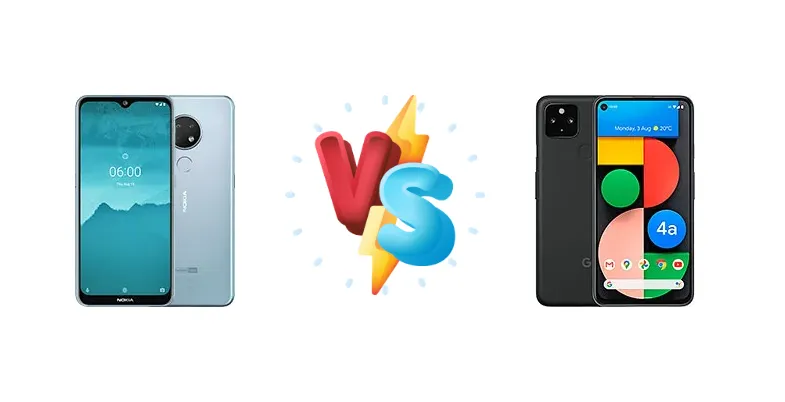
|
🏆 Quick Verdict
For most users, the Google Pixel 4a 5G is the superior choice. Its Snapdragon 765G chipset delivers significantly improved performance and 5G capabilities, while Google’s software and camera processing provide a more refined experience. However, the Nokia 6.2’s exceptional battery endurance remains a compelling advantage for those prioritizing longevity.
| PHONES | ||
|---|---|---|
| Phone Names | Nokia 6.2 | Google Pixel 4a 5G |
| Network | ||
|---|---|---|
| 2G bands | GSM 850 / 900 / 1800 / 1900 | GSM 850 / 900 / 1800 / 1900 |
| 3G bands | HSDPA 850 / 900 / 2100 - ROW | HSDPA 850 / 900 / 1700(AWS) / 1900 / 2100 |
| 4G bands | 1, 3, 5, 7, 8, 20, 28, 38, 40, 41 - ROW | 1, 2, 3, 4, 5, 7, 8, 12, 13, 14, 17, 18, 19, 20, 25, 26, 28, 29, 30, 32, 38, 39, 40, 41, 42, 46, 48, 66, 71 |
| 5G bands | - | 1, 2, 3, 5, 7, 8, 12, 28, 41, 66, 71, 77, 78 Sub6, mmWave (market dependant) |
| Speed | HSPA 42.2/5.76 Mbps, LTE Cat4 150/50 Mbps | HSPA, LTE, 5G |
| Technology | GSM / HSPA / LTE | GSM / HSPA / LTE / 5G |
| 1, 3, 5, 8, 40, 41 - IN | - | |
| Launch | ||
|---|---|---|
| Announced | 2019, September 05. Released 2019, October 17 | 2020, September 30 |
| Status | Discontinued | Available. Released 2020, November 05 |
| Body | ||
|---|---|---|
| Build | Glass front (Gorilla Glass 3), glass back (Gorilla Glass 3), plastic frame | Glass front (Gorilla Glass 3), plastic back, plastic frame |
| Dimensions | 159.9 x 75.1 x 8.3 mm (6.30 x 2.96 x 0.33 in) | 153.9 x 74 x 8.2 mm (Sub-6) or 8.5 mm (Sub-6 and mmWave) |
| SIM | · Nano-SIM· Nano-SIM + Nano-SIM | Nano-SIM + eSIM |
| Weight | 180 g (6.35 oz) | 168 g (5G Sub-6); 171 g ( 5G Sub-6 and mmWave) (5.93 oz) |
| Display | ||
|---|---|---|
| Protection | Corning Gorilla Glass 3 | Corning Gorilla Glass 3 |
| Resolution | 1080 x 2280 pixels, 19:9 ratio (~400 ppi density) | 1080 x 2340 pixels, 19.5:9 ratio (~413 ppi density) |
| Size | 6.3 inches, 99.1 cm2 (~82.5% screen-to-body ratio) | 6.2 inches, 95.7 cm2 (~84.1% screen-to-body ratio) |
| Type | IPS LCD, HDR10 | OLED, HDR |
| Always-on display | Always-on display | |
| Platform | ||
|---|---|---|
| CPU | Octa-core (4x1.8 GHz Kryo 260 Gold & 4x1.6 GHz Kryo 260 Silver) | Octa-core (1x2.4 GHz Kryo 475 Prime & 1x2.2 GHz Kryo 475 Gold & 6x1.8 GHz Kryo 475 Silver) |
| Chipset | Qualcomm SDM636 Snapdragon 636 (14 nm) | Qualcomm SM7250 Snapdragon 765G 5G (7 nm) |
| GPU | Adreno 509 | Adreno 620 |
| OS | Android 9.0 (Pie), upgradable to Android 10, Android One | Android 11, upgradable to Android 14 |
| Memory | ||
|---|---|---|
| Card slot | microSDXC (dedicated slot) | No |
| Internal | 32GB 3GB RAM, 64GB 3GB RAM, 64GB 4GB RAM, 128GB 4GB RAM | 128GB 6GB RAM |
| eMMC 5.1 | UFS 2.1 | |
| Main Camera | ||
|---|---|---|
| Dual | - | 12.2 MP, f/1.7, 27mm (wide), 1/2.55", 1.4µm, dual pixel PDAF, OIS 16 MP, f/2.2, 107˚ (ultrawide), 1.0µm |
| Features | LED flash, panorama, HDR | LED flash, Pixel Shift, Auto-HDR, panorama |
| Triple | 16 MP, f/1.8, 27mm (wide), 1.0µm, PDAF 8 MP, f/2.2, 13mm (ultrawide), 1/4.0", 1.12µm Auxiliary lens | - |
| Video | 4K@30fps, 1080p@30fps | 4K@30/60fps, 1080p@30/60/120/240fps; gyro-EIS |
| Selfie camera | ||
|---|---|---|
| Features | HDR | HDR |
| Single | 8 MP, f/2.0, 1/4.0", 1.12µm | 8 MP, f/2.0, 24mm (wide), 1/4.0", 1.12µm |
| Video | 1080p@30fps | 1080p@30fps |
| Sound | ||
|---|---|---|
| 3.5mm jack | Yes | Yes |
| 35mm jack | Yes | Yes |
| Loudspeaker | Yes | Yes, with stereo speakers |
| Comms | ||
|---|---|---|
| Bluetooth | 5.0, A2DP, EDR, LE, aptX | 5.0, A2DP, LE, aptX HD |
| NFC | Yes (excl. India) | Yes |
| Positioning | GPS, GLONASS, GALILEO, BDS | GPS, GLONASS, GALILEO, QZSS, BDS |
| Radio | FM radio | No |
| USB | USB Type-C 2.0, OTG | USB Type-C 3.1 |
| WLAN | Wi-Fi 802.11 b/g/n/ac, dual-band, Wi-Fi Direct | Wi-Fi 802.11 a/b/g/n/ac, dual-band, Wi-Fi Direct |
| Features | ||
|---|---|---|
| Sensors | Fingerprint (rear-mounted), accelerometer, gyro, proximity, compass | Fingerprint (rear-mounted), accelerometer, gyro, proximity, compass, barometer |
| Battery | ||
|---|---|---|
| Charging | 10W wired | 18W wired, PD2.0 |
| Type | Li-Po 3500 mAh, non-removable | Li-Po 3885 mAh |
| Misc | ||
|---|---|---|
| Colors | Ceramic Black, Ice | Just Black, Clearly White |
| Models | TA-1200, TA-1198, TA-1201, TA-1187 | GD1YQ, G025I, G025E, G025H, G6QU3 |
| Price | About 180 EUR | About 140 EUR |
| SAR | 1.04 W/kg (head) 1.05 W/kg (body) | - |
| SAR EU | 0.97 W/kg (head) 1.42 W/kg (body) | - |
| Tests | ||
|---|---|---|
| Audio quality | Noise -91.0dB / Crosstalk -94.8dB | - |
| Battery life | Endurance rating 73h | - |
| Camera | Photo / Video | - |
| Display | Contrast ratio: 1525:1 (nominal) | - |
| Loudspeaker | Voice 65dB / Noise 70dB / Ring 79dB | - |
| Performance | AnTuTu: 114947 (v7), 140736 (v8) GeekBench: 4882 (v4.4) GFXBench: 5.7fps (ES 3.1 onscreen) | - |
Nokia 6.2
- Exceptional battery life (73h endurance)
- More affordable price point
- Larger display size (6.3 inches)
- Outdated Snapdragon 636 chipset
- Slow 10W charging
- No 5G connectivity
Google Pixel 4a 5G
- Faster Snapdragon 765G 5G chipset
- Superior camera performance (Google’s processing)
- Faster 18W charging with PD2.0
- Potentially shorter battery life
- Higher price compared to Nokia 6.2
- Smaller display size (6.2 inches)
Display Comparison
The Nokia 6.2 boasts a measured peak brightness of 580 nits and a 1525:1 contrast ratio, providing a reasonably vibrant viewing experience for its time. However, the Pixel 4a 5G, while lacking specific published display specs, benefits from a more modern panel and Google’s image processing, likely resulting in more accurate colors. The Nokia 6.2’s larger size (6.3 inches vs 6.2 inches) doesn’t necessarily translate to a better viewing experience given the older panel technology. The Pixel 4a 5G’s display is likely to offer better outdoor visibility and color accuracy, though detailed measurements are unavailable.
Camera Comparison
Both phones offer photo and video capabilities, but the Pixel 4a 5G leverages Google’s renowned computational photography expertise. While sensor sizes aren’t specified, the Pixel 4a 5G’s image processing algorithms are likely to produce superior results in challenging lighting conditions. The Nokia 6.2’s camera performance is adequate for casual snapshots, but it lacks the dynamic range and detail capture of the Pixel 4a 5G. The Pixel 4a 5G’s software optimizations, such as Night Sight, provide a significant advantage in low-light photography. The absence of OIS information for both devices makes it difficult to assess stabilization performance, but Google’s software stabilization is generally very effective.
Performance
The core difference lies in the chipsets. The Nokia 6.2’s Qualcomm Snapdragon 636 (14nm) is a capable mid-range processor, but it’s significantly outmatched by the Pixel 4a 5G’s Snapdragon 765G (7nm). The 7nm process node of the 765G offers superior power efficiency and thermal performance, allowing for sustained higher clock speeds. The Pixel 4a 5G’s CPU configuration – a 1x2.4 GHz Kryo 475 Prime core, 1x2.2 GHz Kryo 475 Gold, and 6x1.8 GHz Kryo 475 Silver – provides a substantial performance boost over the Nokia 6.2’s Octa-core (4x1.8 GHz Kryo 260 Gold & 4x1.6 GHz Kryo 260 Silver). This translates to faster app loading times, smoother multitasking, and a more responsive user experience on the Pixel 4a 5G. Crucially, the 765G also integrates a 5G modem, a feature absent in the Nokia 6.2.
Battery Life
The Nokia 6.2 shines in battery endurance, achieving an impressive 73-hour rating. However, the Pixel 4a 5G compensates for potentially lower capacity with its more efficient Snapdragon 765G chipset and faster 18W charging with PD2.0 support. The Nokia 6.2 is limited to 10W charging, resulting in significantly longer charge times. While the Nokia 6.2 offers longer runtimes on a single charge, the Pixel 4a 5G’s faster charging allows for quicker top-ups, mitigating the impact of potentially shorter battery life. The 7nm process of the 765G contributes to lower power consumption during typical usage.
Buying Guide
Buy the Nokia 6.2 if you absolutely prioritize maximizing battery life and are comfortable with a less powerful processor and older software. It’s ideal for users who primarily use their phone for basic tasks like calls, texts, and light browsing. Buy the Google Pixel 4a 5G if you want a faster, more future-proof device with 5G connectivity, a superior camera experience, and guaranteed software updates. This is the better option for users who enjoy photography, gaming, or streaming content.