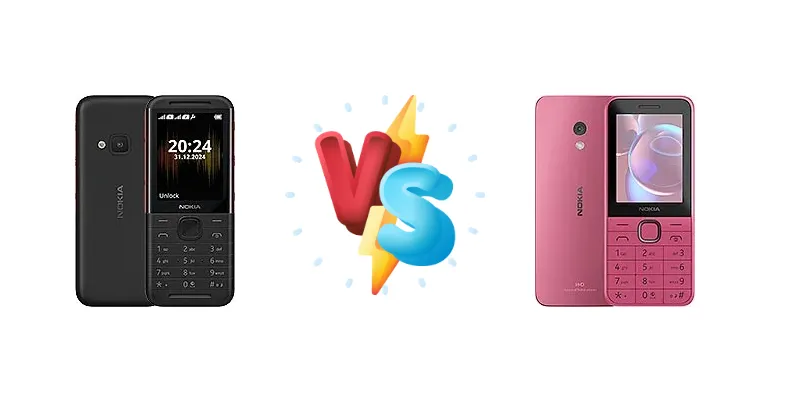
In a market saturated with smartphones, Nokia continues to cater to the demand for simple, reliable feature phones. The Nokia 5310 (2024) and Nokia 225 4G (2024) represent two distinct approaches within this segment. While both offer essential call and text functionality with 4G connectivity, their underlying hardware differs significantly, impacting performance and user experience. This comparison dissects those differences to help you choose the right phone for your needs.
🏆 Quick Verdict
For the average user prioritizing a slightly smoother experience and potential for future software updates, the Nokia 5310 (2024) is the better choice. Its Unisoc 6531F chipset, while still basic, offers a modest performance advantage over the Nokia 225 4G’s Unisoc T107, making it more responsive for simple tasks.
| Network |
|---|
| 2G bands | GSM 900 / 1800 | GSM 850 / 900 / 1800 / 1900 |
| 3G bands | - | HSDPA 850 / 900 / 2100 |
| 4G bands | - | 1, 3, 5, 7, 8, 20, 28, 38, 40, 41 - EU, EMEA, APAC |
| EDGE | Yes | - |
| GPRS | Yes | - |
| Speed | No | HSPA, LTE |
| Technology | GSM | GSM / HSPA / LTE |
| Launch |
|---|
| Announced | 2024, April 11 | 2024, April 30 |
| Status | Available. Released 2024, April 26 | Available. Released 2024, May |
| Body |
|---|
| Dimensions | 132 x 57 x 13.1 mm (5.20 x 2.24 x 0.52 in) | 121.5 x 52 x 11.6 mm (4.78 x 2.05 x 0.46 in) |
| SIM | · Nano-SIM· Nano-SIM + Nano-SIM | Nano-SIM + Nano-SIM |
| Weight | - | - |
| Display |
|---|
| Resolution | 240 x 320 pixels, 4:3 ratio (~143 ppi density) | 240 x 320 pixels, 4:3 ratio (~167 ppi density) |
| Size | 2.8 inches, 24.3 cm2 (~32.3% screen-to-body ratio) | 2.4 inches, 17.8 cm2 (~28.2% screen-to-body ratio) |
| Type | IPS LCD | TFT LCD |
| Platform |
|---|
| CPU | - | 1.0 GHz Cortex-A7 |
| Chipset | Unisoc 6531F | Unisoc T107 (22 nm) |
| Memory |
|---|
| Call records | Yes | Yes |
| Card slot | microSDHC | microSDHC |
| Internal | 16MB 8MB RAM | 128MB 64MB RAM |
| Phonebook | Yes | Yes |
| Main Camera |
|---|
| Features | LED flash | LED flash |
| Single | VGA | 0.3 MP |
| Video | Yes | Yes |
| Sound |
|---|
| 35mm jack | Yes | Yes |
| Loudspeaker | Yes, with dual speakers | Yes |
| Comms |
|---|
| Bluetooth | 5.0, A2DP, LE | 5.0, A2DP, LE |
| NFC | No | No |
| Positioning | No | No |
| Radio | Wireless FM radio | Wireless FM radio |
| USB | USB Type-C | USB Type-C |
| WLAN | No | No |
| Features |
|---|
| Games | Yes | Yes |
| Java | No | No |
| Messaging | SMS, MMS, Email, IM | SMS |
| Sensors | - | No |
| Battery |
|---|
| Type | Li-Ion 1450 mAh, removable | Li-Ion 1450 mAh, removable |
| Misc |
|---|
| Colors | White/Red, Black/Red | Pink, Dark Blue |
| Price | About 60 EUR | - |
Nokia 5310 (2024)
- Slightly more powerful Unisoc 6531F chipset
- Potential for future software updates
- May offer a smoother user experience
- Likely slightly higher price point
- Battery life may be marginally shorter than the 225 4G
Nokia 225 4G (2024)
- Proven and reliable Unisoc T107 chipset
- Potentially longer battery life
- More affordable price point
- Slower performance compared to the 5310
- Limited future software update potential
Display Comparison
Both phones likely feature similar low-resolution color displays typical of feature phones, prioritizing legibility over visual fidelity. Detailed display specs (resolution, panel type) are unavailable, but the focus is on power efficiency rather than image quality. Bezels are expected to be substantial on both models. Color accuracy is not a primary consideration in this segment.
Camera Comparison
Both phones are likely equipped with basic VGA or 2MP cameras primarily intended for occasional snapshots. Image quality will be limited, and these cameras are not suitable for detailed photography. The aperture and sensor size are not specified, and image processing will be minimal. Focusing on camera performance is not a key consideration for these devices.
Performance
The core difference lies in the chipsets. The Nokia 5310 (2024) utilizes the Unisoc 6531F, while the Nokia 225 4G (2024) employs the Unisoc T107 (22nm). The T107’s 1.0 GHz Cortex-A7 CPU is a well-established, low-power design, but the 6531F, while details are scarce, likely represents a newer generation with potentially improved efficiency and processing capabilities. The 22nm process node of the T107 indicates a larger transistor size compared to potentially newer nodes used in the 6531F, suggesting the T107 will consume more power for the same task. This translates to a slightly snappier experience on the 5310 for tasks like navigating menus or loading simple web pages.
Battery Life
Battery capacity details are unavailable for both models. However, given the low-power chipsets and basic displays, both phones should offer several days of standby time and reasonable talk time. The Unisoc T107’s older 22nm process may result in slightly higher power consumption, potentially giving the 5310 a marginal battery life advantage, but this difference is likely to be minimal in real-world usage. Charging wattage is also unspecified, suggesting slow charging via micro-USB.
Buying Guide
Buy the Nokia 5310 (2024) if you need a feature phone with a slightly more responsive interface for accessing basic apps like FM radio or a simple web browser. Buy the Nokia 225 4G (2024) if you prioritize maximum battery life and a proven, if slower, chipset for core communication functions, and are looking for the most affordable option.
Frequently Asked Questions
❓ Will the Nokia 5310 (2024) run WhatsApp or Facebook?
While both phones support 4G, running modern apps like WhatsApp or Facebook is unlikely to be a smooth experience. These apps are designed for smartphones with significantly more processing power and RAM. Limited functionality may be possible through lightweight web versions, but performance will be slow and unreliable.
❓ How long will the battery last on the Nokia 225 4G (2024) with typical use?
With typical use (calls, texts, occasional FM radio), the Nokia 225 4G (2024) should provide several days of battery life – potentially 5-7 days on standby and a full day of talk time. However, heavy use of 4G data will significantly reduce battery life.
❓ Can I expand the storage on either the Nokia 5310 (2024) or Nokia 225 4G (2024)?
Both phones support microSD card expansion, allowing you to increase storage for contacts, messages, and media files. The maximum supported microSD card capacity is typically 32GB, but it's best to check the official specifications for confirmation.