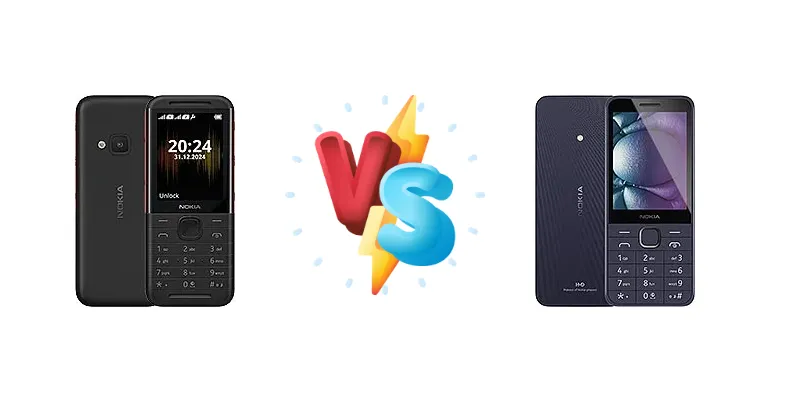
In the realm of ultra-budget mobile phones, Nokia continues to offer reliable and affordable options. The Nokia 5310 (2024) and Nokia 215 4G (2024) represent the latest iterations of classic feature phones, but beneath the familiar designs lie key differences in processing power and capabilities. This comparison dives deep into the specifications to determine which phone best suits your needs.
🏆 Quick Verdict
For most users seeking a basic, reliable phone with 4G connectivity, the Nokia 215 4G (2024) offers a slightly better value proposition. Its Unisoc T107 chipset, while modest, provides a functional experience for calls, texts, and light feature phone tasks, and its 22nm process is more mature than the 5310's.
| Network |
|---|
| 2G bands | GSM 900 / 1800 | GSM 850 / 900 / 1800 / 1900 |
| 3G bands | - | HSDPA 850 / 900 / 2100 |
| 4G bands | - | 1, 3, 5, 7, 8, 20, 28, 38, 40, 41 - EU, EMEA, APAC |
| EDGE | Yes | - |
| GPRS | Yes | - |
| Speed | No | HSPA, LTE |
| Technology | GSM | GSM / HSPA / LTE |
| Launch |
|---|
| Announced | 2024, April 11 | 2024, April 30 |
| Status | Available. Released 2024, April 26 | Available. Released 2024, May |
| Body |
|---|
| Dimensions | 132 x 57 x 13.1 mm (5.20 x 2.24 x 0.52 in) | 127.3 x 54.2 x 11.6 mm (5.01 x 2.13 x 0.46 in) |
| SIM | · Nano-SIM· Nano-SIM + Nano-SIM | Nano-SIM + Nano-SIM |
| Weight | - | - |
| Display |
|---|
| Resolution | 240 x 320 pixels, 4:3 ratio (~143 ppi density) | 240 x 320 pixels, 4:3 ratio (~143 ppi density) |
| Size | 2.8 inches, 24.3 cm2 (~32.3% screen-to-body ratio) | 2.8 inches, 24.3 cm2 (~35.2% screen-to-body ratio) |
| Type | IPS LCD | TFT LCD |
| Platform |
|---|
| CPU | - | 1.0 GHz Cortex-A7 |
| Chipset | Unisoc 6531F | Unisoc T107 (22 nm) |
| Memory |
|---|
| Call records | Yes | Yes |
| Card slot | microSDHC | microSDHC |
| Internal | 16MB 8MB RAM | 128MB 64MB RAM |
| Phonebook | Yes | Yes |
| Main Camera |
|---|
| Features | LED flash | - |
| Single | VGA | - |
| Video | Yes | - |
| Sound |
|---|
| 35mm jack | Yes | Yes |
| Loudspeaker | Yes, with dual speakers | Yes |
| Comms |
|---|
| Bluetooth | 5.0, A2DP, LE | 5.0, A2DP, LE |
| NFC | No | No |
| Positioning | No | No |
| Radio | Wireless FM radio | Wireless FM radio |
| USB | USB Type-C | USB Type-C |
| WLAN | No | No |
| Features |
|---|
| Games | Yes | Yes |
| Java | No | No |
| Messaging | SMS, MMS, Email, IM | SMS |
| Sensors | - | No |
| Battery |
|---|
| Type | Li-Ion 1450 mAh, removable | Li-Ion 1450 mAh, removable |
| Misc |
|---|
| Colors | White/Red, Black/Red | Peach, Black, Dark Blue |
| Price | About 60 EUR | - |
Nokia 5310 (2024)
- Potentially more modern chipset (Unisoc 6531F)
- May receive longer software support (though limited)
- Slightly more future-proof platform
- Chipset fabrication node unknown, potentially less efficient
- Likely higher price point than the 215 4G
- Performance gains over the 215 4G are likely minimal
Nokia 215 4G (2024)
- Proven and efficient Unisoc T107 chipset (22nm)
- Lower price point expected
- Excellent battery life due to efficient chipset
- Older chipset architecture
- Limited performance capabilities
- May receive shorter software support
Display Comparison
Both phones likely feature similar low-resolution color displays typical of feature phones, prioritizing battery life over visual fidelity. Detailed display specs (resolution, panel type, brightness) are unavailable, but the focus is on legibility rather than immersive viewing. Bezels are expected to be substantial on both models, reflecting their cost-conscious design.
Camera Comparison
Both phones are expected to feature basic VGA or 2MP cameras primarily for capturing simple snapshots. Image quality will be limited, and these cameras are not intended for serious photography. The aperture and sensor size are likely similar, making image processing the primary differentiator, though details are unavailable. Focusing on camera performance is not a key consideration for these devices.
Performance
The core difference lies in the chipsets. The Nokia 215 4G (2024) utilizes the Unisoc T107 (22nm), featuring a 1.0 GHz Cortex-A7 CPU. This is a proven, low-power chipset designed for basic feature phone functionality. The Nokia 5310 (2024) employs the Unisoc 6531F. While the exact architecture isn't specified, the '6531' series generally indicates a slightly more modern design. However, without knowing the fabrication node of the 6531F, it's difficult to assess any significant performance or efficiency gains. The T107's 22nm process suggests better thermal characteristics and potentially longer battery life under sustained use, even with a slower clock speed.
Battery Life
Battery capacity details are not provided. However, feature phones are renowned for exceptional battery life. The Unisoc T107's 22nm process in the Nokia 215 4G likely contributes to slightly longer standby and talk times compared to the Nokia 5310, assuming similar battery capacities. Charging is expected to be via Micro-USB, with charging speeds being relatively slow on both models.
Buying Guide
Buy the Nokia 5310 (2024) if you prioritize a potentially more future-proof platform with the newer Unisoc 6531F chipset, even if real-world performance gains are minimal. Buy the Nokia 215 4G (2024) if you prefer a proven, cost-effective solution for essential communication, benefiting from a well-established chipset and potentially lower price point.
Frequently Asked Questions
❓ Will the Nokia 215 4G (2024) support VoLTE in my region?
VoLTE support depends on your carrier and region. While the '4G' in the name indicates 4G connectivity, specific VoLTE band compatibility varies. Check with your mobile carrier to confirm if the Nokia 215 4G is compatible with their VoLTE network.
❓ Can I use WhatsApp on either the Nokia 5310 (2024) or Nokia 215 4G (2024)?
WhatsApp's system requirements are constantly evolving. While older versions of WhatsApp were compatible with feature phones, newer versions may require more processing power and memory than these devices offer. Compatibility is not guaranteed and may change over time. Check the WhatsApp website for the latest supported devices.
❓ How much storage do these phones have for contacts and messages?
Feature phones typically store contacts and messages directly in the phone's internal memory, which is usually quite limited (often a few megabytes). Both the Nokia 5310 and 215 4G likely support storing hundreds of contacts and a reasonable number of SMS messages, but extensive media storage is not expected.