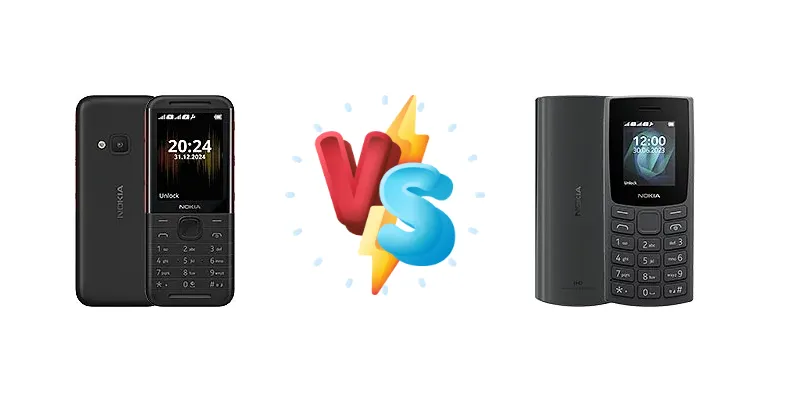
The feature phone isn't dead, and Nokia is proving it. We're pitting the newly released Nokia 5310 (2024) against the established Nokia 105 4G 2nd Edition. While both cater to the ultra-budget market, the 5310 introduces a modern chipset, raising the question: is the upgrade worth it for users prioritizing basic communication and longevity?
🏆 Quick Verdict
For the average user needing reliable call quality and basic functionality, the Nokia 5310 (2024) is the better choice. The Unisoc 6531F chipset provides a future-proofed 4G experience and potential for software updates, unlike the Nokia 105 4G 2nd Edition which relies on a more limited platform.
| Network |
|---|
| 2G bands | GSM 900 / 1800 | GSM 900 / 1800 |
| 3G bands | - | HSDPA 850 / 900 / 1700(AWS) / 1900 / 2100 |
| 4G bands | - | LTE |
| EDGE | Yes | - |
| GPRS | Yes | - |
| Speed | No | HSPA, LTE |
| Technology | GSM | GSM / HSPA / LTE |
| Launch |
|---|
| Announced | 2024, April 11 | 2024, December |
| Status | Available. Released 2024, April 26 | Available. Released 2024, December |
| Body |
|---|
| Dimensions | 132 x 57 x 13.1 mm (5.20 x 2.24 x 0.52 in) | 121.5 x 50 x 14.4 mm (4.78 x 1.97 x 0.57 in) |
| SIM | · Nano-SIM· Nano-SIM + Nano-SIM | · Nano-SIM· Nano-SIM + Nano-SIM |
| Weight | - | 93 g (3.28 oz) |
| Display |
|---|
| Resolution | 240 x 320 pixels, 4:3 ratio (~143 ppi density) | 120 x 160 pixels, 4:3 ratio (~111 ppi density) |
| Size | 2.8 inches, 24.3 cm2 (~32.3% screen-to-body ratio) | 1.8 inches, 10.0 cm2 (~16.5% screen-to-body ratio) |
| Type | IPS LCD | IPS LCD |
| Platform |
|---|
| Chipset | Unisoc 6531F | - |
| Memory |
|---|
| Call records | Yes | Yes |
| Card slot | microSDHC | microSDHC |
| Internal | 16MB 8MB RAM | 48MB 128MB RAM |
| Phonebook | Yes | Yes |
| Main Camera |
|---|
| Features | LED flash | - |
| Single | VGA | - |
| Video | Yes | - |
| Sound |
|---|
| 35mm jack | Yes | Yes |
| Loudspeaker | Yes, with dual speakers | Yes |
| Comms |
|---|
| Bluetooth | 5.0, A2DP, LE | 5.0, A2DP |
| NFC | No | No |
| Positioning | No | No |
| Radio | Wireless FM radio | Wireless FM radio |
| USB | USB Type-C | USB Type-C |
| WLAN | No | No |
| Features |
|---|
| Games | Yes | Yes |
| Java | No | No |
| Messaging | SMS, MMS, Email, IM | SMS |
| Battery |
|---|
| Type | Li-Ion 1450 mAh, removable | Li-Ion 1450 mAh, removable |
| Misc |
|---|
| Colors | White/Red, Black/Red | Charcoal |
| Price | About 60 EUR | About 50 EUR |
Nokia 5310 (2024)
- Modern Unisoc 6531F chipset for improved performance
- 4G connectivity with VoLTE support for better call quality
- Potential for future software updates
- Slightly higher price point
- May consume battery faster than the 105 4G
Nokia 105 4G 2nd Edition
- Extremely affordable price
- Exceptional standby time
- Simple and easy to use
- Outdated hardware and limited functionality
- Potentially limited 4G support and no VoLTE
- Uncertain long-term software support
Display Comparison
Both devices feature small displays geared towards basic information presentation. Specifics regarding the Nokia 105 4G 2nd Edition's display are unavailable, but given its market segment, it likely utilizes a standard TFT panel. The Nokia 5310 (2024) also likely uses a TFT, but the inclusion of a more modern chipset *could* translate to slightly improved color reproduction and viewing angles, though this is unlikely to be significant. Bezels are expected to be substantial on both devices, prioritizing durability over immersive viewing.
Camera Comparison
Neither device is intended for photography. While the Nokia 5310 (2024) may include a basic camera, its image quality will be limited. The Nokia 105 4G 2nd Edition’s camera specifications are unknown, but it’s safe to assume it’s similarly basic. Focusing on camera performance is irrelevant for these devices; their primary function is communication, not content creation.
Performance
The Nokia 5310 (2024) is powered by the Unisoc 6531F chipset, a quad-core processor designed for entry-level smartphones and feature phones. This represents a significant leap over the Nokia 105 4G 2nd Edition, which lacks publicly available chipset information but is presumed to utilize a much older and less capable platform. The Unisoc 6531F’s architecture allows for smoother operation of basic apps and a more responsive user interface, and crucially, supports VoLTE for improved call quality on 4G networks. Users who frequently make calls will benefit from the 5310’s superior processing power.
Battery Life
Both phones prioritize long battery life. The Nokia 105 4G 2nd Edition is known for its exceptional standby time, a hallmark of basic feature phones. The Nokia 5310 (2024), while also offering good battery life, will likely consume more power due to the more powerful Unisoc 6531F chipset and 4G connectivity. However, the 5310’s more efficient 4G implementation and potential for software optimization could mitigate this difference, offering comparable real-world usage time for moderate users.
Buying Guide
Buy the Nokia 5310 (2024) if you need a dependable 4G connection for voice calls and messaging, and want a device that's likely to remain compatible with evolving network standards. Buy the Nokia 105 4G 2nd Edition if you prioritize absolute lowest cost and only require 2G/4G connectivity for infrequent use, and are comfortable with a potentially shorter lifespan regarding software support.
Frequently Asked Questions
❓ Will the Nokia 5310 (2024) receive software updates to maintain 4G compatibility as networks evolve?
The Unisoc 6531F chipset offers a degree of future-proofing, and Nokia has a history of providing limited software support for its feature phones. While major Android updates aren't expected, security patches and compatibility updates for 4G networks are possible, extending the device's lifespan.
❓ Is the Nokia 105 4G 2nd Edition still a viable option if I primarily need a phone for making calls and sending texts in areas with strong 2G/4G coverage?
Yes, the Nokia 105 4G 2nd Edition remains a perfectly functional device for basic communication. Its exceptional battery life and low cost make it suitable for users with minimal needs and reliable network coverage. However, be aware of potential limitations with newer 4G features like VoLTE.
❓ Does the Nokia 5310 (2024) support any apps beyond basic pre-installed tools?
The Nokia 5310 (2024) runs a feature phone operating system, typically a simplified version of Series 30+. It supports a limited number of Java-based apps, but the app ecosystem is significantly smaller than that of smartphones. Expect basic functionality like FM radio and a few pre-installed games.