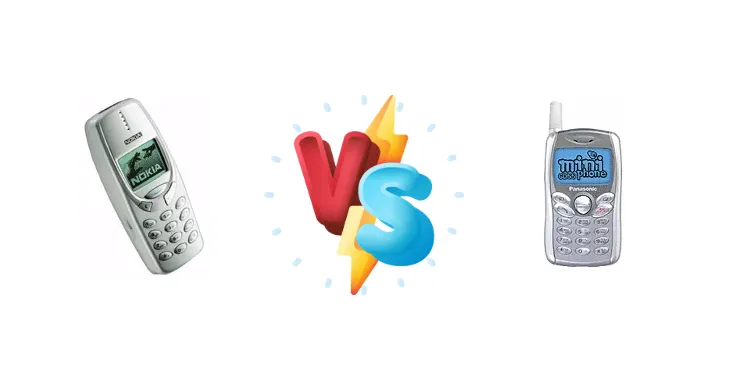
The late 1990s and early 2000s saw a rapid evolution in mobile phone technology. We pit two icons of that era against each other: the virtually indestructible Nokia 3310, renowned for its robustness, and the Panasonic GD55, a groundbreaking device that introduced a built-in camera to the consumer market. This comparison isn't about raw specs – it's about understanding the design philosophies and user experiences that defined a generation.
🏆 Quick Verdict
For the average user seeking a nostalgic and incredibly durable phone, the Nokia 3310 remains the clear winner. Its legendary battery life and near-indestructible build quality outweigh the GD55’s innovative, but limited, camera functionality. The GD55 is a collector’s item, while the 3310 is a usable piece of history.
| Network |
|---|
| 2G bands | GSM 900 / 1800 | GSM 900 / 1800 / 1900 |
| EDGE | No | No |
| GPRS | No | No |
| Technology | GSM | GSM |
| Launch |
|---|
| Announced | 2000 | 2002, Oct |
| Status | Discontinued | Discontinued |
| Body |
|---|
| Dimensions | 113 x 48 x 22 mm, 97 cc (4.45 x 1.89 x 0.87 in) | 77 x 43 x 17 mm, 51 cc (3.03 x 1.69 x 0.67 in) |
| SIM | Mini-SIM | Mini-SIM |
| Weight | 133 g (4.69 oz) | 65 g (2.29 oz) |
| Display |
|---|
| Resolution | 5 lines | 112 x 64 pixels, 16:9 ratio |
| Type | Monochrome graphic | Graphics |
| | - | Blue backlight
20 wallpapers
CallerID graphics |
| Memory |
|---|
| Call records | 8 dialed, 8 received, 8 missed calls | 20 dialed, 10 received, 10 missed calls |
| Card slot | No | No |
| Phonebook | SIM only | 250 |
| | - | Message templates
100 calendar events |
| Sound |
|---|
| 3.5mm jack | - | No |
| 35mm jack | No | No |
| Alert types | Vibration; Downloadable monophonic ringtones | Vibration; Polyphonic ringtones, composer |
| Loudspeaker | No | No |
| Comms |
|---|
| Bluetooth | No | No |
| Positioning | No | No |
| Radio | No | No |
| WLAN | No | No |
| Features |
|---|
| Alarm | Yes | Yes |
| Browser | - | WAP 1.2.1 |
| Clock | Yes | Yes |
| Games | 4 ( Snake II, Pairs II, Space Impact, Bantumi ) | 1 |
| Java | No | No |
| Languages | 17 for menu, 11 for T9 | - |
| Messaging | SMS | SMS, EMS |
| | - | Predictive text input
Organizer |
| Battery |
|---|
| Stand-by | 55 h to 245 h | Up to 230 h |
| Talk time | 2 h 30 min to 4 h 30 | Up to 8 h |
| Type | Removable NiMH 900 mAh battery (BMC-3) | Removable Li-Ion 720 mAh battery |
| Misc |
|---|
| Colors | User exchangeable front and back covers | 3 - Silver, Red, Pink |
| SAR EU | 0.96 W/kg (head) | - |
Nokia 3310
- Exceptional durability and build quality
- Legendary battery life
- Simple and reliable user interface
- Monochrome display
- Lack of advanced features (no camera)
Panasonic GD55
- First integrated camera phone
- Larger display than the 3310
- Unique and collectible design
- Poor camera image quality
- Significantly shorter battery life
- Bulky and less durable build
Display Comparison
Both the Nokia 3310 and Panasonic GD55 utilized monochrome LCD screens, typical of the era. The GD55’s screen, however, was larger, approximately 1.7 inches compared to the 3310’s 1.5 inches, likely to accommodate the camera viewfinder. While neither display offers any semblance of modern color accuracy or brightness, the GD55’s larger size provided a slightly more comfortable viewing experience, albeit at the cost of increased device bulk. The 3310’s display, while smaller, was known for its readability in direct sunlight.
Camera Comparison
The Panasonic GD55’s defining feature was its integrated 0.11-megapixel camera – a revolutionary addition for its time. However, the image quality was extremely limited, producing grainy, low-resolution images suitable only for novelty purposes. The 3310 lacked a camera entirely, focusing instead on core communication features. The GD55’s camera necessitated a larger device profile and significantly reduced battery life, highlighting the trade-offs inherent in early mobile camera technology. The GD55’s camera was more of a proof-of-concept than a practical imaging tool.
Performance
Analyzing 'performance' in these devices is unconventional. Both relied on proprietary chipsets designed for basic voice calls and SMS messaging. The GD55’s chipset had the additional burden of processing images from its camera, suggesting a slightly more complex architecture. However, neither phone offered any multitasking capabilities or advanced processing power. The 3310’s simpler design likely contributed to its superior battery life, as less power was consumed by ancillary functions. The GD55’s camera functionality, while innovative, demonstrably impacted battery performance.
Battery Life
The Nokia 3310 boasted a NiMH battery offering up to 260 hours of standby time and 2.5 to 4.5 hours of talk time – a remarkable achievement for the period. The Panasonic GD55, burdened by the power demands of its camera and larger screen, offered significantly less battery life, typically around 140 hours of standby and 1.5 to 2.5 hours of talk time. This difference in battery performance is a key differentiator, making the 3310 a far more practical choice for users prioritizing longevity.
Buying Guide
Buy the Nokia 3310 if you need a phone that can withstand significant abuse, offers exceptional battery life, and provides a simple, reliable communication experience. It’s ideal for those who prioritize practicality and longevity. Buy the Panasonic GD55 if you’re a collector of mobile phone history, fascinated by early camera phone technology, and appreciate a unique, albeit bulky, design. It’s a conversation starter, not a daily driver.
Frequently Asked Questions
❓ Is the Panasonic GD55's camera actually usable in 2024?
While historically significant, the GD55’s 0.11-megapixel camera produces images that are extremely low resolution and grainy by modern standards. It’s more of a novelty item for demonstrating early mobile camera technology than a practical imaging tool. Expect images suitable only for very small displays or historical archiving.
❓ How does the Nokia 3310's build quality compare to modern smartphones?
The Nokia 3310 is legendary for its durability. Its polycarbonate construction and simple design make it incredibly resistant to drops and impacts. Modern smartphones, while featuring glass and metal, are significantly more fragile and prone to damage from even minor falls. The 3310’s robustness is a key reason for its enduring appeal.
❓ Can I still use the Panasonic GD55 on a modern cellular network?
The Panasonic GD55 operates on 2G networks, which are being phased out in many parts of the world. Its compatibility with modern networks is limited and may require specific adapters or network configurations. In many regions, it will no longer be able to connect to a cellular network.