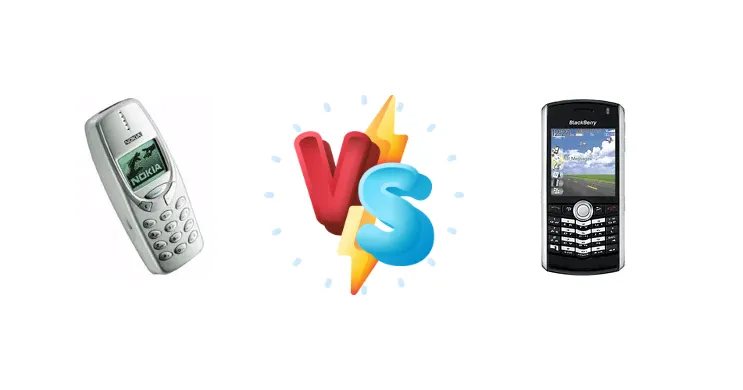
The Nokia 3310 and BlackBerry Pearl 8100 represent vastly different stages in mobile phone evolution. The 3310, a bastion of pre-smartphone simplicity and legendary durability, contrasts sharply with the Pearl 8100, a pioneering device attempting to bridge the gap between traditional phones and the emerging smartphone landscape. This comparison examines how these two devices catered to distinct user needs and how their core philosophies shaped their respective legacies.
🏆 Quick Verdict
For the average user seeking a reliable, long-lasting device for basic communication, the Nokia 3310 remains the superior choice due to its unparalleled battery life and ruggedness. However, users needing email access and limited web browsing will find the BlackBerry Pearl 8100 a more functional, albeit less durable, option.
| Network |
|---|
| 2G bands | GSM 900 / 1800 | GSM 850 / 900 / 1800 / 1900 |
| EDGE | No | Yes |
| GPRS | No | Yes |
| Technology | GSM | GSM |
| Launch |
|---|
| Announced | 2000 | 2006, September |
| Status | Discontinued | Discontinued |
| Body |
|---|
| Dimensions | 113 x 48 x 22 mm, 97 cc (4.45 x 1.89 x 0.87 in) | 107 x 50 x 14.5 mm (4.21 x 1.97 x 0.57 in) |
| Keyboard | - | QWERTY |
| SIM | Mini-SIM | Mini-SIM |
| Weight | 133 g (4.69 oz) | 89.5 g (3.14 oz) |
| Display |
|---|
| Resolution | 5 lines | 240 x 260 pixels (~161 ppi density) |
| Size | - | 2.2 inches, 15.6 cm2 (~29.1% screen-to-body ratio) |
| Type | Monochrome graphic | 65K colors |
| | - | Wallpapers |
| Platform |
|---|
| CPU | - | 32-bit Intel XScale PXA272 312 MHz |
| OS | - | BlackBerry OS |
| Memory |
|---|
| Call records | 8 dialed, 8 received, 8 missed calls | - |
| Card slot | No | microSD (dedicated slot) |
| Internal | - | 64MB |
| Phonebook | SIM only | - |
| Main Camera |
|---|
| Features | - | LED flash |
| Single | - | 1.3 MP |
| Video | - | No |
| Sound |
|---|
| 3.5mm jack | - | No |
| 35mm jack | No | No |
| Alert types | Vibration; Downloadable monophonic ringtones | Vibration; Downloadable polyphonic, MP3 ringtones |
| Loudspeaker | No | Yes |
| Comms |
|---|
| Bluetooth | No | 2.0 |
| Positioning | No | No |
| Radio | No | No |
| USB | - | Proprietary |
| WLAN | No | No |
| Features |
|---|
| Alarm | Yes | - |
| Browser | - | HTML |
| Clock | Yes | - |
| Games | 4 ( Snake II, Pairs II, Space Impact, Bantumi ) | - |
| Java | No | - |
| Languages | 17 for menu, 11 for T9 | - |
| Messaging | SMS | - |
| | - | Document viewer (Word, Excel, PowerPoint, PDF)
Media player
SureType keyboard software
Organizer |
| Battery |
|---|
| Stand-by | 55 h to 245 h | Up to 360 h |
| Talk time | 2 h 30 min to 4 h 30 | Up to 3 h 30 min |
| Type | Removable NiMH 900 mAh battery (BMC-3) | Removable Li-Ion 900 mAh battery |
| Misc |
|---|
| Colors | User exchangeable front and back covers | Black, White, Red |
| Price | - | About 200 EUR |
| SAR EU | 0.96 W/kg (head) | - |
Nokia 3310
- Unmatched durability and build quality
- Exceptional battery life (days or weeks)
- Simple and reliable operation
- Lack of advanced features (no email, web browsing)
- Monochrome display
BlackBerry Pearl 8100
- Email access and limited web browsing
- Color display
- Physical QWERTY keyboard for efficient typing
- Significantly shorter battery life
- Less durable construction
- Slower performance compared to modern smartphones
Display Comparison
The Nokia 3310’s display specifications are largely undocumented, but it featured a monochrome LCD, prioritizing visibility and power efficiency over color reproduction. In contrast, the BlackBerry Pearl 8100 boasted a 240x260 pixel color LCD. While the Pearl 8100 offered a richer visual experience, the Nokia 3310’s simpler display contributed significantly to its extended battery life. The Pearl 8100’s screen, while offering more information density, was more susceptible to damage and consumed more power.
Camera Comparison
Neither device featured a camera. The Nokia 3310 predates the widespread inclusion of cameras in mobile phones, while the BlackBerry Pearl 8100, despite being a more advanced device, did not prioritize camera functionality. This reflects the different priorities of each phone – the 3310 focused on core communication, while the Pearl 8100 aimed for productivity features like email.
Performance
The BlackBerry Pearl 8100’s 32-bit Intel XScale PXA272 312 MHz processor represented a significant leap in mobile processing power compared to the Nokia 3310’s unknown chipset. This allowed the Pearl 8100 to handle tasks like email synchronization and limited web browsing, features entirely absent on the 3310. However, the XScale processor’s power consumption impacted battery life, and its performance, while groundbreaking for its time, feels incredibly slow by modern standards. The Nokia 3310’s simpler architecture prioritized efficiency and reliability over raw processing speed.
Battery Life
The Nokia 3310 is renowned for its exceptional battery life, often lasting days or even weeks on a single charge. This was achieved through its low-power display, simple operating system, and efficient chipset. The BlackBerry Pearl 8100, powered by the Intel XScale processor and a color LCD, offered significantly shorter battery life, typically requiring daily charging with moderate use. The Pearl 8100’s battery life was a necessary compromise for its added functionality.
Buying Guide
Buy the Nokia 3310 if you need an incredibly durable phone for basic calling and texting, prioritizing battery life and simplicity above all else. It’s ideal for travelers, construction workers, or anyone needing a dependable backup device. Buy the BlackBerry Pearl 8100 if you prefer early smartphone functionality, including email access, a more sophisticated user interface, and a physical keyboard, accepting trade-offs in battery life and overall robustness.
Frequently Asked Questions
❓ Is the BlackBerry Pearl 8100’s trackwheel reliable over the long term?
The BlackBerry Pearl 8100’s trackwheel was a novel input method, but it was prone to wear and tear over time, often becoming less responsive or developing issues with accidental selections. This is a common complaint from long-term users and a significant point of failure compared to the Nokia 3310’s physical buttons.
❓ Can the Nokia 3310 be used as a reliable backup phone in emergency situations?
Absolutely. The Nokia 3310’s exceptional battery life and rugged construction make it an ideal emergency phone. It can remain functional for extended periods without needing a charge, and its durability ensures it can withstand harsh conditions.
❓ How does the Intel XScale processor in the BlackBerry Pearl 8100 perform with modern mobile applications (if any are still compatible)?
The Intel XScale PXA272 processor is severely underpowered by today’s standards. While some very basic Java applications might still function, attempting to run modern mobile apps is impractical and will result in extremely slow performance or crashes. It was designed for a different era of mobile computing.