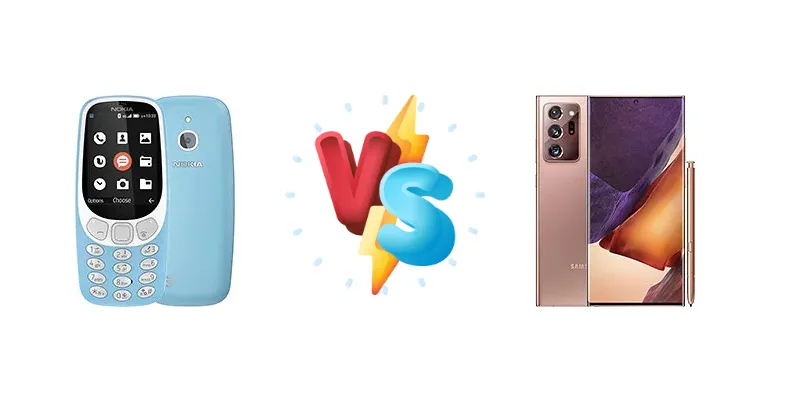
The Nokia 3310 4G evokes nostalgia with its iconic design, while the Samsung Galaxy Note20 Ultra 5G represents the pinnacle of modern smartphone technology. This comparison explores how these two vastly different devices stack up against each other, catering to distinct user needs and budgets.
🏆 Quick Verdict
The Samsung Galaxy Note20 Ultra 5G is the clear winner in terms of performance, camera quality, and features. However, the Nokia 3310 4G offers incredible value and simplicity for those prioritizing battery life and a durable, basic phone experience. It's a battle of priorities, not raw power.
| Network |
|---|
| 2G bands | GSM 850 / 900 / 1800 / 1900 | GSM 850 / 900 / 1800 / 1900 |
| 3G bands | HSDPA 850 / 900 / 1900 / 2100 | HSDPA 850 / 900 / 1700(AWS) / 1900 / 2100 |
| 4G bands | 38, 39, 40, 41 | 1, 2, 3, 4, 5, 7, 8, 12, 13, 14, 18, 19, 20, 25, 26, 28, 29, 30, 38, 39, 40, 41, 46, 48, 66, 71 - SM-N986U |
| 5G bands | - | 2, 5, 41, 66, 71, 260, 261 SA/NSA/Sub6/mmWave - SM-N986U |
| Speed | HSPA 42.2/5.76 Mbps, LTE Cat4 150/50 Mbps | HSPA 42.2/5.76 Mbps, LTE (7CA) Cat20 2000/200 Mbps, 5G |
| Technology | GSM / HSPA / LTE | GSM / CDMA / HSPA / EVDO / LTE / 5G |
| | - | 41, 66, 71 Sub6 - SM-N986W |
| Launch |
|---|
| Announced | 2018, January. Released 2018, February | 2020, August 05 |
| Status | Discontinued | Available. Released 2020, August 21 |
| Body |
|---|
| Build | Glass front, plastic back, plastic frame | Glass front (Gorilla Glass Victus), glass back (Gorilla Glass Victus), stainless steel frame |
| Dimensions | 117 x 52.4 x 13.4 mm (4.61 x 2.06 x 0.53 in) | 164.8 x 77.2 x 8.1 mm (6.49 x 3.04 x 0.32 in) |
| SIM | Micro-SIM | · Nano-SIM + eSIM· Nano-SIM + Nano-SIM |
| Weight | 88.1 g (3.10 oz) | 208 g (7.34 oz) |
| | Flashlight | IP68 dust/water resistant (up to 1.5m for 30 min)
Stylus, 9ms latency (Bluetooth integration, accelerometer, gyro) |
| Display |
|---|
| Protection | - | Corning Gorilla Glass Victus |
| Resolution | 240 x 320 pixels, 4:3 ratio (~167 ppi density) | 1440 x 3088 pixels, 19.3:9 ratio (~496 ppi density) |
| Size | 2.4 inches, 17.8 cm2 (~29.1% screen-to-body ratio) | 6.9 inches, 116.7 cm2 (~91.7% screen-to-body ratio) |
| Type | TFT | Dynamic AMOLED 2X, 120Hz, HDR10+ |
| | - | Always-on display
120Hz@FHD/60Hz@QHD refresh rate |
| Platform |
|---|
| CPU | - | Octa-core (2x2.73 GHz Mongoose M5 & 2x2.50 GHz Cortex-A76 & 4x2.0 GHz Cortex-A55) - GlobalOcta-core (1x3.0 GHz Kryo 585 & 3x2.42 GHz Cortex-A77 & 4x1.80 GHz Cortex-A55) - USA |
| Chipset | - | Exynos 990 (7 nm+) - GlobalQualcomm SM8250 Snapdragon 865 5G+ (7 nm+) - USA |
| GPU | - | Mali-G77 MP11 - GlobalAdreno 650 - USA |
| OS | - | Android 10, upgradable to Android 13, One UI 5 |
| Memory |
|---|
| Call records | Yes | - |
| Card slot | microSDXC (dedicated slot) | microSDXC (uses shared SIM slot) |
| Internal | 512MB 256MB RAM | 128GB 6GB RAM, 128GB 8GB RAM, 128GB 12GB RAM, 256GB 8GB RAM, 256GB 12GB RAM, 512GB 12GB RAM |
| Phonebook | Yes | - |
| | - | UFS 3.0 |
| Main Camera |
|---|
| Features | LED flash | Laser AF, LED flash, auto-HDR, panorama |
| Single | 2 MP | 3.15 MP |
| Triple | - | 108 MP, f/1.8, 26mm (wide), 1/1.33", 0.8µm, PDAF, OIS
12 MP, f/3.0, 120mm (periscope telephoto), 1.0µm, PDAF, OIS, 5x optical zoom, 50x hybrid zoom
12 MP, f/2.2, 120˚, 13mm (ultrawide), 1/2.55", 1.4µm |
| Video | Yes | 8K@24fps, 4K@30/60fps, 1080p@30/60/240fps, 720p@960fps, HDR10+, stereo sound rec., gyro-EIS & OIS |
| Selfie camera |
|---|
| Features | - | HDR |
| Single | - | 10 MP, f/2.2, 26mm (wide), 1/3.2", 1.22µm, dual pixel PDAF |
| Video | - | 4K@30/60fps, 1080p@30fps |
| | No | - |
| Sound |
|---|
| 3.5mm jack | Yes | No |
| 35mm jack | Yes | No |
| Loudspeaker | Yes | Yes, with stereo speakers |
| | - | 32-bit/384kHz audio
Tuned by AKG |
| Comms |
|---|
| Bluetooth | 4.0, A2DP, LE | 5.0, A2DP, LE, aptX |
| NFC | No | Yes |
| Positioning | No | GPS, GLONASS, BDS, GALILEO |
| Radio | FM radio | FM radio (Snapdragon model only; market/operator dependent) |
| USB | microUSB 2.0 | USB Type-C 3.2, OTG |
| WLAN | Wi-Fi 802.11 b/g/n | Wi-Fi 802.11 a/b/g/n/ac/6, dual-band, Wi-Fi Direct |
| Features |
|---|
| Games | Yes | - |
| Java | No | - |
| Messaging | SMS | - |
| Sensors | - | Fingerprint (under display, ultrasonic), accelerometer, gyro, proximity, compass, barometer |
| | Audio/Video player | Samsung Wireless DeX (desktop experience support)
ANT+
Bixby natural language commands and dictation
Samsung Pay (Visa, MasterCard certified)
Ultra Wideband (UWB) support |
| Battery |
|---|
| Charging | - | 25W wired, PD3.0
15W wireless (Qi)
4.5W reverse wireless |
| Music play | Up to 31 h | - |
| Stand-by | Up to 360 h (3G) | - |
| Talk time | Up to 8 h (3G) | - |
| Type | Li-Ion 1200 mAh, removable (BL-4UL) | Li-Ion 4500 mAh |
| Misc |
|---|
| Colors | Azure, Yellow, Warm Red, Charcoa | Mystic Bronze, Mystic Black, Mystic White |
| Models | - | SM-N986B, SM-N986B/DS, SM-N986U, SM-N986U1, SM-N986W, SM-N9860, SM-N986N, SC-53A |
| Price | About 100 EUR | € 381.00 / $ 248.44 |
| SAR | - | 0.71 W/kg (head) 1.18 W/kg (body) |
| SAR EU | - | 0.34 W/kg (head) 1.47 W/kg (body) |
| Tests |
|---|
| Battery life | - |
Endurance rating 88h
|
| Camera | - |
Photo / Video |
| Display | - |
Contrast ratio: Infinite (nominal) |
| Loudspeaker | - |
-27.8 LUFS (Good)
|
| Performance | - |
AnTuTu: 508760 (v8)
GeekBench: 2603 (v5.1)
GFXBench: 42fps (ES 3.1 onscreen) |
Nokia 3310 4G
- Extremely long battery life
- Durable and robust design
- Affordable price
- Nostalgic appeal
- Basic display
- Limited functionality
- Low-resolution camera
- Slow performance
Samsung Galaxy Note20 Ultra 5G
- Stunning display
- Powerful performance
- Versatile camera system
- 5G connectivity
- S Pen stylus
- Expensive
- Large and heavy
- Battery life could be better (compared to 3310)
- Complex software
Display Comparison
The Note20 Ultra's 6.9-inch Dynamic AMOLED 2X display with a 120Hz refresh rate and 1024 nits brightness is a visual masterpiece. The Nokia 3310 4G's 2.4-inch QVGA display is functional but basic, prioritizing durability over visual fidelity. The Note20 Ultra wins hands down.
Camera Comparison
The Note20 Ultra's camera system is incredibly versatile, offering high-resolution photos and videos. The Nokia 3310 4G has a basic VGA camera, suitable only for the most casual snapshots. The Note20 Ultra's camera is significantly superior.
Performance
The Note20 Ultra, powered by either the Exynos 990 or Snapdragon 865 5G+, delivers blazing-fast performance. The Nokia 3310 4G's chipset is sufficient for basic tasks but struggles with demanding apps. The Note20 Ultra's processing power is in a different league.
Battery Life
The Note20 Ultra boasts an impressive 88h endurance rating, thanks to its large battery. The Nokia 3310 4G is renowned for its exceptional battery life, often lasting for days on a single charge. While the Note20 Ultra has a high rating, the 3310's simplicity contributes to longer real-world usage.
Buying Guide
The Nokia 3310 4G is ideal for users seeking a reliable, affordable phone for calls, texts, and basic usage. It's perfect for those who want a phone that can withstand drops and boasts exceptional battery life. The Samsung Galaxy Note20 Ultra 5G is for power users, creatives, and anyone demanding top-tier performance, a stunning display, and a versatile camera system.
Frequently Asked Questions
❓ Is the Nokia 3310 4G a smartphone?
While it has 4G connectivity, the Nokia 3310 4G is more of a feature phone than a smartphone. It offers basic smartphone features but lacks the full capabilities of a modern smartphone.
❓ What is the main advantage of the Samsung Galaxy Note20 Ultra 5G?
The Note20 Ultra's main advantage is its combination of powerful performance, a stunning display, a versatile camera system, and the included S Pen stylus for enhanced productivity and creativity.