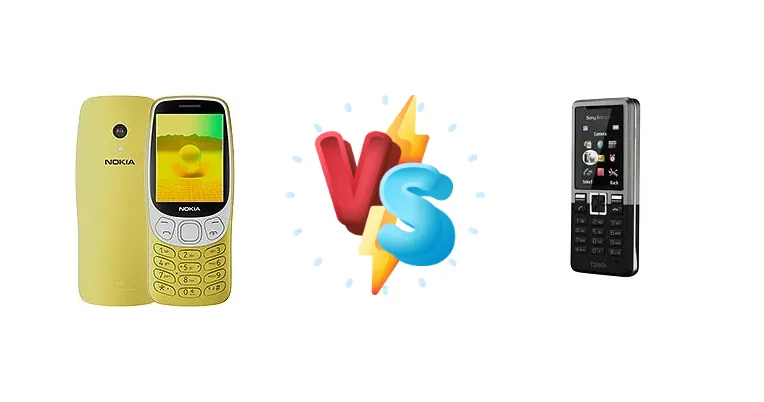
In a world dominated by smartphones, the feature phone persists, offering simplicity, durability, and exceptional battery life. We pit the modern Nokia 3210, equipped with a Unisoc processor, against the classic Sony Ericsson T280 to determine which best serves the needs of users seeking a no-frills mobile experience.
🏆 Quick Verdict
For the average user prioritizing a slightly more responsive experience and a known chipset, the Nokia 3210 emerges as the winner. Its Unisoc T107 processor, while modest, provides a measurable performance advantage over the Sony Ericsson T280, which lacks publicly available specifications, making it a less predictable choice.
| Network |
|---|
| 2G bands | GSM 850 / 900 / 1800 / 1900 | GSM 900 / 1800 - T280i |
| 3G bands | HSDPA 850 / 900 / 2100 | - |
| 4G bands | 1, 3, 5, 7, 8, 20, 28, 38, 40, 41 - International | - |
| EDGE | No | No |
| GPRS | No | Class 10 |
| Speed | HSPA, LTE | - |
| Technology | GSM / HSPA / LTE | GSM |
| | - | GSM 850 / 1900 - T280a |
| Launch |
|---|
| Announced | 2024, May 07 | 2008, January. Released 2008, May |
| Status | Available. Released 2024, May 07 | Discontinued |
| Body |
|---|
| Build | Plastic frame, plastic back | - |
| Dimensions | 122 x 52 x 13.1 mm (4.80 x 2.05 x 0.52 in) | 100 x 45 x 13 mm (3.94 x 1.77 x 0.51 in) |
| SIM | · Nano-SIM· Nano-SIM + Nano-SIM | Mini-SIM |
| Weight | - | 82 g (2.89 oz) |
| Display |
|---|
| Resolution | 240 x 320 pixels, 4:3 ratio (~167 ppi density) | 128 x 160 pixels (~121 ppi density) |
| Size | 2.4 inches, 17.8 cm2 (~28.1% screen-to-body ratio) | 1.7 inches, 9.1 cm2 (~20.2% screen-to-body ratio) |
| Type | TFT | TFT, 65K colors |
| | Dynamic font size
Softkey
Welcome message | Wallpapers, screensavers |
| Platform |
|---|
| CPU | 1.0 GHz Cortex-A7 | - |
| Chipset | Unisoc T107 (22 nm) | - |
| Memory |
|---|
| Call records | Yes | 30 received, dialed and missed calls |
| Card slot | microSDHC | No |
| Internal | 128MB 64MB RAM | 10MB |
| Phonebook | Yes | 300 contacts, Photo call |
| Main Camera |
|---|
| Features | LED flash | - |
| Single | 2 MP | 1.3 MP |
| Video | - | No |
| Sound |
|---|
| 3.5mm jack | No | No |
| 35mm jack | Yes | No |
| Alert types | Downloadable monophonic ringtones, composer | Vibration; Downloadable polyphonic, MP3 ringtones, composer |
| Loudspeaker | Yes | Yes |
| | 6 Ringing tone levels
10 Volume levels | - |
| Comms |
|---|
| Bluetooth | 5.0, A2DP | Yes |
| NFC | No | - |
| Positioning | No | No |
| Radio | Wireless FM radio | FM radio |
| USB | USB Type-C | No |
| WLAN | No | No |
| Features |
|---|
| Alarm | Yes | - |
| Browser | - | WAP 2.0/xHTML |
| Clock | Yes | - |
| Games | Yes | Yes + downloadable |
| Java | No | Yes, MIDP 2.0 |
| Languages | 11 from 35 total | - |
| Messaging | SMS, MMS, Email, IM | SMS, MMS |
| | Predictive text input
Smart messaging (Over the Air SMS)
Calculator | Organizer
Stopwatch
Predictive text input |
| Battery |
|---|
| Stand-by | - | Up to 300 h |
| Talk time | - | Up to 7 h |
| Type | Li-Ion 1450 mAh, removable | Removable Li-Po 780 mAh battery (BST-36) |
| Misc |
|---|
| Colors | Scuba Blue, Y2K Gold, Grunge Black | Silver on Black, Copper on Silver, Firmanent Blue, Blossom Pink |
| Price | € 68.49 / $ 61.22 / £ 79.99 | About 60 EUR |
| SAR EU | - | 0.96 W/kg (head) |
Nokia 3210
- Known Unisoc T107 processor offers predictable performance.
- Potentially better power efficiency due to 22nm process.
- Modern design with potentially improved display quality.
- Camera quality is limited by VGA resolution.
- Still a basic feature phone with limited functionality.
Sony Ericsson T280
- Classic Sony Ericsson brand recognition and potential durability.
- Simple and easy to use interface.
- Long battery life characteristic of feature phones.
- Lack of publicly available specifications makes performance unpredictable.
- Older hardware may exhibit signs of wear and tear.
Display Comparison
Given the era of both devices, display technology is largely comparable – likely 2.4-2.6 inch TFT LCDs with resolutions around 320x240. However, the Nokia 3210 benefits from being a more recent design, potentially incorporating slightly improved color reproduction and viewing angles. The Sony Ericsson T280’s display quality is largely dependent on its age and usage, with potential for fading or discoloration. Neither device will offer the brightness or clarity of modern smartphone displays.
Camera Comparison
Both the Nokia 3210 and Sony Ericsson T280 feature basic cameras, likely VGA resolution. Image quality will be limited by the sensor size and lack of image stabilization. Neither device is intended for serious photography; their cameras serve primarily for basic documentation. The Nokia 3210’s camera, while still low-resolution, benefits from potentially more advanced image processing algorithms due to its newer chipset, potentially resulting in slightly clearer images in good lighting conditions. The T280’s camera performance is largely dependent on the age and condition of the sensor.
Performance
The Nokia 3210’s Unisoc T107 (22nm) chipset, featuring a 1.0 GHz Cortex-A7 CPU, represents a significant, albeit modest, performance leap over the likely hardware found in the Sony Ericsson T280. While neither phone is designed for demanding tasks, the Cortex-A7 architecture allows for smoother menu navigation and faster application loading times within the feature phone environment. The 22nm process node also suggests better power efficiency compared to older manufacturing processes likely used in the T280. The lack of specific specs for the T280 makes a precise performance comparison impossible, but it’s reasonable to assume it relies on older ARM cores and a less efficient manufacturing process.
Battery Life
Both phones excel in battery life, a hallmark of feature phones. The Nokia 3210, with its Unisoc T107’s 22nm process, likely offers slightly longer standby and talk times compared to the Sony Ericsson T280. While specific battery capacities are not readily available, the Nokia 3210’s more efficient chipset translates to less power consumption during operation. Both devices can realistically achieve several days of use on a single charge with moderate usage, making them ideal for emergency situations or extended travel.
Buying Guide
Buy the Nokia 3210 if you need a reliable, basic phone with a known processor for occasional calls, texts, and simple tasks like using the FM radio. It’s ideal for emergency use or as a secondary device. Buy the Sony Ericsson T280 if you prioritize brand loyalty to Sony Ericsson and are comfortable with an unknown internal configuration, potentially valuing its build quality and historical reputation for durability.
Frequently Asked Questions
❓ Is the Nokia 3210's Unisoc T107 processor powerful enough for basic tasks like making calls and sending texts?
Yes, the Unisoc T107 is more than sufficient for core feature phone functions. While not designed for demanding applications, its Cortex-A7 architecture provides a smooth experience for calls, texts, and using the FM radio. It represents a noticeable improvement over the likely hardware in the Sony Ericsson T280.
❓ How does the battery life of the Nokia 3210 compare to the Sony Ericsson T280 in real-world usage?
Both phones offer excellent battery life, but the Nokia 3210 likely has an edge. The Unisoc T107’s 22nm process is more power-efficient than the older technology likely used in the T280. Expect several days of standby time and hours of talk time on both devices, but the Nokia 3210 may last slightly longer between charges.
❓ Can I use apps like WhatsApp on the Nokia 3210?
No, the Nokia 3210 runs on a feature phone operating system (likely Series 30+), which does not support modern smartphone applications like WhatsApp. It is designed for basic communication and functionality, not app ecosystems.