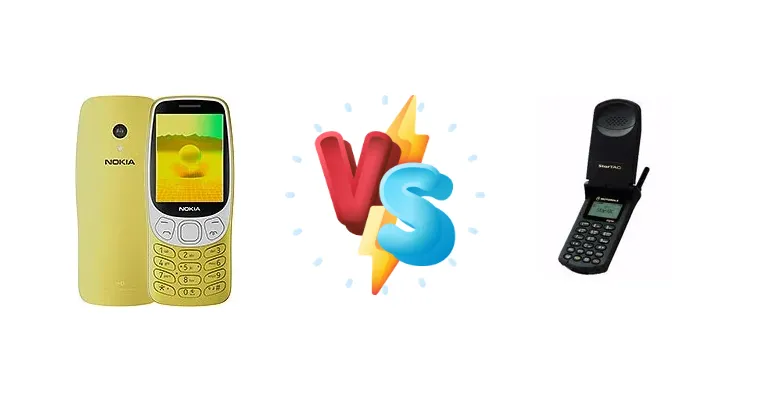
We're pitting a modern reimagining of a classic against the original trailblazer. The Nokia 3210, updated with a contemporary chipset, faces off against the Motorola StarTAC 130, a phone that defined the early mobile landscape. This isn't about raw power; it's about understanding how far mobile technology has come, and what enduring qualities define a great phone.
🏆 Quick Verdict
For the average user seeking basic connectivity and a modern feature set, the Nokia 3210 is the clear winner. Its Unisoc T107 chipset provides a level of functionality the StarTAC 130 simply cannot match. However, the StarTAC 130’s historical significance and compact design hold a unique appeal for collectors and enthusiasts.
| Network |
|---|
| 2G bands | GSM 850 / 900 / 1800 / 1900 | GSM 900 |
| 3G bands | HSDPA 850 / 900 / 2100 | - |
| 4G bands | 1, 3, 5, 7, 8, 20, 28, 38, 40, 41 - International | - |
| EDGE | No | No |
| GPRS | No | No |
| Speed | HSPA, LTE | - |
| Technology | GSM / HSPA / LTE | GSM |
| Launch |
|---|
| Announced | 2024, May 07 | 1998 |
| Status | Available. Released 2024, May 07 | Discontinued |
| Body |
|---|
| Build | Plastic frame, plastic back | - |
| Dimensions | 122 x 52 x 13.1 mm (4.80 x 2.05 x 0.52 in) | 94 x 55 x 19 mm (3.70 x 2.17 x 0.75 in) |
| SIM | · Nano-SIM· Nano-SIM + Nano-SIM | Mini-SIM |
| Weight | - | 95 g (3.35 oz) |
| Display |
|---|
| Resolution | 240 x 320 pixels, 4:3 ratio (~167 ppi density) | 4 x 15 chars |
| Size | 2.4 inches, 17.8 cm2 (~28.1% screen-to-body ratio) | - |
| Type | TFT | Monochrome graphic |
| | Dynamic font size
Softkey
Welcome message | Fixed icons |
| Platform |
|---|
| CPU | 1.0 GHz Cortex-A7 | - |
| Chipset | Unisoc T107 (22 nm) | - |
| Memory |
|---|
| Call records | Yes | 10 dialed, 5 received, 5 missed calls |
| Card slot | microSDHC | No |
| Internal | 128MB 64MB RAM | - |
| Phonebook | Yes | 100 |
| Main Camera |
|---|
| Features | LED flash | - |
| Single | 2 MP | - |
| Sound |
|---|
| 3.5mm jack | No | No |
| 35mm jack | Yes | No |
| Alert types | Downloadable monophonic ringtones, composer | Vibration; Monophonic ringtones |
| Loudspeaker | Yes | No |
| | 6 Ringing tone levels
10 Volume levels | - |
| Comms |
|---|
| Bluetooth | 5.0, A2DP | No |
| NFC | No | - |
| Positioning | No | No |
| Radio | Wireless FM radio | No |
| USB | USB Type-C | - |
| WLAN | No | No |
| Features |
|---|
| Alarm | Yes | No |
| Clock | Yes | Yes |
| Games | Yes | No |
| Java | No | No |
| Languages | 11 from 35 total | 16 |
| Messaging | SMS, MMS, Email, IM | SMS |
| | Predictive text input
Smart messaging (Over the Air SMS)
Calculator | Voice note ( 3 min )
Organizer |
| Battery |
|---|
| Stand-by | - | 50 h |
| Talk time | - | 140 min |
| Type | Li-Ion 1450 mAh, removable | Removable NiMH 500 mAh battery |
| Misc |
|---|
| Colors | Scuba Blue, Y2K Gold, Grunge Black | - |
| Price | € 68.49 / $ 61.22 / £ 79.99 | - |
Nokia 3210
- Modern chipset enables basic apps and features.
- Color display provides visual feedback.
- Improved battery life compared to vintage phones.
- Still limited in functionality compared to smartphones.
- Build quality may not match the StarTAC 130’s robustness.
Motorola StarTAC 130
- Iconic design and historical significance.
- Extremely compact and lightweight.
- Durable construction for its time.
- Limited functionality – primarily voice and SMS.
- Monochrome display.
- Short battery life by modern standards.
Display Comparison
The Nokia 3210 features a color display, a significant advancement over the monochrome screen of the StarTAC 130. While the Nokia 3210’s display resolution is likely low, it offers visual feedback for menus and basic applications. The StarTAC 130’s display, limited by the technology of its time, prioritized information density over visual appeal. Bezels on the StarTAC 130 were dictated by component size, while the Nokia 3210 benefits from modern manufacturing techniques allowing for a slightly more efficient use of space.
Camera Comparison
The Nokia 3210, depending on the specific variant, may include a basic camera. The StarTAC 130, however, did not feature a camera. This highlights a fundamental shift in mobile phone functionality – the integration of imaging capabilities. While the Nokia 3210’s camera quality would be far from modern standards, it offers a feature entirely absent in the StarTAC 130.
Performance
The Nokia 3210’s Unisoc T107 (22nm) chipset, with its 1.0 GHz Cortex-A7 CPU, represents a substantial leap in processing power compared to the StarTAC 130. The StarTAC 130’s internal architecture is largely unknown, but it was designed for voice calls and SMS messaging, lacking the capacity for even basic app execution. The 22nm fabrication process of the Unisoc T107 allows for a reasonable level of efficiency, extending battery life while enabling features like FM radio and basic games. The StarTAC 130’s performance was constrained by its era’s component limitations.
Battery Life
The Nokia 3210 benefits from modern battery technology and the efficiency of the Unisoc T107, offering significantly longer standby and talk times than the StarTAC 130. The StarTAC 130, constrained by its battery technology, prioritized a compact form factor over extended battery life. While specific mAh ratings are unavailable for both, the Nokia 3210’s 22nm chipset contributes to a more favorable power consumption profile.
Buying Guide
Buy the Nokia 3210 if you need a functional, modern 2G phone with basic apps, improved call quality, and a longer battery life. It’s ideal for emergency use, travel, or as a secondary device. Buy the Motorola StarTAC 130 if you prioritize historical significance, a truly compact form factor, and a piece of mobile technology history – accepting its limitations as a vintage device.
Frequently Asked Questions
❓ Is the Nokia 3210 capable of running modern apps like WhatsApp or Facebook?
No, the Nokia 3210’s Unisoc T107 chipset and limited memory are not sufficient to run demanding applications like WhatsApp or Facebook. It supports basic Java apps, but the experience will be significantly different from a smartphone.
❓ Can the Motorola StarTAC 130 be used on modern cellular networks?
The Motorola StarTAC 130 is a 2G-only device. As 2G networks are being phased out in many countries, its usability is becoming increasingly limited. It may still function in areas with active 2G coverage, but its long-term compatibility is uncertain.
❓ What is the primary benefit of owning a Motorola StarTAC 130 in 2024?
The primary benefit is owning a piece of mobile history. The StarTAC 130 was a groundbreaking device that popularized the clamshell form factor and represented a significant step forward in mobile technology. It's a collector's item and a conversation starter.