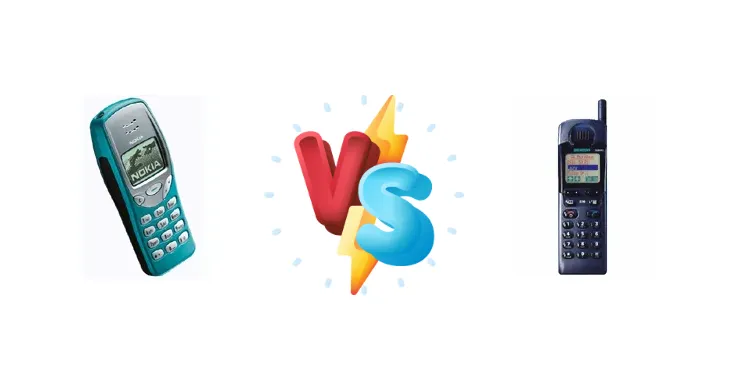
In 1999, the mobile phone landscape was rapidly evolving. The Nokia 3210 and Siemens S10 represented two distinct approaches to this new technology – Nokia focusing on mass-market appeal and customization, while Siemens aimed for a more sophisticated, business-oriented experience. This comparison revisits these iconic devices, analyzing their design, features, and lasting impact.
🏆 Quick Verdict
For the average user in 1999, the Nokia 3210 was the clear winner. Its lower price point, wider availability, and customizable features – particularly the iconic ringtones – made it a cultural phenomenon. While the Siemens S10 offered a more premium feel, its higher cost limited its reach.
| Network |
|---|
| 2G bands | GSM 900 / 1800 | GSM 900 |
| EDGE | No | No |
| GPRS | No | No |
| Technology | GSM | GSM |
| Launch |
|---|
| Announced | 1999 | 1998 |
| Status | Discontinued | Discontinued |
| Body |
|---|
| Dimensions | 123.8 x 50.5 x 16.7-22.5 mm | 147 x 46 x 25 mm, 160 cc (5.79 x 1.81 x 0.98 in) |
| SIM | Mini-SIM | Mini-SIM |
| Weight | 151 g (5.33 oz) | 185 g (6.53 oz) |
| Display |
|---|
| Resolution | 5 lines | 97 x 54 pixels, 6 lines, 16:9 ratio |
| Type | Monochrome graphic | Color graphic |
| | - | Dynamic font size
Softkey |
| Memory |
|---|
| Call records | 8 dialed, 8 received, 8 missed calls | 10 dialed, 10 received, 10 missed calls |
| Card slot | No | No |
| Phonebook | SIM only | 50 |
| Sound |
|---|
| 3.5mm jack | - | No |
| 35mm jack | No | No |
| Alert types | Downloadable monophonic ringtones, composer | Monophonic ringtones |
| Loudspeaker | No | No |
| Comms |
|---|
| Bluetooth | No | No |
| Positioning | No | No |
| Radio | No | No |
| WLAN | No | No |
| Features |
|---|
| Alarm | Yes | Yes |
| Clock | Yes | Yes |
| Games | Rotation, Snake, and Memory | No |
| Java | No | No |
| Languages | 11 from 35 total | 20 |
| Messaging | SMS | SMS |
| | - | Voice memo (20 sec)
Help function |
| Battery |
|---|
| Stand-by | - | 120 h |
| Talk time | - | 10 h |
| Type | Removable Li-Ion battery | Removable Li-Ion 1800 mAh battery |
| Misc |
|---|
| Colors | User exchangeable front and back covers | Anthracite |
Nokia 3210 (1999)
- Lower price point made it accessible to a wider audience.
- Highly customizable with interchangeable faceplates and ringtones.
- Widespread availability and strong brand recognition.
- Monochrome display limited visual appeal.
- Basic feature set compared to later models.
Siemens S10
- More refined and sophisticated design.
- Potentially slightly higher screen resolution.
- Appealed to business users seeking a more professional device.
- Higher price point limited its market reach.
- Less customizable than the Nokia 3210.
Display Comparison
Both the Nokia 3210 and Siemens S10 utilized monochrome LCD screens, typical for the era. The Nokia 3210’s screen, while similar in size to the S10’s, benefited from Nokia’s established supply chain, potentially resulting in slightly better contrast. The S10, however, may have employed a slightly higher resolution display, offering marginally sharper text, though this difference would be subtle to the naked eye. Bezels were substantial on both devices, dictated by the technology of the time.
Camera Comparison
Neither the Nokia 3210 nor the Siemens S10 featured a built-in camera. Cameras in mobile phones were still several years away from becoming mainstream. The absence of a camera highlights the primary function of these devices: communication through voice and text, not image capture.
Performance
Analyzing 'performance' in 1999 requires a different lens. Both phones relied on proprietary chipsets optimized for basic voice calls and SMS messaging. The Nokia 3210, benefiting from Nokia’s scale, likely had a more optimized software stack, resulting in slightly faster menu navigation and SMS sending speeds. The Siemens S10, targeting a business user, may have included slightly more robust memory for contact storage, but this wouldn’t translate to noticeable speed improvements in core functions. Thermal management wasn’t a concern given the low power consumption.
Battery Life
Both phones offered comparable battery life, typically several days of standby time and several hours of talk time. The Nokia 3210, with its simpler feature set, may have eked out slightly longer battery life due to lower power consumption. The Siemens S10, potentially utilizing a slightly larger battery to support its more sophisticated features, aimed to provide comparable endurance. Charging times were lengthy, requiring several hours via a proprietary charger.
Buying Guide
Buy the Nokia 3210 if you prioritized affordability, customization, and being part of a cultural movement. Its widespread adoption meant easy access to accessories and a large user base. Buy the Siemens S10 if you valued a more refined design, a slightly more business-focused feature set, and were willing to pay a premium for a more exclusive experience. It appealed to users seeking a more sophisticated mobile device.
Frequently Asked Questions
❓ What made the Nokia 3210 so popular with teenagers?
The Nokia 3210’s popularity with teenagers stemmed from its affordability, customizable faceplates, and, most importantly, its downloadable ringtones. This allowed for a level of personalization previously unavailable in mobile phones, turning it into a fashion accessory and a status symbol.
❓ Was the Siemens S10 aimed at a specific professional demographic?
Yes, the Siemens S10 was positioned as a more sophisticated device for business users. Its design and potentially slightly larger contact memory suggested a focus on professional communication, though it lacked features like email support which would become crucial later.
❓ How did the antenna design differ between the Nokia 3210 and Siemens S10?
The Nokia 3210 featured a prominent, retractable antenna, a common design element at the time. The Siemens S10, in contrast, often integrated the antenna internally, resulting in a sleeker, more compact profile, though potentially at the cost of slightly reduced signal strength.