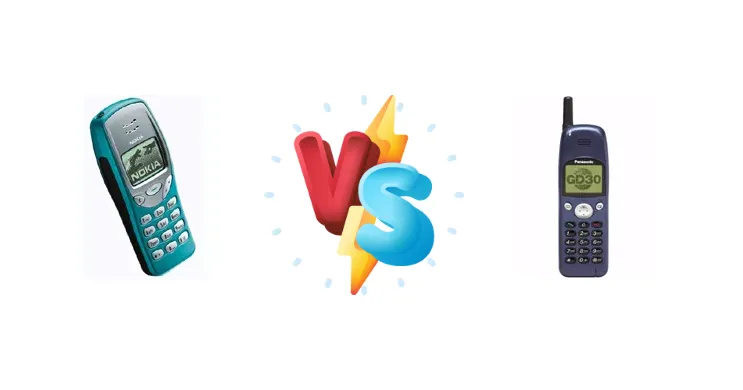
The late 1990s marked a pivotal moment in personal communication. The Nokia 3210 and Panasonic GD30, both released around the same time, represented the burgeoning consumer mobile phone market. While both aimed to deliver portability and connectivity, they approached the challenge with distinct design philosophies and feature sets, shaping the future of mobile technology. This comparison examines how these two devices defined the era.
🏆 Quick Verdict
For the average user seeking a glimpse into mobile history, the Nokia 3210 emerges as the slightly more impactful device. Its widespread adoption, iconic design, and focus on user-friendly features like messaging cemented its place in popular culture, overshadowing the GD30's more niche appeal.
| Network |
|---|
| 2G bands | GSM 900 / 1800 | GSM 900 / 1800 |
| EDGE | No | No |
| GPRS | No | No |
| Technology | GSM | GSM |
| Launch |
|---|
| Announced | 1999 | 1999 |
| Status | Discontinued | Discontinued |
| Body |
|---|
| Dimensions | 123.8 x 50.5 x 16.7-22.5 mm | 135 x 45 x 20 mm (5.31 x 1.77 x 0.79 in) |
| SIM | Mini-SIM | Mini-SIM |
| Weight | 151 g (5.33 oz) | 135 g (4.76 oz) |
| Display |
|---|
| Resolution | 5 lines | 4 x 16 chars |
| Type | Monochrome graphic | Monochrome graphic |
| Memory |
|---|
| Call records | 8 dialed, 8 received, 8 missed calls | - |
| Card slot | No | No |
| Phonebook | SIM only | 50 |
| | - | Message templates |
| Sound |
|---|
| 3.5mm jack | - | No |
| 35mm jack | No | No |
| Alert types | Downloadable monophonic ringtones, composer | Vibration; Monophonic ringtones |
| Loudspeaker | No | No |
| Comms |
|---|
| Bluetooth | No | No |
| Positioning | No | No |
| Radio | No | No |
| WLAN | No | No |
| Features |
|---|
| Alarm | Yes | Yes |
| Clock | Yes | Yes |
| Games | Rotation, Snake, and Memory | No |
| Java | No | No |
| Languages | 11 from 35 total | - |
| Messaging | SMS | SMS |
| | - | On/off timers |
| Battery |
|---|
| Stand-by | - | 90 h |
| Talk time | - | 180 min |
| Type | Removable Li-Ion battery | Removable NiMH 700 mAh battery |
| Misc |
|---|
| Colors | User exchangeable front and back covers | - |
Nokia 3210 (1999)
- Iconic and recognizable design
- Widespread availability and support
- User-friendly interface for basic functions
- Larger size compared to the GD30
- Monochrome display with no backlight
- Limited functionality beyond calls and SMS
Panasonic GD30
- Extremely compact and lightweight design
- Innovative miniaturization for the time
- Unique aesthetic appeal
- Smaller screen size
- Potentially shorter battery life
- Less cultural impact than the Nokia 3210
Display Comparison
Both the Nokia 3210 and Panasonic GD30 utilized monochrome LCD screens, typical for the era. However, the GD30’s screen was notably smaller, reflecting its emphasis on compactness. While neither device offered any form of backlight, the Nokia 3210’s slightly larger display area likely provided marginally better readability in brighter conditions. The GD30’s smaller form factor meant a denser pixel arrangement, potentially offering a slightly sharper image, though the difference would be minimal to the naked eye.
Camera Comparison
Neither the Nokia 3210 nor the Panasonic GD30 featured a built-in camera. Cameras in mobile phones were still several years away. This absence highlights the primary function of these devices: voice communication and text messaging, rather than image capture.
Performance
Analyzing 'performance' in these devices requires a different lens. Both operated on the 900/1800 MHz GSM bands, and their processing power was limited to handling basic call functions and SMS messaging. The GD30, being smaller, likely employed a more integrated chipset to minimize component size, potentially sacrificing some processing headroom compared to the 3210. However, the practical impact on user experience was negligible, as both phones were constrained by the limitations of the network and available memory.
Battery Life
Battery life was a crucial consideration in the late 90s. The Nokia 3210, with its larger size, likely housed a slightly larger battery capacity than the GD30. This, combined with potentially more efficient power management, likely translated to longer talk time and standby duration. The GD30’s compact design necessitated a smaller battery, requiring more frequent charging, a trade-off for its portability.
Buying Guide
Buy the Nokia 3210 (1999) if you prioritize cultural significance, ease of use, and a phone that embodies the spirit of early mobile communication. Buy the Panasonic GD30 if you appreciate a more compact, arguably more technologically ambitious design, and are interested in a device that pushed the boundaries of miniaturization at the time.
Frequently Asked Questions
❓ Was the Panasonic GD30 truly smaller than the Nokia 3210, and how did this affect usability?
Yes, the Panasonic GD30 was significantly smaller and lighter. While this made it more pocketable, the smaller size also meant a smaller keypad and screen, potentially making it less comfortable for users with larger fingers or those who preferred a more expansive display for reading messages.
❓ Did either phone offer any form of data connectivity beyond SMS?
Neither the Nokia 3210 nor the Panasonic GD30 supported any form of data connectivity beyond SMS. GPRS and EDGE, the precursors to 3G, were not yet widely available on consumer handsets at the time. These phones were strictly designed for voice calls and text messaging.
❓ How did the antenna design differ between the Nokia 3210 and the Panasonic GD30?
The Nokia 3210 featured a retractable antenna, a common design element for the era, providing a reasonable balance between signal strength and portability. The Panasonic GD30, in its pursuit of miniaturization, utilized a flush-mounted internal antenna. While aesthetically cleaner, this internal antenna likely offered slightly reduced signal reception compared to the 3210’s retractable design.