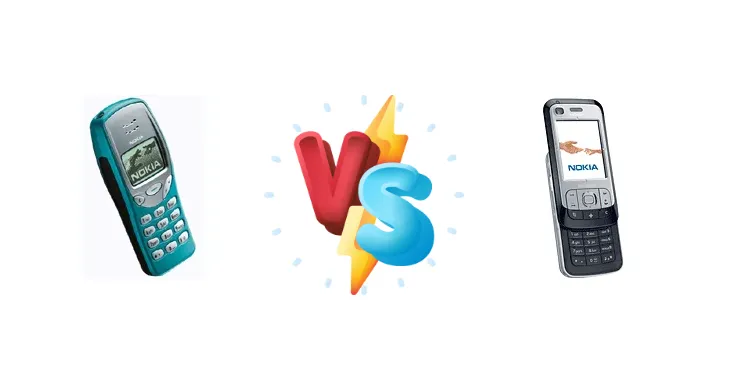
The late 1990s and early 2000s were a period of rapid innovation in mobile technology. The Nokia 3210, released in 1999, represented the peak of the feature phone era, while the 6110 Navigator, launched shortly after, signaled Nokia’s foray into the burgeoning smartphone market. This comparison examines how these two devices, both iconic in their own right, defined their respective segments and foreshadowed the future of mobile computing.
🏆 Quick Verdict
For the average user seeking a nostalgic experience, the Nokia 3210 wins due to its simplicity, robust build quality, and legendary battery life. However, the Nokia 6110 Navigator is the more forward-thinking device, offering a glimpse into the smartphone future with its S60 OS and integrated GPS, appealing to tech enthusiasts.
| Network |
|---|
| 2G bands | GSM 900 / 1800 | GSM 850 / 900 / 1800 / 1900 |
| 3G bands | - | HSDPA 2100 |
| EDGE | No | - |
| GPRS | No | - |
| Speed | - | HSPA 3.6/0.384 Mbps |
| Technology | GSM | GSM / HSPA |
| Launch |
|---|
| Announced | 1999 | 2007, February |
| Status | Discontinued | Discontinued |
| Body |
|---|
| Dimensions | 123.8 x 50.5 x 16.7-22.5 mm | 101 x 49 x 20 mm, 89 cc (3.98 x 1.93 x 0.79 in) |
| SIM | Mini-SIM | Mini-SIM |
| Weight | 151 g (5.33 oz) | 125 g (4.41 oz) |
| Display |
|---|
| Resolution | 5 lines | 240 x 320 pixels, 4:3 ratio (~182 ppi density) |
| Size | - | 2.2 inches, 15.0 cm2 (~30.3% screen-to-body ratio) |
| Type | Monochrome graphic | TFT, 16M colors |
| | - | Downloadable themes |
| Platform |
|---|
| OS | - | Symbian 9.2, S60 rel. 3.1 |
| Memory |
|---|
| Call records | 8 dialed, 8 received, 8 missed calls | - |
| Card slot | No | microSDHC (dedicated slot) |
| Internal | - | 40MB 128MB RAM |
| Phonebook | SIM only | - |
| Main Camera |
|---|
| Features | - | LED flash |
| Single | - | 2 MP |
| Video | - | 320p |
| Selfie camera |
|---|
| Single | - | VGA videocall camera |
| Sound |
|---|
| 3.5mm jack | - | No |
| 35mm jack | No | No |
| Alert types | Downloadable monophonic ringtones, composer | Vibration; Downloadable polyphonic, MP3, AAC ringtones |
| Loudspeaker | No | Yes, with stereo speakers |
| Comms |
|---|
| Bluetooth | No | 2.0, A2DP |
| Positioning | No | GPS, A-GPS; Nokia Navigator |
| Radio | No | Stereo FM radio |
| USB | - | miniUSB 2.0 |
| WLAN | No | No |
| Features |
|---|
| Alarm | Yes | - |
| Browser | - | WAP 2.0/xHTML, HTML |
| Clock | Yes | - |
| Games | Rotation, Snake, and Memory | - |
| Java | No | - |
| Languages | 11 from 35 total | - |
| Messaging | SMS | - |
| | - | Built-in maps
Push to talk
WMV/RV/MP4/3GP player
MP3/WMA/WAV/RA/AAC/M4A player
Document viewer (Word, Excel, PowerPoint, PDF)
Predictive text input
Voice command/memo
Organizer
Printing |
| Battery |
|---|
| Stand-by | - | Up to 265 h (2G) / 264 h (3G) |
| Talk time | - | Up to 3 h 30 min (2G) / 3 h 30 min (3G) |
| Type | Removable Li-Ion battery | Removable Li-Po 900 mAh battery |
| Misc |
|---|
| Colors | User exchangeable front and back covers | White, Black |
| Price | - | About 230 EUR |
| SAR | - | 1.52 W/kg (head) 0.51 W/kg (body) |
| SAR EU | - | 1.25 W/kg (head) |
| Tests |
|---|
| Audio quality | - |
Noise -75.1dB / Crosstalk -75.0dB |
| Loudspeaker | - |
Voice 65dB / Noise 65dB / Ring 72dB |
Nokia 3210 (1999)
- Exceptional battery life
- Extremely durable build quality
- Iconic and simple user interface
- Monochrome display
- Limited functionality
- No camera
Nokia 6110 Navigator
- Color display
- S60 OS with application support
- Integrated GPS navigation
- Shorter battery life
- Less durable build compared to 3210
- Slower performance than later smartphones
Display Comparison
The Nokia 3210 featured a monochrome LCD display, prioritizing battery life over visual fidelity. In contrast, the Nokia 6110 Navigator boasted a color LCD, a significant step forward for mobile displays. While neither device offered high resolution by modern standards, the 6110’s color screen enabled a richer user interface and the display of more detailed graphics, crucial for its nascent application ecosystem. The 3210’s display was optimized for readability in direct sunlight, a practical consideration for its target audience.
Camera Comparison
Neither the Nokia 3210 nor the Nokia 6110 Navigator included a built-in camera. This was typical for phones of that era. The absence of a camera highlights the different priorities of each device; the 3210 focused on core communication features and affordability, while the 6110 prioritized emerging smartphone functionalities like GPS and application support over image capture.
Performance
The Nokia 3210’s performance was dictated by its basic chipset, sufficient for calls, SMS, and the iconic Snake game. The Nokia 6110 Navigator, powered by a 32-bit RISC processor and running the S60 OS, represented a substantial leap in processing power. This allowed for multitasking, application installation, and more complex operations. The S60 OS, while primitive by today’s standards, was a fully-fledged mobile operating system, enabling developers to create and distribute applications, a key differentiator for the 6110. The 6110’s performance, however, was limited by the available RAM, a common constraint in early smartphones.
Battery Life
The Nokia 3210 was renowned for its exceptional battery life, often lasting several days on a single charge due to its low-power monochrome display and simple functionality. The Nokia 6110 Navigator, with its color screen, more powerful processor, and GPS functionality, offered significantly shorter battery life, typically lasting a day or less with moderate use. This trade-off between features and battery life was a defining characteristic of early smartphones.
Buying Guide
Buy the Nokia 3210 (1999) if you need an incredibly durable, long-lasting phone for basic communication and a taste of mobile gaming history. Buy the Nokia 6110 Navigator if you prefer a device that introduced smartphone features like application support, GPS navigation, and a more customizable user experience, even with the limitations of early smartphone technology.
Frequently Asked Questions
❓ How accurate was the GPS on the Nokia 6110 Navigator compared to modern GPS?
The GPS on the Nokia 6110 Navigator was a groundbreaking feature for its time, but its accuracy was significantly lower than modern GPS systems. It relied on older satellite technology and lacked the Assisted GPS (A-GPS) features found in contemporary smartphones, resulting in slower lock-on times and less precise positioning. It was, however, a functional navigation tool for basic route guidance.
❓ Can I still play Snake on the Nokia 3210 today?
Yes, you can! The Nokia 3210’s Snake game is a core part of its appeal. While the original hardware is required for the authentic experience, emulators are readily available for modern smartphones and computers, allowing you to relive the classic mobile gaming experience. Many re-releases of the 3210 also include Snake.
❓ What kind of applications were available for the Nokia 6110 Navigator’s S60 OS?
The S60 OS on the Nokia 6110 Navigator supported a range of applications, including basic productivity tools, games, and utilities. While the app ecosystem was limited compared to modern app stores, it allowed users to extend the functionality of their device beyond basic communication. Popular applications included dictionary apps, file managers, and early versions of mobile email clients.