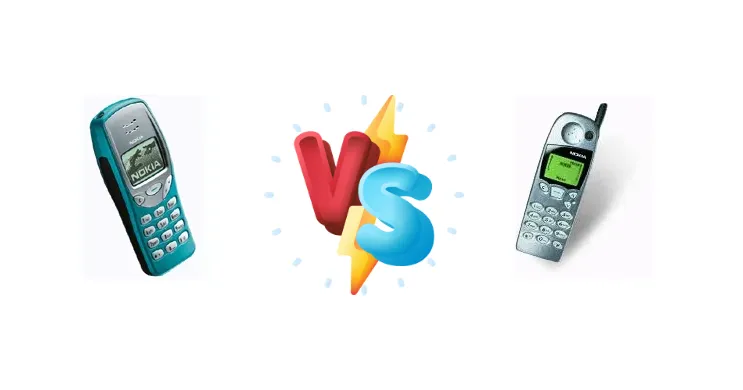
Before smartphones dominated our pockets, Nokia ruled the mobile world. The 3210 and 5110 represent pivotal moments in that era, each offering a unique blend of functionality and style. This comparison revisits these icons, analyzing their strengths and weaknesses to understand why they became cultural touchstones.
🏆 Quick Verdict
For the average user seeking a durable, reliable, and iconic piece of mobile history, the Nokia 5110 edges out the 3210. Its robust build, particularly the XQ antenna, and slightly more refined feature set made it a more practical and enduring choice for the late 90s consumer.
| Network |
|---|
| 2G bands | GSM 900 / 1800 | GSM 900 |
| EDGE | No | No |
| GPRS | No | No |
| Technology | GSM | GSM |
| Launch |
|---|
| Announced | 1999 | 1998 |
| Status | Discontinued | Discontinued |
| Body |
|---|
| Dimensions | 123.8 x 50.5 x 16.7-22.5 mm | 132 x 47.5 x 31 mm, 143 cc (5.20 x 1.87 x 1.22 in) |
| SIM | Mini-SIM | Mini-SIM |
| Weight | 151 g (5.33 oz) | 170 g (6.00 oz) |
| Display |
|---|
| Resolution | 5 lines | 5 lines |
| Type | Monochrome graphic | Monochrome graphic |
| | - | Dynamic font size
Softkey
Welcome message |
| Memory |
|---|
| Call records | 8 dialed, 8 received, 8 missed calls | 8 dialed, 5 received, 5 missed calls |
| Card slot | No | No |
| Phonebook | SIM only | SIM only |
| Sound |
|---|
| 3.5mm jack | - | No |
| 35mm jack | No | No |
| Alert types | Downloadable monophonic ringtones, composer | Downloadable monophonic ringtones |
| Loudspeaker | No | No |
| | - | 6 Ringing tone levels
10 Volume levels |
| Comms |
|---|
| Bluetooth | No | No |
| Positioning | No | No |
| Radio | No | No |
| WLAN | No | No |
| Features |
|---|
| Alarm | Yes | Yes |
| Clock | Yes | Yes |
| Games | Rotation, Snake, and Memory | 3 (Memory, Snake, Logic) |
| Java | No | No |
| Languages | 11 from 35 total | 28 |
| Messaging | SMS | SMS |
| | - | Closed user group
|
| Battery |
|---|
| Stand-by | - | 60-270 h |
| Talk time | - | 3-5 h |
| Type | Removable Li-Ion battery | Removable Li-Po 600 mAh battery |
| Misc |
|---|
| Colors | User exchangeable front and back covers | Xpress-On covers, 4 basic, 7 metallic |
Nokia 3210 (1999)
- More compact and pocketable design.
- Iconic and playful aesthetic.
- Early adopter of customizable faceplates.
- Smaller screen size.
- Potentially less durable build quality.
- Weaker antenna performance compared to the 5110.
Nokia 5110
- More robust and durable construction.
- Improved antenna performance with the XQ antenna.
- Slightly larger battery capacity.
- Larger and heavier form factor.
- Less visually striking design.
- Higher price point at launch.
Display Comparison
Both the 3210 and 5110 utilized monochrome LCD screens, typical for the period. While specific resolution details are scarce, the 5110’s display was generally perceived as slightly clearer, likely due to minor improvements in contrast ratio and pixel density. Neither phone offered backlighting, limiting usability in low-light conditions, a common constraint of the era. The 3210’s smaller overall size meant a correspondingly smaller screen, potentially impacting readability for some users.
Camera Comparison
Neither the Nokia 3210 nor the Nokia 5110 featured a built-in camera. This was standard for phones of this generation. The concept of mobile photography was still years away from becoming mainstream. Any image capture would have required external accessories, which were uncommon and expensive.
Performance
Performance, in the modern sense, is irrelevant for these devices. Both relied on a single-chip solution handling baseband processing, user interface, and limited application functionality. The 3210 was marketed as being faster in SMS sending and receiving, potentially indicating a slightly optimized software implementation or a marginally faster processor clock speed. However, the practical difference in everyday use would have been negligible. The 5110’s focus was more on reliable connectivity, suggesting resources were allocated towards radio performance.
Battery Life
Both phones utilized NiMH (Nickel-Metal Hydride) batteries, offering talk times of around 2.5 to 3 hours. The 5110, being slightly larger, could accommodate a marginally larger battery capacity, potentially providing a small advantage in standby time. However, battery life was heavily dependent on network conditions and usage patterns, particularly the frequency of SMS messaging and game playing. The 3210’s smaller size meant more frequent charging was likely for power users.
Buying Guide
Buy the Nokia 3210 (1999) if you prioritize a smaller, more compact form factor and a playful aesthetic, valuing its initial impact as a design statement. Buy the Nokia 5110 if you prefer a more rugged, durable device with improved signal reception thanks to the antenna, and a slightly more mature feature set geared towards practical communication.
Frequently Asked Questions
❓ What was the significance of the Nokia 5110's XQ antenna?
The XQ antenna was a key selling point of the Nokia 5110. It was a detachable antenna designed to improve signal reception, particularly in areas with weak coverage. This was crucial in the late 90s when network infrastructure was less developed, and reliable connectivity was a major concern for mobile users.
❓ How customizable were the Nokia 3210 and 5110?
Both phones offered a degree of customization through interchangeable faceplates. The 3210 was particularly known for its vibrant and colorful faceplate options, allowing users to personalize their device. The 5110 also had faceplate options, but they were generally more subdued in color and design.
❓ What games were popular on the Nokia 3210?
Snake II was the killer app for the Nokia 3210. Its simple yet addictive gameplay made it a cultural phenomenon. Other popular games included Space Impact and Bantuz. These games were limited by the monochrome display and basic processing power, but they provided hours of entertainment for users.