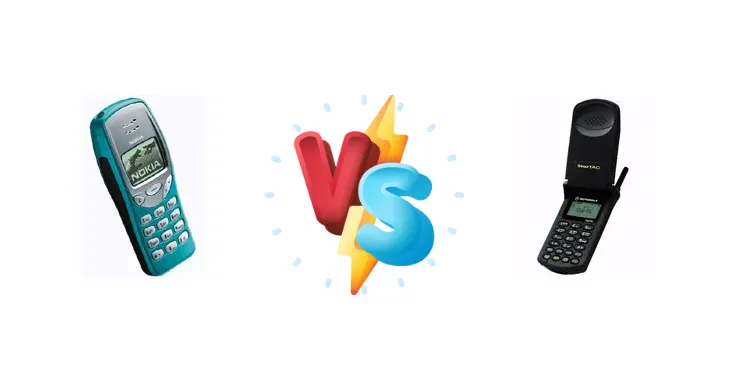
Before smartphones dominated our pockets, the Nokia 3210 and Motorola StarTAC 130 represented the pinnacle of mobile technology. Both launched in the late 1990s, but catered to slightly different user priorities – the StarTAC prioritizing size and status, while the 3210 aimed for broader accessibility and feature richness. This comparison revisits these iconic devices, analyzing their design, usability, and lasting impact.
🏆 Quick Verdict
For the average user interested in experiencing a piece of mobile history, the Nokia 3210 emerges as the more compelling choice. Its lower price point (at launch), wider availability, and inclusion of features like the Snake game made it a cultural phenomenon, overshadowing the StarTAC's premium positioning.
| Network |
|---|
| 2G bands | GSM 900 / 1800 | GSM 900 |
| EDGE | No | No |
| GPRS | No | No |
| Technology | GSM | GSM |
| Launch |
|---|
| Announced | 1999 | 1998 |
| Status | Discontinued | Discontinued |
| Body |
|---|
| Dimensions | 123.8 x 50.5 x 16.7-22.5 mm | 94 x 55 x 19 mm (3.70 x 2.17 x 0.75 in) |
| SIM | Mini-SIM | Mini-SIM |
| Weight | 151 g (5.33 oz) | 95 g (3.35 oz) |
| Display |
|---|
| Resolution | 5 lines | 4 x 15 chars |
| Type | Monochrome graphic | Monochrome graphic |
| | - | Fixed icons |
| Memory |
|---|
| Call records | 8 dialed, 8 received, 8 missed calls | 10 dialed, 5 received, 5 missed calls |
| Card slot | No | No |
| Phonebook | SIM only | 100 |
| Sound |
|---|
| 3.5mm jack | - | No |
| 35mm jack | No | No |
| Alert types | Downloadable monophonic ringtones, composer | Vibration; Monophonic ringtones |
| Loudspeaker | No | No |
| Comms |
|---|
| Bluetooth | No | No |
| Positioning | No | No |
| Radio | No | No |
| WLAN | No | No |
| Features |
|---|
| Alarm | Yes | No |
| Clock | Yes | Yes |
| Games | Rotation, Snake, and Memory | No |
| Java | No | No |
| Languages | 11 from 35 total | 16 |
| Messaging | SMS | SMS |
| | - | Voice note ( 3 min )
Organizer |
| Battery |
|---|
| Stand-by | - | 50 h |
| Talk time | - | 140 min |
| Type | Removable Li-Ion battery | Removable NiMH 500 mAh battery |
| Misc |
|---|
| Colors | User exchangeable front and back covers | - |
Nokia 3210 (1999)
- More affordable price point at launch.
- Larger battery capacity for longer talk time.
- Included the popular 'Snake' game.
- Wider availability and cultural impact.
- Larger and less stylish design.
- Monochrome display with no backlight.
Motorola StarTAC 130
- Ultra-compact and stylish clamshell design.
- Premium build quality and materials.
- Represented a status symbol in the late 90s.
- Lightweight and pocketable.
- Significantly higher price than the Nokia 3210.
- Shorter battery life.
- Smaller display.
- Limited feature set compared to the 3210.
Display Comparison
Both the Nokia 3210 and Motorola StarTAC 130 utilized monochrome LCD screens, typical for the era. However, the StarTAC’s screen was notably smaller, reflecting its emphasis on compactness. The 3210’s slightly larger display, while still limited in resolution, offered a marginally better experience for reading text messages and navigating the basic menu system. Neither device offered any form of backlight, limiting usability in low-light conditions.
Camera Comparison
Neither the Nokia 3210 nor the Motorola StarTAC 130 included a camera. Digital cameras were still expensive and bulky in 1999, and integrating one into a mobile phone was not yet feasible or considered a priority for these devices. The focus remained firmly on voice communication and text messaging.
Performance
Analyzing 'performance' in these devices is different than today. Both relied on proprietary chipsets optimized for basic voice calls and SMS messaging. The Motorola StarTAC 130, being a more premium device, likely benefited from slightly more efficient power management, contributing to its smaller size. However, the Nokia 3210’s software was arguably more refined, offering a smoother user experience, particularly with features like the address book and the aforementioned Snake game. Neither device had any capacity for app installation or data processing beyond basic functions.
Battery Life
Battery life was a critical concern for early mobile phones. The Motorola StarTAC 130, due to its smaller size, had a smaller battery capacity, resulting in shorter talk times – typically around 30-60 minutes. The Nokia 3210, with its larger form factor, could accommodate a larger battery, offering approximately 50-90 minutes of talk time. Standby times were also longer on the 3210, making it more suitable for users who didn’t make frequent calls. Both devices used NiCd or NiMH batteries, prone to memory effect and requiring careful charging habits.
Buying Guide
Buy the Nokia 3210 (1999) if you need a nostalgic experience with a focus on affordability and playful features. It’s ideal for collectors or those wanting to understand the roots of mobile gaming. Buy the Motorola StarTAC 130 if you prioritize a compact, stylish design and a sense of exclusivity, representing a status symbol of the late 90s.
Frequently Asked Questions
❓ Was the Motorola StarTAC 130 considered a luxury item at the time?
Yes, the Motorola StarTAC 130 was positioned as a premium device and carried a significantly higher price tag than competitors like the Nokia 3210. Its compact size, stylish design, and brand recognition made it a status symbol for affluent consumers in the late 1990s.
❓ How did the Nokia 3210's 'Snake' game contribute to its popularity?
The 'Snake' game was a massive cultural phenomenon. Pre-dating the widespread availability of mobile gaming, it provided a compelling and addictive entertainment experience directly on the phone. This feature significantly boosted the Nokia 3210’s appeal, particularly among younger users, and helped solidify its position as a must-have device.
❓ What type of network technology did these phones use?
Both the Nokia 3210 and Motorola StarTAC 130 operated on 2G GSM networks. This technology enabled voice calls and SMS messaging, but offered limited data capabilities compared to modern 3G, 4G, and 5G networks.