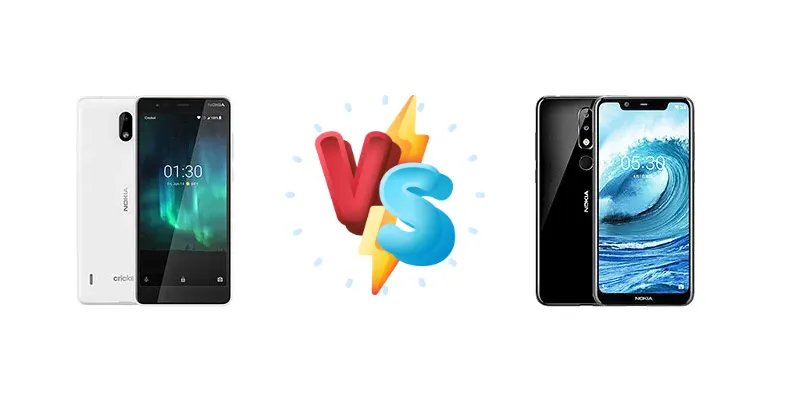
The Nokia 3.1 C and Nokia 5.1 Plus (also known as the Nokia X5 in some markets) represent two distinct approaches to the budget smartphone segment. The 3.1 C prioritizes affordability, while the 5.1 Plus aims for a more balanced experience with a more powerful chipset. This comparison dissects their key differences to determine which device delivers the best value for your money.
🏆 Quick Verdict
For most users, the Nokia 5.1 Plus (X5) is the superior choice. Its MediaTek Helio P60 chipset, featuring a combination of Cortex-A73 and A53 cores, provides a significantly faster and more responsive experience than the Nokia 3.1 C’s Snapdragon 429. While both offer similar battery charging speeds, the 5.1 Plus’s processing power justifies the potential price difference.
| Network |
|---|
| 2G bands | GSM 850 / 900 / 1800 / 1900 | GSM 850 / 900 / 1800 / 1900 |
| 3G bands | HSDPA 850 / 1700(AWS) / 1900 | HSDPA 850 / 900 / 1900 / 2100 |
| 4G bands | 2, 4, 5, 12, 14, 29, 30 | 1, 2, 3, 4, 5, 7, 8, 12, 13, 17, 28, 38, 40, 66 - USA |
| Speed | HSPA 42.2/5.76 Mbps, LTE Cat4 150/50 Mbps | HSPA 42.2/5.76 Mbps, LTE Cat4 150/50 Mbps |
| Technology | GSM / HSPA / LTE | GSM / CDMA / HSPA / LTE |
| | - | 1, 3, 5, 8, 40, 41 - India |
| Launch |
|---|
| Announced | 2019, June. Released 2019, June | 2018, July 18. Released 2018, December 05 |
| Status | Discontinued | Discontinued |
| Body |
|---|
| Build | - | Glass front, glass back, plastic frame |
| Dimensions | 152.7 x 71.9 x 9.4 mm (6.01 x 2.83 x 0.37 in) | 149.5 x 72 x 8.1 mm (5.89 x 2.83 x 0.32 in) |
| SIM | Nano-SIM | Nano-SIM + Nano-SIM |
| Weight | 156 g (5.50 oz) | 160 g (5.64 oz) |
| Display |
|---|
| Resolution | 720 x 1440 pixels, 18:9 ratio (~295 ppi density) | 720 x 1520 pixels, 19:9 ratio (~287 ppi density) |
| Size | 5.45 inches, 76.7 cm2 (~69.8% screen-to-body ratio) | 5.86 inches, 85.7 cm2 (~79.6% screen-to-body ratio) |
| Type | IPS LCD | IPS LCD |
| Platform |
|---|
| CPU | Quad-core 1.8 GHz Cortex-A53 | Octa-core (4x1.8 GHz Cortex-A73 & 4x1.8 GHz Cortex-A53) - GlobalOcta-core (4x2.0 GHz Cortex-A73 & 4x2.0 GHz Cortex-A53) - China |
| Chipset | Qualcomm SDM429 Snapdragon 429 (12 nm) | Mediatek MT6771 Helio P60 (12 nm) |
| GPU | Adreno 504 | Mali-G72 MP3 |
| OS | Android 9.0 (Pie) | Android 8.1 (Oreo), upgradable to Android 10, Android One |
| Memory |
|---|
| Card slot | microSDXC (dedicated slot) | microSDXC (uses shared SIM slot) |
| Internal | 32GB 2GB RAM | 32GB 3GB RAM, 64GB 4GB RAM, 64GB 6GB RAM |
| | eMMC 5.1 | eMMC 5.1 |
| Main Camera |
|---|
| Dual | - | 13 MP, f/2.0, PDAF
Auxiliary lens |
| Features | LED flash, HDR, panorama | LED flash, HDR, panorama |
| Single | 8 MP, f/2.0, AF | - |
| Video | 1080p@30fps | 1080p@30fps |
| Selfie camera |
|---|
| Features | HDR | - |
| Single | 5 MP, f/2.2 | 8 MP, f/2.2, 26mm (wide) |
| Video | 720p@30fps | 1080p@30fps |
| Sound |
|---|
| 3.5mm jack | Yes | Yes |
| 35mm jack | Yes | Yes |
| Loudspeaker | Yes | Yes |
| Comms |
|---|
| Bluetooth | 5.0, A2DP, LE | 4.2, A2DP, LE |
| NFC | No | No |
| Positioning | GPS, GLONASS, BDS | GPS, GLONASS, BDS, GALILEO |
| Radio | FM radio | FM radio |
| USB | USB Type-C 2.0 | USB Type-C 2.0, OTG |
| WLAN | Wi-Fi 802.11 b/g/n | Wi-Fi 802.11 a/b/g/n/ac, dual-band, Wi-Fi Direct |
| Features |
|---|
| Sensors | Accelerometer, gyro, proximity | Fingerprint (rear-mounted), accelerometer, gyro, proximity, compass |
| Battery |
|---|
| Charging | 10W wired | - |
| Type | Li-Ion 2990 mAh, non-removable | Li-Ion 3060 mAh, non-removable |
| Misc |
|---|
| Colors | White | Night black, Glacier white, Baltic sea blue |
| Models | TA-1140 | TA-1120, TA-1105, TA-1102 |
| Price | - | About 190 EUR |
| SAR | 1.11 W/kg (head) 0.81 W/kg (body) | 1.10 W/kg (head) |
| SAR EU | - | 0.78 W/kg (head) 1.89 W/kg (body) |
| Tests |
|---|
| Performance | - |
AnTuTu: 119428 (v7)
GFXBench: 7.4fps (ES 3.1 onscreen) |
Nokia 3.1 C
- Extremely affordable price point
- Potentially slightly longer battery life due to lower power chipset
- Simple and easy-to-use interface
- Significantly slower performance compared to the 5.1 Plus
- Limited multitasking capabilities
- Basic camera system
Nokia 5.1 Plus (Nokia X5)
- Much faster and more responsive performance
- Better multitasking and gaming capabilities
- More capable image signal processor
- Potentially slightly shorter battery life
- May be slightly more expensive than the 3.1 C
- Still a budget device with limitations
Display Comparison
Neither device boasts a particularly impressive display. Details regarding panel type, resolution, and brightness are absent from the provided data, suggesting both likely utilize standard IPS LCD panels common in this price bracket. The focus here isn't on visual fidelity, but rather on basic usability. Bezels are likely comparable, given the similar target market. Color accuracy is expected to be standard for budget phones, meaning it won't be color-accurate for professional work.
Camera Comparison
Without detailed camera specifications, a direct comparison is difficult. However, it’s safe to assume both phones feature basic camera setups geared towards casual photography. The absence of information regarding sensor size or aperture suggests neither device excels in low-light conditions. The Helio P60’s image signal processor (ISP) is likely more capable than the Snapdragon 429’s, potentially leading to slightly better image processing and dynamic range. Any 2MP macro or depth sensors on either device should be considered marketing features rather than significant photographic assets.
Performance
The core difference lies in the chipset. The Nokia 3.1 C’s Qualcomm Snapdragon 429, with its quad-core Cortex-A53 configuration at 1.8 GHz, is designed for basic functionality. In contrast, the Nokia 5.1 Plus (X5) utilizes the MediaTek Helio P60. This chipset’s octa-core arrangement – combining four Cortex-A73 cores at 1.8 GHz (2.0 GHz in China) with four Cortex-A53 cores – delivers a substantial performance boost. The A73 cores are significantly more powerful than the A53 cores, resulting in faster app loading times, smoother multitasking, and improved gaming performance. The Helio P60 also benefits from a more advanced GPU, further enhancing graphics capabilities. The 12nm process node used by both chipsets suggests similar power efficiency, but the Helio P60’s architectural advantages will still translate to a better overall experience.
Battery Life
Both devices feature 10W wired charging, indicating similar charging speeds. A full 0-100% charge will likely take around 2.5 to 3 hours for both. While battery capacity isn’t specified, the Snapdragon 429’s lower power consumption *could* translate to slightly longer battery life on the Nokia 3.1 C, but the Helio P60’s efficiency optimizations may mitigate this difference. The real-world impact will depend heavily on usage patterns.
Buying Guide
Buy the Nokia 3.1 C if you need an extremely affordable smartphone for basic tasks like calls, texts, and light social media use, and battery life is your absolute top priority. Buy the Nokia 5.1 Plus (Nokia X5) if you prefer a smoother, more capable experience for multitasking, moderate gaming, and a generally more responsive user interface. The 5.1 Plus is the better option for anyone who doesn't want to constantly fight with lag.
Frequently Asked Questions
❓ Will the Nokia 5.1 Plus (X5) struggle with demanding games like PUBG Mobile?
While the Helio P60 isn't a gaming powerhouse, it's capable of running PUBG Mobile at medium settings with reasonable frame rates. Expect some occasional stuttering, but it's a far more playable experience than the Snapdragon 429-powered Nokia 3.1 C, which would likely struggle even at the lowest settings.
❓ Is the difference in CPU cores (quad-core vs octa-core) really noticeable in everyday use?
Yes, the difference is significant. The Nokia 5.1 Plus’s octa-core processor, with its more powerful Cortex-A73 cores, allows for smoother app switching, faster web browsing, and a more responsive overall experience. The Nokia 3.1 C’s quad-core processor will feel sluggish when handling multiple tasks simultaneously.
❓ Does the Nokia 5.1 Plus (X5) have any software features that the 3.1 C lacks?
Both phones likely ran on a similar version of Android One at launch, offering a clean and bloatware-free experience. However, the Helio P60’s processing power allows for faster software updates and a smoother user interface overall.