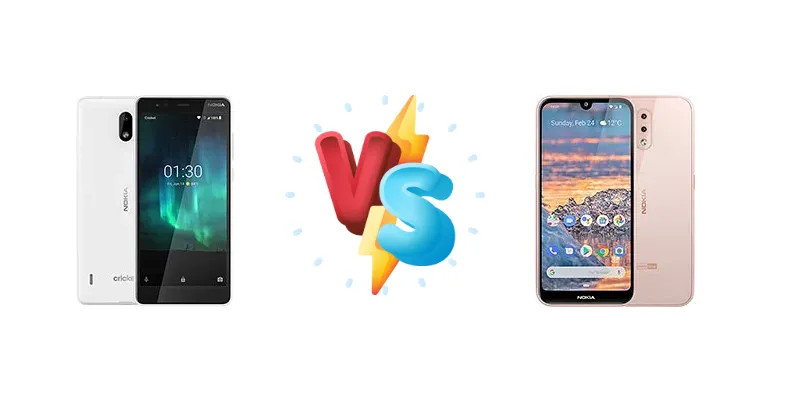
The Nokia 3.1 C and Nokia 4.2 represent Nokia's attempts to deliver affordable Android experiences. While both target the budget-conscious consumer, they differ significantly in their internal hardware, specifically the chipset. This comparison dissects those differences, focusing on how the Snapdragon 439 in the 4.2 impacts real-world performance compared to the Snapdragon 429 found in the 3.1 C.
🏆 Quick Verdict
For most users, the Nokia 4.2 is the better choice. Its octa-core Snapdragon 439 processor provides a noticeable performance boost over the quad-core 429 in the 3.1 C, making it more capable for multitasking and demanding apps. While both offer similar basic functionality, the 4.2 delivers a smoother experience.
| Network |
|---|
| 2G bands | GSM 850 / 900 / 1800 / 1900 | GSM 850 / 900 / 1800 / 1900 |
| 3G bands | HSDPA 850 / 1700(AWS) / 1900 | HSDPA 850 / 900 / 2100 - Global |
| 4G bands | 2, 4, 5, 12, 14, 29, 30 | 1, 3, 5, 7, 8, 20, 28, 38, 40, 41 - EMEA, APAC, MENA |
| Speed | HSPA 42.2/5.76 Mbps, LTE Cat4 150/50 Mbps | HSPA 42.2/5.76 Mbps, LTE Cat4 150/50 Mbps |
| Technology | GSM / HSPA / LTE | GSM / HSPA / LTE |
| | - | 1, 3, 5, 8, 40, 41 - India |
| Launch |
|---|
| Announced | 2019, June. Released 2019, June | 2019, February 24. Released 2019, May 07 |
| Status | Discontinued | Discontinued |
| Body |
|---|
| Build | - | Glass front, glass back, plastic frame |
| Dimensions | 152.7 x 71.9 x 9.4 mm (6.01 x 2.83 x 0.37 in) | 149 x 71.3 x 8.4 mm (5.87 x 2.81 x 0.33 in) |
| SIM | Nano-SIM | Nano-SIM + Nano-SIM |
| Weight | 156 g (5.50 oz) | 161 g (5.68 oz) |
| Display |
|---|
| Resolution | 720 x 1440 pixels, 18:9 ratio (~295 ppi density) | 720 x 1520 pixels, 19:9 ratio (~295 ppi density) |
| Size | 5.45 inches, 76.7 cm2 (~69.8% screen-to-body ratio) | 5.71 inches, 81.4 cm2 (~76.6% screen-to-body ratio) |
| Type | IPS LCD | IPS LCD |
| Platform |
|---|
| CPU | Quad-core 1.8 GHz Cortex-A53 | Octa-core (4x1.95 GHz Cortex-A53 & 4x1.45 GHz Cortex A53) |
| Chipset | Qualcomm SDM429 Snapdragon 429 (12 nm) | Qualcomm SDM439 Snapdragon 439 (12 nm) |
| GPU | Adreno 504 | Adreno 505 |
| OS | Android 9.0 (Pie) | Android 9.0 (Pie), upgradable to Android 11, Android One |
| Memory |
|---|
| Card slot | microSDXC (dedicated slot) | microSDXC (dedicated slot) |
| Internal | 32GB 2GB RAM | 16GB 2GB RAM, 32GB 3GB RAM |
| | eMMC 5.1 | eMMC 5.1 |
| Main Camera |
|---|
| Dual | - | 13 MP, f/2.2, 1/3.1", 1.12µm, PDAF
Auxiliary lens |
| Features | LED flash, HDR, panorama | LED flash |
| Single | 8 MP, f/2.0, AF | - |
| Video | 1080p@30fps | 1080p@30fps |
| Selfie camera |
|---|
| Features | HDR | - |
| Single | 5 MP, f/2.2 | 8 MP, f/2.0, 1/4.0", 1.12µm |
| Video | 720p@30fps | 1080p@30fps |
| Sound |
|---|
| 3.5mm jack | Yes | Yes |
| 35mm jack | Yes | Yes |
| Loudspeaker | Yes | Yes |
| Comms |
|---|
| Bluetooth | 5.0, A2DP, LE | 4.2, A2DP, LE, aptX |
| NFC | No | Yes (market dependent) |
| Positioning | GPS, GLONASS, BDS | GPS, GLONASS, BDS |
| Radio | FM radio | FM radio |
| USB | USB Type-C 2.0 | microUSB 2.0, OTG |
| WLAN | Wi-Fi 802.11 b/g/n | Wi-Fi 802.11 b/g/n |
| Features |
|---|
| Sensors | Accelerometer, gyro, proximity | Fingerprint (rear-mounted), accelerometer, proximity |
| Battery |
|---|
| Charging | 10W wired | - |
| Type | Li-Ion 2990 mAh, non-removable | Li-Ion 3000 mAh, non-removable |
| Misc |
|---|
| Colors | White | Black, Pink Sand |
| Models | TA-1140 | TA-1184, TA-1133, TA-1149, TA-1150, TA-1157, TA-1152 |
| Price | - | About 130 EUR |
| SAR | 1.11 W/kg (head) 0.81 W/kg (body) | 0.43 W/kg (head) 1.08 W/kg (body) |
| SAR EU | - | 0.45 W/kg (head) 1.53 W/kg (body) |
Nokia 3.1 C
- Most affordable option
- Reliable for basic tasks
- Simple and easy to use
- Slow performance with multitasking
- Struggles with demanding apps
- Limited future-proofing
Nokia 4.2
- Noticeably faster performance
- Better multitasking capabilities
- More responsive user experience
- Slightly higher price
- Still limited for heavy gaming
- 10W charging is slow
Display Comparison
Neither Nokia provides detailed display specifications beyond size and resolution. However, given their market positioning, both likely utilize IPS LCD panels. The key difference lies in the processing power driving the display; the Snapdragon 439’s improved GPU in the 4.2 will contribute to smoother animations and potentially faster app loading times that affect the perceived visual experience. Bezels are expected to be similar, reflecting the budget nature of both devices.
Camera Comparison
Without detailed camera specs, a direct comparison is difficult. Both phones likely feature basic camera setups geared towards casual photography. The image signal processor (ISP) within the Snapdragon 439 of the 4.2 is more advanced than the 429’s, potentially leading to slightly better image processing, particularly in low-light conditions. However, the quality will largely depend on the sensor and lens used, which are not specified in the provided data. It's safe to assume both will struggle with complex scenes or significant zoom.
Performance
The core distinction between these phones is the chipset. The Nokia 3.1 C’s Snapdragon 429 features a quad-core Cortex-A53 CPU clocked at 1.8 GHz. In contrast, the Nokia 4.2 boasts a Snapdragon 439 with an octa-core configuration – four cores at 1.95 GHz and four at 1.45 GHz. This architectural difference is significant. The 439’s eight cores allow for better parallel processing, resulting in faster app launches, smoother multitasking, and improved performance in graphically intensive applications. While both are built on a 12nm process, the 439’s core count provides a clear advantage. The 4.2 will handle more demanding tasks without the same level of slowdown experienced on the 3.1 C.
Battery Life
Both devices feature 10W wired charging. While battery capacity isn't specified, the Snapdragon 439 in the Nokia 4.2 is generally more power-efficient than the 429. This means the 4.2 could potentially offer slightly longer battery life despite potentially having a similar capacity. The 10W charging speed is slow on both devices, meaning a full charge will take a considerable amount of time – likely exceeding 3 hours.
Buying Guide
Buy the Nokia 3.1 C if you prioritize absolute affordability and only need a phone for basic tasks like calls, texts, and light social media. It's ideal for first-time smartphone users or as a reliable backup device. Buy the Nokia 4.2 if you value a more responsive user experience, enjoy occasional gaming, or frequently switch between apps. The extra processing power justifies the likely price difference for those seeking a more versatile device.
Frequently Asked Questions
❓ Will the Nokia 4.2 handle popular games like PUBG Mobile?
The Nokia 4.2 can run PUBG Mobile, but expect to play at lower graphics settings and frame rates to maintain a smooth experience. The Snapdragon 439 isn't a gaming powerhouse, and demanding titles will push its limits. The 3.1 C will struggle significantly more with PUBG.
❓ Is the difference in performance between the Snapdragon 429 and 439 noticeable in everyday use?
Yes, the difference is noticeable. While both phones can handle basic tasks, the 439 in the Nokia 4.2 provides a smoother and more responsive experience when opening apps, switching between them, and browsing the web. The 3.1 C can feel sluggish in comparison.
❓ How long will it take to fully charge both phones with the 10W charger?
Expect a full charge to take approximately 3 to 4 hours for both devices. 10W charging is a slow standard, and neither phone offers faster charging capabilities. It's best to charge them overnight.