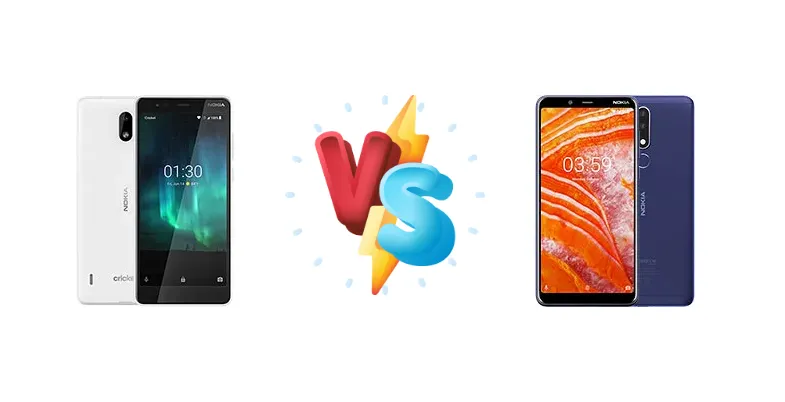
The Nokia 3.1C and 3.1 Plus represent Nokia’s attempts to deliver affordable Android experiences. While both target the entry-level market, they diverge significantly in their core processing power, offering different trade-offs for the budget-conscious consumer. This comparison dissects those differences to help you choose the right phone.
🏆 Quick Verdict
For most users, the Nokia 3.1 Plus is the better choice. Its Mediatek Helio P22 (or Snapdragon 439 in the US) offers a substantial performance uplift over the Snapdragon 429 in the 3.1C, making it more capable for multitasking and light gaming. The 3.1C remains a viable option for extremely basic use cases.
| Network |
|---|
| 2G bands | GSM 850 / 900 / 1800 / 1900 | GSM 850 / 900 / 1800 / 1900 |
| 3G bands | HSDPA 850 / 1700(AWS) / 1900 | HSDPA 850 / 900 / 1900 / 2100 |
| 4G bands | 2, 4, 5, 12, 14, 29, 30 | 2, 4, 5, 12, 14, 29, 30 - USA |
| Speed | HSPA 42.2/5.76 Mbps, LTE Cat4 150/50 Mbps | HSPA 42.2/5.76 Mbps, LTE Cat4 150/50 Mbps |
| Technology | GSM / HSPA / LTE | GSM / HSPA / LTE |
| | - | HSDPA 850 / 1700(AWS) / 1900 - USA |
| Launch |
|---|
| Announced | 2019, June. Released 2019, June | 2018, October. Released 2018, October |
| Status | Discontinued | Discontinued |
| Body |
|---|
| Build | - | Glass front, aluminum back, aluminum frame |
| Dimensions | 152.7 x 71.9 x 9.4 mm (6.01 x 2.83 x 0.37 in) | 156.9 x 76.4 x 8.2 mm (6.18 x 3.01 x 0.32 in) |
| SIM | Nano-SIM | Nano-SIM + Nano-SIM |
| Weight | 156 g (5.50 oz) | 180 g (6.35 oz) |
| Display |
|---|
| Resolution | 720 x 1440 pixels, 18:9 ratio (~295 ppi density) | 720 x 1440 pixels, 18:9 ratio (~268 ppi density) |
| Size | 5.45 inches, 76.7 cm2 (~69.8% screen-to-body ratio) | 6.0 inches, 92.9 cm2 (~77.5% screen-to-body ratio) |
| Type | IPS LCD | IPS LCD |
| Platform |
|---|
| CPU | Quad-core 1.8 GHz Cortex-A53 | Octa-core 2.0 GHz Cortex-A53 - GlobalOcta-core (4x1.95 GHz Cortex-A53 & 4x1.45 GHz Cortex A53) - USA |
| Chipset | Qualcomm SDM429 Snapdragon 429 (12 nm) | Mediatek MT6762 Helio P22 (12 nm) - GlobalQualcomm SDM439 Snapdragon 439 (12 nm) - USA |
| GPU | Adreno 504 | PowerVR GE8320 - GlobalAdreno 505 - USA |
| OS | Android 9.0 (Pie) | Android 8.1 (Oreo), upgradable to Android 10, Android One |
| Memory |
|---|
| Card slot | microSDXC (dedicated slot) | microSDXC (dedicated slot) |
| Internal | 32GB 2GB RAM | 16GB 2GB RAM, 32GB 2GB RAM, 32GB 3GB RAM |
| | eMMC 5.1 | eMMC 5.1 |
| Main Camera |
|---|
| Dual | - | 13 MP, f/2.0, AF
Auxiliary lens |
| Features | LED flash, HDR, panorama | LED flash, HDR, panorama |
| Single | 8 MP, f/2.0, AF | - |
| Video | 1080p@30fps | 1080p@30fps |
| Selfie camera |
|---|
| Features | HDR | LED flash, HDR |
| Single | 5 MP, f/2.2 | 8 MP, f/2.2 |
| Video | 720p@30fps | 720p@30fps |
| Sound |
|---|
| 3.5mm jack | Yes | Yes |
| 35mm jack | Yes | Yes |
| Loudspeaker | Yes | Yes |
| Comms |
|---|
| Bluetooth | 5.0, A2DP, LE | 4.1, A2DP, LE |
| NFC | No | Yes (USA, APAC & EMEA) |
| Positioning | GPS, GLONASS, BDS | GPS, GLONASS, BDS, GALILEO |
| Radio | FM radio | FM radio |
| USB | USB Type-C 2.0 | microUSB 2.0, OTG |
| WLAN | Wi-Fi 802.11 b/g/n | Wi-Fi 802.11 b/g/n, Wi-Fi Direct |
| Features |
|---|
| Sensors | Accelerometer, gyro, proximity | Fingerprint (rear-mounted), accelerometer, gyro, proximity, compass |
| Battery |
|---|
| Charging | 10W wired | 10W wired |
| Type | Li-Ion 2990 mAh, non-removable | Li-Ion 3500 mAh, non-removable |
| Misc |
|---|
| Colors | White | Blue, White, Gray |
| Models | TA-1140 | TA-1118, TA-1125, TA-1113, TA-1117, TA-1124, TA-1125 |
| Price | - | About 120 EUR |
| SAR | 1.11 W/kg (head) 0.81 W/kg (body) | - |
| SAR EU | - | 0.41 W/kg (head) 1.58 W/kg (body) |
Nokia 3.1 C
- Lower price point (likely)
- Simple and straightforward user experience
- Qualcomm chipset generally offers good power efficiency
- Significantly slower performance than the 3.1 Plus
- Less capable for multitasking and gaming
- Limited future-proofing
Nokia 3.1 Plus
- Faster and more responsive performance
- Better suited for multitasking and light gaming
- More capable processor (Helio P22/Snapdragon 439)
- Potentially higher price
- Mediatek chipset may have slightly less optimized software support (depending on region)
- US variant with SD439 has a dual-core cluster running at a lower clock speed
Display Comparison
Both devices utilize 12nm process technology, but the display specifications are not provided. Given their market segment, we can assume both feature LCD panels with 720p+ resolution. The lack of information prevents a detailed comparison of brightness, color accuracy, or viewing angles. However, the focus here is on internal performance, not display fidelity.
Camera Comparison
Camera specifications are not detailed enough for a meaningful comparison. Both phones likely feature basic camera setups geared towards casual photography. Without knowing sensor sizes, apertures, or image processing capabilities, it’s impossible to determine which phone captures better photos. The presence of a 2MP macro camera on either device is unlikely to significantly impact image quality.
Performance
The core difference lies in the chipset. The Nokia 3.1C is powered by the Qualcomm Snapdragon 429, a quad-core processor clocked at 1.8 GHz. In contrast, the Nokia 3.1 Plus boasts the Mediatek Helio P22 globally, or the Qualcomm Snapdragon 439 in the US. The Helio P22/SD439 is an octa-core processor clocked at 2.0 GHz (or 1.95/1.45 GHz for the US variant). This doubling of cores, coupled with a slightly higher clock speed, translates to significantly improved multitasking and application launch times. The Snapdragon 439, specifically, offers a more powerful GPU than the 429, making it better suited for light gaming. The Cortex-A53 architecture is consistent across both, meaning the performance gap is primarily due to core count and clock speed.
Battery Life
Both devices support 10W wired charging. Battery capacity is not specified, but given their similar size and target market, they likely feature batteries in the 3000-4000 mAh range. The more efficient Helio P22/SD439 in the 3.1 Plus *may* result in slightly better battery life, but the difference is unlikely to be substantial. Charging times will be comparable, taking several hours to reach a full charge.
Buying Guide
Buy the Nokia 3.1C if you prioritize absolute affordability and only need a phone for essential tasks like calls, texts, and very light web browsing. Buy the Nokia 3.1 Plus if you want a smoother, more responsive experience for everyday use, including social media, occasional gaming, and running multiple apps simultaneously. The Plus model’s extra processing power justifies the potential price difference.
Frequently Asked Questions
❓ Will the Nokia 3.1 Plus handle popular social media apps like Facebook and Instagram smoothly?
Yes, the Mediatek Helio P22 (or Snapdragon 439) in the Nokia 3.1 Plus provides enough processing power to run social media apps smoothly, with minimal lag or stuttering. The Snapdragon 429 in the 3.1C may struggle with multiple apps open simultaneously.
❓ Is the difference between the Helio P22 and Snapdragon 439 versions of the Nokia 3.1 Plus significant?
The US variant with the Snapdragon 439 features a big.LITTLE architecture with a 1.95 GHz quad-core cluster and a 1.45 GHz quad-core cluster. While still an improvement over the 3.1C, the performance is slightly lower than the globally available Helio P22, which has eight cores running at 2.0 GHz. However, the difference is unlikely to be noticeable in everyday use.
❓ Can the Nokia 3.1C run games like PUBG Mobile?
While technically possible, PUBG Mobile will likely be unplayable on the Nokia 3.1C due to the Snapdragon 429’s limited processing power and GPU. Frame rates will be extremely low, and the game will likely experience significant lag and stuttering. The 3.1 Plus offers a more playable experience, but still requires low graphics settings.