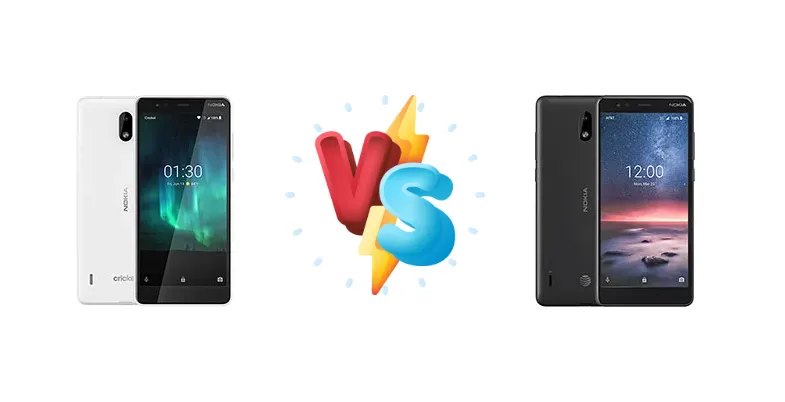
The Nokia 3.1C and 3.1A present a curious case. Both devices are positioned in the ultra-budget smartphone segment and, remarkably, share nearly identical core specifications. This comparison isn't about which phone is *better* in a technical sense, but rather which offers the most compelling value proposition given their likely market positioning and software experiences.
🏆 Quick Verdict
For the average user prioritizing pure affordability, the Nokia 3.1C likely represents the better value. Given the identical Snapdragon 429 chipset and 10W charging, the 3.1C's typically lower price point makes it the more sensible choice. The 3.1A may appeal to those seeking a slightly newer model, but the performance difference will be negligible.
| Network |
|---|
| 2G bands | GSM 850 / 900 / 1800 / 1900 | GSM 850 / 900 / 1800 / 1900 |
| 3G bands | HSDPA 850 / 1700(AWS) / 1900 | HSDPA 850 / 1700(AWS) / 1900 |
| 4G bands | 2, 4, 5, 12, 14, 29, 30 | 2, 4, 5, 12, 14, 29, 30 |
| Speed | HSPA 42.2/5.76 Mbps, LTE Cat4 150/50 Mbps | HSPA 42.2/5.76 Mbps, LTE Cat4 150/50 Mbps |
| Technology | GSM / HSPA / LTE | GSM / HSPA / LTE |
| Launch |
|---|
| Announced | 2019, June. Released 2019, June | 2019, June. Released 2019, June |
| Status | Discontinued | Discontinued |
| Body |
|---|
| Dimensions | 152.7 x 71.9 x 9.4 mm (6.01 x 2.83 x 0.37 in) | 152.7 x 71.9 x 9.4 mm (6.01 x 2.83 x 0.37 in) |
| SIM | Nano-SIM | Nano-SIM |
| Weight | 156 g (5.50 oz) | 156 g (5.50 oz) |
| Display |
|---|
| Resolution | 720 x 1440 pixels, 18:9 ratio (~295 ppi density) | 720 x 1440 pixels, 18:9 ratio (~295 ppi density) |
| Size | 5.45 inches, 76.7 cm2 (~69.8% screen-to-body ratio) | 5.45 inches, 76.7 cm2 (~69.8% screen-to-body ratio) |
| Type | IPS LCD | IPS LCD |
| Platform |
|---|
| CPU | Quad-core 1.8 GHz Cortex-A53 | Quad-core 1.8 GHz Cortex-A53 |
| Chipset | Qualcomm SDM429 Snapdragon 429 (12 nm) | Qualcomm SDM429 Snapdragon 429 (12 nm) |
| GPU | Adreno 504 | Adreno 504 |
| OS | Android 9.0 (Pie) | Android 9.0 (Pie) |
| Memory |
|---|
| Card slot | microSDXC (dedicated slot) | microSDXC (dedicated slot) |
| Internal | 32GB 2GB RAM | 32GB 2GB RAM |
| | eMMC 5.1 | eMMC 5.1 |
| Main Camera |
|---|
| Features | LED flash, HDR, panorama | LED flash, HDR, panorama |
| Single | 8 MP, f/2.0, AF | 8 MP, f/2.0, AF |
| Video | 1080p@30fps | 1080p@30fps |
| Selfie camera |
|---|
| Features | HDR | HDR |
| Single | 5 MP, f/2.2 | 5 MP, f/2.2 |
| Video | 720p@30fps | 720p@30fps |
| Sound |
|---|
| 3.5mm jack | Yes | Yes |
| 35mm jack | Yes | Yes |
| Loudspeaker | Yes | Yes |
| Comms |
|---|
| Bluetooth | 5.0, A2DP, LE | 5.0, A2DP, LE |
| NFC | No | No |
| Positioning | GPS, GLONASS, BDS | GPS, GLONASS, BDS |
| Radio | FM radio | FM radio |
| USB | USB Type-C 2.0 | USB Type-C 2.0 |
| WLAN | Wi-Fi 802.11 b/g/n | Wi-Fi 802.11 b/g/n |
| Features |
|---|
| Sensors | Accelerometer, gyro, proximity | Accelerometer, gyro, proximity |
| Battery |
|---|
| Charging | 10W wired | 10W wired |
| Type | Li-Ion 2990 mAh, non-removable | Li-Ion 2990 mAh, non-removable |
| Misc |
|---|
| Colors | White | Black |
| Models | TA-1140 | TA1140 |
| SAR | 1.11 W/kg (head) 0.81 W/kg (body) | 1.11 W/kg (head) 0.81 W/kg (body) |
Nokia 3.1 C
- Potentially newer software updates
- Slightly more recent model availability
- Identical Snapdragon 429 performance
- Likely higher price than the 3.1C
- No significant hardware advantages
Nokia 3.1 A
- Generally lower price point
- Identical Snapdragon 429 performance
- Reliable basic smartphone functionality
- May receive fewer software updates
- Older model
Display Comparison
Both the Nokia 3.1C and 3.1A utilize unspecified LCD panels, a common trait in this price bracket. Without knowing the panel's resolution, brightness (in nits), or color gamut coverage, a direct comparison is impossible. However, given the target market, we can assume both displays prioritize power efficiency over visual fidelity. Expect standard 60Hz refresh rates and likely wide bezels. The user experience will be similar on both devices, focused on readability rather than immersive viewing.
Camera Comparison
Camera specifications are not detailed enough to draw meaningful conclusions. Both phones likely feature a primary camera and potentially a depth sensor, but the sensor size, aperture, and image processing algorithms are unknown. Given the price point, image quality will likely be adequate for casual snapshots in good lighting conditions, but struggle in low-light scenarios. The absence of Optical Image Stabilization (OIS) is almost certain. Any differences in camera performance will likely stem from software processing rather than hardware capabilities.
Performance
The heart of both devices is the Qualcomm Snapdragon 429 (SDM429) fabricated on a 12nm process. This chipset features a quad-core 1.8 GHz Cortex-A53 CPU. This means performance will be virtually identical in day-to-day tasks. The 12nm process node, while not cutting-edge, provides a reasonable balance between power consumption and performance. Users should expect smooth operation for basic apps, but noticeable slowdowns with demanding multitasking or graphically intensive games. RAM capacity, which is not specified, will be a key determinant of multitasking performance; more RAM will mitigate slowdowns. The shared chipset means thermal throttling will also be comparable.
Battery Life
Both the Nokia 3.1C and 3.1A support 10W wired charging. Battery capacity is also not specified, but given the target market, we can estimate capacities around 3000-4000 mAh. With 10W charging, a full charge from 0-100% will likely take over 3 hours. Real-world battery life will depend heavily on usage patterns, but users can expect a full day of light use. The identical charging wattage and likely similar battery capacities mean there's no significant advantage for either device in this area.
Buying Guide
Buy the Nokia 3.1C if you need a functional, reliable smartphone for basic tasks like calling, texting, and light social media use, and your budget is extremely limited. Buy the Nokia 3.1A if you prefer a slightly newer device within the same ultra-budget category, potentially benefiting from minor software updates or availability, but are willing to pay a small premium for it.
Frequently Asked Questions
❓ Will the Snapdragon 429 handle popular apps like WhatsApp and Facebook smoothly?
Yes, the Snapdragon 429 is capable of running apps like WhatsApp and Facebook without significant issues. However, expect some slowdowns when multitasking or using multiple apps simultaneously, especially if the device has limited RAM.
❓ How long will it take to fully charge the Nokia 3.1C or 3.1A with the 10W charger?
With the 10W charger, a full charge from 0% to 100% will likely take between 3 to 4 hours. This is typical for budget smartphones with lower charging wattage.
❓ Can either of these phones play PUBG Mobile?
PUBG Mobile is likely playable on the Nokia 3.1C and 3.1A, but only at the lowest graphics settings and frame rates. Expect significant frame drops and a less-than-optimal gaming experience due to the Snapdragon 429's limited processing power.