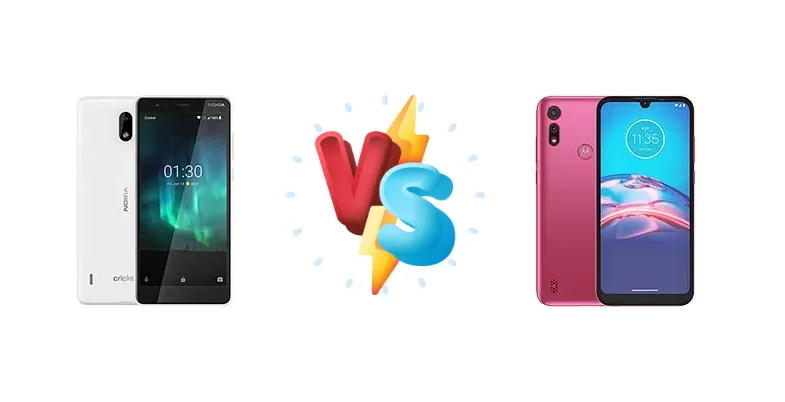
The Nokia 3.1 C and Motorola Moto E6i represent the absolute bottom end of the smartphone market, targeting users prioritizing affordability above all else. Both devices aim to deliver a functional Android experience without breaking the bank, but they achieve this with significantly different hardware approaches. This comparison dissects those differences to determine which phone offers the best value for the money.
🏆 Quick Verdict
For the average user seeking a reliable, if basic, smartphone experience, the Nokia 3.1 C emerges as the slightly better choice. Its Qualcomm Snapdragon 429, built on a more efficient 12nm process, offers a smoother and more consistent experience than the Unisoc SC9863A in the Moto E6i, despite the latter's octa-core configuration.
| Network |
|---|
| 2G bands | GSM 850 / 900 / 1800 / 1900 | GSM 850 / 900 / 1800 / 1900 |
| 3G bands | HSDPA 850 / 1700(AWS) / 1900 | HSDPA 850 / 900 / 1700(AWS) / 1900 / 2100 |
| 4G bands | 2, 4, 5, 12, 14, 29, 30 | 1, 2, 3, 4, 5, 7, 8, 19, 28, 66 |
| Speed | HSPA 42.2/5.76 Mbps, LTE Cat4 150/50 Mbps | HSPA, LTE |
| Technology | GSM / HSPA / LTE | GSM / HSPA / LTE |
| Launch |
|---|
| Announced | 2019, June. Released 2019, June | 2021, February 11 |
| Status | Discontinued | Available. Released 2021, February 11 |
| Body |
|---|
| Build | - | Glass front, plastic back, plastic frame |
| Dimensions | 152.7 x 71.9 x 9.4 mm (6.01 x 2.83 x 0.37 in) | 155.6 x 73 x 8.5 mm (6.13 x 2.87 x 0.33 in) |
| SIM | Nano-SIM | Nano-SIM + Nano-SIM |
| Weight | 156 g (5.50 oz) | 160 g (5.64 oz) |
| Display |
|---|
| Resolution | 720 x 1440 pixels, 18:9 ratio (~295 ppi density) | 720 x 1560 pixels, 19.5:9 ratio (~282 ppi density) |
| Size | 5.45 inches, 76.7 cm2 (~69.8% screen-to-body ratio) | 6.1 inches, 91.3 cm2 (~80.4% screen-to-body ratio) |
| Type | IPS LCD | IPS LCD |
| Platform |
|---|
| CPU | Quad-core 1.8 GHz Cortex-A53 | Octa-core (4x1.6 GHz Cortex-A55 & 4x1.2 GHz Cortex-A55) |
| Chipset | Qualcomm SDM429 Snapdragon 429 (12 nm) | Unisoc SC9863A (28 nm) |
| GPU | Adreno 504 | IMG8322 |
| OS | Android 9.0 (Pie) | Android 10 (Go edition) |
| Memory |
|---|
| Card slot | microSDXC (dedicated slot) | microSDXC (uses shared SIM slot) |
| Internal | 32GB 2GB RAM | 32GB 2GB RAM |
| | eMMC 5.1 | eMMC 5.1 |
| Main Camera |
|---|
| Dual | - | 13 MP, f/2.2, 26mm (wide), 1/3.1", 1.12µm, PDAF
Auxiliary lens |
| Features | LED flash, HDR, panorama | LED flash, HDR, panorama |
| Single | 8 MP, f/2.0, AF | - |
| Video | 1080p@30fps | 1080p@30fps |
| Selfie camera |
|---|
| Features | HDR | - |
| Single | 5 MP, f/2.2 | 5 MP, f/2.2, 27mm (wide), 1.12µm |
| Video | 720p@30fps | 1080p@30fps |
| Sound |
|---|
| 3.5mm jack | Yes | Yes |
| 35mm jack | Yes | Yes |
| Loudspeaker | Yes | Yes |
| Comms |
|---|
| Bluetooth | 5.0, A2DP, LE | 4.2, A2DP, LE |
| NFC | No | No |
| Positioning | GPS, GLONASS, BDS | GPS, GLONASS |
| Radio | FM radio | Unspecified |
| USB | USB Type-C 2.0 | microUSB 2.0, OTG |
| WLAN | Wi-Fi 802.11 b/g/n | Wi-Fi 802.11 b/g/n |
| Features |
|---|
| Sensors | Accelerometer, gyro, proximity | Fingerprint (rear-mounted), accelerometer, proximity |
| Battery |
|---|
| Charging | 10W wired | 10W wired |
| Type | Li-Ion 2990 mAh, non-removable | Li-Ion 3000 mAh |
| Misc |
|---|
| Colors | White | Titanium Gray, Pink |
| Models | TA-1140 | XT2053-5 |
| Price | - | About 170 EUR |
| SAR | 1.11 W/kg (head) 0.81 W/kg (body) | - |
Nokia 3.1 C
- More efficient Snapdragon 429 processor
- Potentially smoother user experience
- Likely better long-term software support (Nokia's reputation)
- Quad-core CPU vs. octa-core on the Moto E6i
- Limited camera capabilities
Motorola Moto E6i
- Lower price point (typically)
- Octa-core CPU (theoretical multi-tasking advantage)
- May include additional software features
- Less efficient Unisoc processor
- Potentially slower performance in demanding tasks
- Questionable long-term software support
Display Comparison
Neither device boasts a standout display. Details regarding panel type, resolution, and brightness are generally unavailable for phones in this segment. However, the focus should be on usability, not visual fidelity. Both will likely feature low-resolution LCD panels. The absence of detailed display specs highlights the cost-cutting measures taken on both sides.
Camera Comparison
Camera performance on both devices will be limited. Details on sensor size and image processing are scarce. Expect basic image quality suitable for casual snapshots in good lighting conditions. The presence of a 2MP macro camera on the Moto E6i is largely a marketing gimmick; its limited resolution offers minimal practical benefit. The Nokia 3.1 C's camera is likely to be similarly constrained, focusing on basic functionality rather than advanced features.
Performance
The core difference lies in the chipsets. The Nokia 3.1 C utilizes the Qualcomm Snapdragon 429, a quad-core processor built on a 12nm process. This smaller node generally translates to better power efficiency and thermal management compared to the Motorola Moto E6i’s Unisoc SC9863A, which is fabricated on a larger 28nm process. While the Moto E6i boasts an octa-core CPU (4x1.6 GHz Cortex-A55 & 4x1.2 GHz Cortex-A55), the Cortex-A53 cores in the Snapdragon 429 are generally more capable per core. The Unisoc chip's reliance on slower Cortex-A55 cores for half of its processing power suggests it's optimized for efficiency rather than raw speed. This means the Nokia 3.1 C will likely offer a smoother experience during everyday tasks and app switching.
Battery Life
Both phones feature 10W wired charging, indicating similar charging speeds. Battery capacity details are not provided, but given the target market, both are likely to house batteries in the 3000-4000 mAh range. The Snapdragon 429’s superior power efficiency in the Nokia 3.1 C could translate to slightly longer battery life, offsetting any potential capacity differences. Real-world usage will heavily depend on individual usage patterns, but the Nokia 3.1 C has a slight edge in this area.
Buying Guide
Buy the Nokia 3.1 C if you prioritize a more responsive user interface and slightly better long-term performance, even if it means sacrificing the theoretical multi-core advantage of the Moto E6i. Buy the Motorola Moto E6i if you are looking for the absolute lowest price point and are willing to accept occasional slowdowns and potentially lower software support longevity. Both are suitable for basic communication and light app usage.
Frequently Asked Questions
❓ Will the Unisoc SC9863A in the Moto E6i struggle with popular apps like Facebook or WhatsApp?
While the Moto E6i can run these apps, the Unisoc SC9863A's lower processing power and less efficient architecture may result in noticeable slowdowns, especially when multitasking or using the apps for extended periods. The Nokia 3.1 C's Snapdragon 429 is more likely to handle these apps smoothly.
❓ Is the software experience significantly different between the Nokia 3.1 C and the Motorola Moto E6i?
The Nokia 3.1 C typically runs a cleaner version of Android, often participating in the Android One program, which guarantees faster updates and a bloatware-free experience. Motorola's software includes some custom features, but it may also include pre-installed apps (bloatware) and potentially slower update cycles.
❓ Can either of these phones handle basic mobile gaming?
Both phones can handle very basic 2D games, but don't expect a smooth experience with more demanding titles. The Snapdragon 429 in the Nokia 3.1 C will likely offer slightly better performance in games, but frame rates will still be low and graphics settings will need to be minimized.