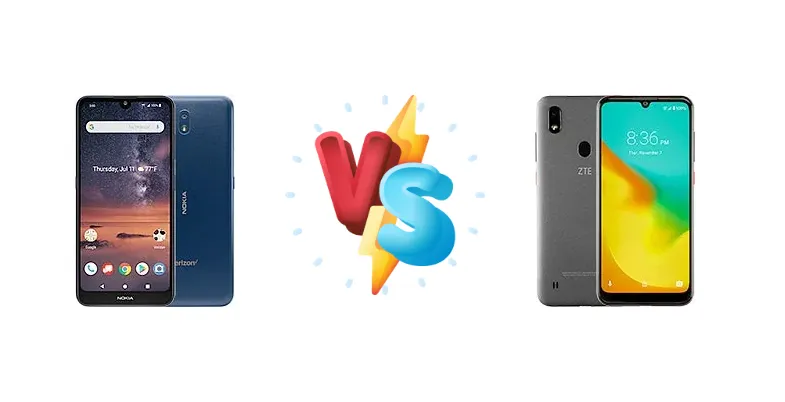
The Nokia 3 V and ZTE Blade A7 Prime represent the very bottom end of the smartphone market, targeting users prioritizing affordability above all else. Both devices run Android (likely Go Edition given the specs) and aim to provide a functional smartphone experience without breaking the bank. This comparison dissects their core components to determine which offers the best value for the money.
🏆 Quick Verdict
For the average user, the ZTE Blade A7 Prime edges out the Nokia 3 V. While both offer similar basic functionality, the A7 Prime’s slightly faster 2.0 GHz CPU provides a marginally smoother experience for everyday tasks, making it a better choice for those prioritizing responsiveness on a tight budget.
| Network |
|---|
| 2G bands | GSM 850 / 900 / 1800 / 1900 | GSM 850 / 900 / 1800 / 1900 |
| 3G bands | HSDPA 850 / 900 / 1700(AWS) / 1900 / 2100 | HSDPA 850 / 1700(AWS) / 1900 / 2100 |
| 4G bands | 1, 2, 4, 5, 8, 13 | 2, 4, 5, 13 |
| Speed | HSPA 42.2/5.76 Mbps, LTE Cat4 150/50 Mbps | HSPA 42.2/5.76 Mbps, LTE Cat4 150/50 Mbps |
| Technology | GSM / HSPA / LTE | GSM / HSPA / LTE |
| Launch |
|---|
| Announced | 2020, August 20. Released 2019, August 23 | 2019, November. Released 2019, November |
| Status | Discontinued | Discontinued |
| Body |
|---|
| Build | Glass front, plastic back, plastic frame | Glass front, plastic back, plastic frame |
| Dimensions | 161.2 x 76.2 x 9.1 mm (6.35 x 3.00 x 0.36 in) | 156.7 x 72.9 x 8.1 mm (6.17 x 2.87 x 0.32 in) |
| SIM | Nano-SIM | Nano-SIM + Nano-SIM |
| Weight | 188.6 g (6.67 oz) | 165 g (5.82 oz) |
| Display |
|---|
| Resolution | 720 x 1520 pixels, 19:9 ratio (~269 ppi density) | 720 x 1560 pixels, 19.5:9 ratio (~282 ppi density) |
| Size | 6.26 inches, 97.8 cm2 (~79.6% screen-to-body ratio) | 6.09 inches, 91.0 cm2 (~79.7% screen-to-body ratio) |
| Type | IPS LCD | IPS LCD |
| Platform |
|---|
| CPU | Quad-core 1.8 GHz Cortex-A53 | Quad-core 2.0 GHz Cortex-A53 |
| Chipset | Qualcomm SDM429 Snapdragon 429 (12 nm) | Mediatek MT6761 Helio A22 (12 nm) |
| GPU | Adreno 504 | PowerVR GE8320 |
| OS | Android 9.0 (Pie), upgradable to Android 10, Android One | Android 9.0 (Pie) |
| Memory |
|---|
| Card slot | microSDXC (dedicated slot) | microSDXC (uses shared SIM slot) |
| Internal | 16GB 2GB RAM | 32GB 3GB RAM |
| | eMMC 5.1 | eMMC 5.1 |
| Main Camera |
|---|
| Features | LED flash | LED flash, HDR, panorama |
| Single | 13 MP, f/2.2, 1/3.1", 1.12µm, AF | 16 MP, f/2.0, PDAF |
| Video | 1080p@30fps | 1080p@30fps |
| Selfie camera |
|---|
| Single | 5 MP, f/2.2, 27mm (wide), 1/5.0", 1.12µm | 5 MP, f/2.2 |
| Sound |
|---|
| 3.5mm jack | Yes | Yes |
| 35mm jack | Yes | Yes |
| Loudspeaker | Yes | Yes |
| Comms |
|---|
| Bluetooth | 4.2, A2DP, LE, aptX | 4.2, A2DP, LE |
| NFC | No | No |
| Positioning | GPS, GLONASS, BDS | GPS |
| Radio | FM radio | FM radio |
| USB | microUSB 2.0, OTG | USB Type-C 2.0 |
| WLAN | Wi-Fi 802.11 b/g/n | Wi-Fi 802.11 b/g/n |
| Features |
|---|
| Sensors | Accelerometer, proximity | Fingerprint (rear-mounted), accelerometer, proximity |
| Battery |
|---|
| Charging | 10W wired | - |
| Type | Li-Ion 4000 mAh | Li-Po 3200 mAh, non-removable |
| Misc |
|---|
| Colors | Blue | Silver |
| Price | About 140 EUR | About 90 EUR |
Nokia 3 V
- Qualcomm chipset generally offers better software support.
- Potentially slightly better image processing due to Qualcomm ISP.
- Nokia’s reputation for clean Android experience.
- Slightly slower CPU clock speed compared to the ZTE.
- Likely similar battery life to the ZTE despite less powerful CPU.
ZTE Blade A7 Prime
- Faster CPU clock speed for slightly improved responsiveness.
- Potentially longer battery life due to more efficient CPU.
- Often available at a lower price point.
- MediaTek chipsets sometimes receive less frequent software updates.
- ZTE’s software experience may be less refined than Nokia’s.
Display Comparison
Neither device boasts a standout display. Given the price point, both likely utilize LCD panels with 720p+ resolutions. Without specific brightness or color gamut data, it’s safe to assume both offer adequate, but not exceptional, viewing experiences. The focus here is on functionality, not visual fidelity. Bezels are likely substantial on both devices, maximizing screen real estate within a compact form factor.
Camera Comparison
Camera performance on both devices will be basic. Without sensor size or aperture information, it’s difficult to make definitive claims. However, given the target market, both likely feature low-resolution primary sensors paired with auxiliary lenses of questionable utility. Image quality will be acceptable in good lighting conditions, but expect significant noise and a lack of detail in low light. Focusing on the chipset’s image signal processor (ISP) capabilities, Qualcomm’s ISP generally offers slightly better image processing, potentially giving the Nokia 3 V a marginal edge in image quality, but this is unlikely to be significant.
Performance
The core difference lies in the chipsets: the Nokia 3 V uses the Qualcomm Snapdragon 429, while the ZTE Blade A7 Prime employs the MediaTek Helio A22. Both are 12nm chips, indicating similar power efficiency. However, the Helio A22 boasts a 2.0 GHz clock speed compared to the Snapdragon 429’s 1.8 GHz. While both CPUs utilize Cortex-A53 cores, the higher clock speed of the A22 translates to a slight performance advantage in CPU-bound tasks. This difference will be most noticeable when opening apps or multitasking. The Snapdragon 429’s Adreno 504 GPU is generally considered slightly more capable than the Helio A22’s PowerVR GE8320, but both are limited in their gaming capabilities, best suited for light titles.
Battery Life
Both devices feature modest battery capacities, and 10W wired charging. The actual battery life will depend heavily on usage patterns. The slightly more efficient Helio A22 in the ZTE Blade A7 Prime *could* translate to marginally longer battery life, but the difference is unlikely to be substantial. Expect both phones to comfortably last a full day with light to moderate use, but heavy users will likely need to top up before the end of the day. The 10W charging will result in relatively slow charging times – expect several hours to reach a full charge.
Buying Guide
Buy the Nokia 3 V if you prioritize brand reputation and potential software update longevity, as Nokia generally offers a cleaner Android experience and more consistent updates within this segment. Buy the ZTE Blade A7 Prime if you prefer a slightly more responsive user experience for basic tasks like browsing and social media, and are comfortable with a potentially less refined software experience.
Frequently Asked Questions
❓ Will the ZTE Blade A7 Prime struggle with popular social media apps like Facebook and Instagram?
While the Helio A22 can handle basic social media tasks, expect some lag when scrolling through image-heavy feeds or loading videos. The phone isn't designed for intensive multitasking, so keeping other apps closed will improve performance.
❓ Is the Nokia 3 V a good choice for playing mobile games?
The Snapdragon 429 is capable of running some light mobile games, but don't expect a smooth experience with graphically demanding titles like PUBG or Fortnite. Frame rates will likely be low, and you may encounter stuttering. It's best suited for casual gaming.
❓ How long will software updates be supported on the Nokia 3 V?
Nokia typically provides at least two years of security updates for its budget smartphones. However, major Android version updates are less common in this price segment. Expect to receive security patches for a reasonable period, but don't count on upgrading to the latest Android version.
❓ Does the ZTE Blade A7 Prime support fast charging?
No, the ZTE Blade A7 Prime only supports 10W wired charging. This is a relatively slow charging speed, so it will take several hours to fully charge the device from 0%.