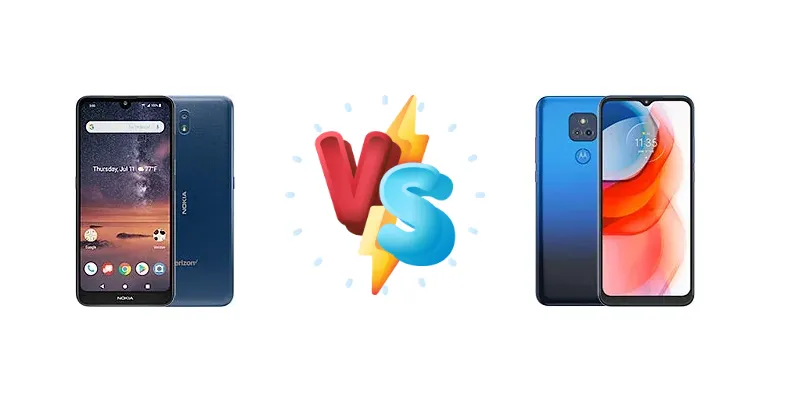
The Nokia 3 V and Motorola Moto G Play (2021) represent the ultra-budget end of the Android spectrum. Both aim to deliver smartphone functionality at the lowest possible price, but they achieve this with different approaches to processing power. This comparison dissects the core differences between the Qualcomm Snapdragon 429 powering the Nokia 3 V and the Snapdragon 460 in the Moto G Play, revealing which device offers the better user experience.
🏆 Quick Verdict
For most users, the Motorola Moto G Play (2021) is the superior choice. Its Snapdragon 460, with its octa-core configuration, provides a noticeable performance uplift over the Nokia 3 V’s quad-core Snapdragon 429. While both offer 10W charging, the G Play’s more capable chipset translates to smoother multitasking and a more responsive overall experience.
| Network |
|---|
| 2G bands | GSM 850 / 900 / 1800 / 1900 | GSM 850 / 900 / 1800 / 1900 |
| 3G bands | HSDPA 850 / 900 / 1700(AWS) / 1900 / 2100 | HSDPA 850 / 900 / 1700(AWS) / 1900 / 2100 |
| 4G bands | 1, 2, 4, 5, 8, 13 | 1, 2, 3, 4, 5, 7, 8, 12, 13, 17, 25, 26, 38, 41, 66, 71 |
| Speed | HSPA 42.2/5.76 Mbps, LTE Cat4 150/50 Mbps | HSPA, LTE |
| Technology | GSM / HSPA / LTE | GSM / CDMA / HSPA / LTE |
| | - | 2, 4, 5, 12, 14, 30, 66 |
| Launch |
|---|
| Announced | 2020, August 20. Released 2019, August 23 | 2021, January 08 |
| Status | Discontinued | Available. Released 2021, January 14 |
| Body |
|---|
| Build | Glass front, plastic back, plastic frame | Plastic frame, plastic back |
| Dimensions | 161.2 x 76.2 x 9.1 mm (6.35 x 3.00 x 0.36 in) | 166.6 x 76 x 9.4 mm (6.56 x 2.99 x 0.37 in) |
| SIM | Nano-SIM | Nano-SIM |
| Weight | 188.6 g (6.67 oz) | 204 g (7.20 oz) |
| | - | Water-repellent coating |
| Display |
|---|
| Resolution | 720 x 1520 pixels, 19:9 ratio (~269 ppi density) | 720 x 1600 pixels, 20:9 ratio (~270 ppi density) |
| Size | 6.26 inches, 97.8 cm2 (~79.6% screen-to-body ratio) | 6.5 inches, 102.0 cm2 (~80.6% screen-to-body ratio) |
| Type | IPS LCD | IPS LCD |
| Platform |
|---|
| CPU | Quad-core 1.8 GHz Cortex-A53 | Octa-core (4x1.8 GHz Kryo 240 & 4x1.6 GHz Kryo 240) |
| Chipset | Qualcomm SDM429 Snapdragon 429 (12 nm) | Qualcomm SM4250 Snapdragon 460 (11 nm) |
| GPU | Adreno 504 | Adreno 610 |
| OS | Android 9.0 (Pie), upgradable to Android 10, Android One | Android 10 |
| Memory |
|---|
| Card slot | microSDXC (dedicated slot) | microSDXC (dedicated slot) |
| Internal | 16GB 2GB RAM | 32GB 3GB RAM |
| | eMMC 5.1 | eMMC 5.1 |
| Main Camera |
|---|
| Dual | - | 13 MP, f/2.0, (wide), 1/3.1", 1.12µm, PDAF
Auxiliary lens |
| Features | LED flash | LED flash, HDR, panorama |
| Single | 13 MP, f/2.2, 1/3.1", 1.12µm, AF | - |
| Video | 1080p@30fps | 1080p@30/60fps |
| Selfie camera |
|---|
| Features | - | HDR |
| Single | 5 MP, f/2.2, 27mm (wide), 1/5.0", 1.12µm | 5 MP, f/2.2, (wide), 1.12µm |
| Video | - | 1080p@30fps |
| Sound |
|---|
| 3.5mm jack | Yes | Yes |
| 35mm jack | Yes | Yes |
| Loudspeaker | Yes | Yes |
| Comms |
|---|
| Bluetooth | 4.2, A2DP, LE, aptX | 5.0, A2DP, LE |
| NFC | No | No |
| Positioning | GPS, GLONASS, BDS | GPS, GLONASS, GALILEO |
| Radio | FM radio | Unspecified |
| USB | microUSB 2.0, OTG | USB Type-C 2.0 |
| WLAN | Wi-Fi 802.11 b/g/n | Wi-Fi 802.11 a/b/g/n/ac, dual-band, Wi-Fi Direct |
| Features |
|---|
| Sensors | Accelerometer, proximity | Fingerprint (rear-mounted), accelerometer, proximity |
| Battery |
|---|
| Charging | 10W wired | 10W wired |
| Type | Li-Ion 4000 mAh | Li-Po 5000 mAh |
| Misc |
|---|
| Colors | Blue | Misty Blue |
| Models | - | XT2093-3, XT2093-7, XT2093-DL, XT2093DL |
| Price | About 140 EUR | About 60 EUR |
Nokia 3 V
- Potentially cleaner software experience (depending on updates)
- Reliable for basic tasks
- Lower price point (potentially)
- Significantly slower performance
- Less efficient processor
- Limited multitasking capabilities
Motorola Moto G Play (2021)
- Faster and more responsive performance
- More efficient processor (Snapdragon 460)
- Better multitasking capabilities
- Motorola’s software additions (potentially bloatware)
- May be slightly more expensive
- Similar slow charging speed
Display Comparison
Neither device boasts a standout display. Both likely utilize LCD panels, typical for this price bracket. The key difference lies under the hood: processing power impacts UI responsiveness, which *feels* like a display improvement. We lack specific brightness or color accuracy data, but given the target market, expect both to prioritize power efficiency over visual fidelity. Bezels are likely comparable, being substantial on both to minimize costs.
Camera Comparison
Both phones likely feature basic camera setups, and detailed specs are unavailable. It’s safe to assume both will struggle in low-light conditions. The focus should be on the image processing capabilities of the Snapdragon 460 in the Moto G Play, which *may* offer slightly better noise reduction and dynamic range. Any claims of advanced features on either device should be viewed skeptically; the priority at this price point is functionality, not photographic excellence. The presence of a 2MP macro lens on either device is largely a marketing gimmick.
Performance
The Motorola Moto G Play (2021) holds a significant advantage here. The Snapdragon 460’s octa-core CPU (4x1.8 GHz Kryo 240 & 4x1.6 GHz Kryo 240) is a substantial upgrade over the Nokia 3 V’s quad-core 1.8 GHz Cortex-A53. The 460’s 11nm process node is also more efficient than the 429’s 12nm node, potentially leading to better battery life under load. This translates to faster app loading times, smoother scrolling, and a more responsive user interface on the Moto G Play. Users who engage in even light multitasking will appreciate the extra cores.
Battery Life
Both devices are equipped with 10W wired charging, indicating a similar charging experience – expect over 3 hours for a full charge. While battery capacity isn’t specified, the Snapdragon 460’s improved efficiency in the Moto G Play could translate to slightly longer battery life, especially during moderate to heavy use. The 11nm process node contributes to this efficiency, allowing the phone to perform tasks with less power consumption.
Buying Guide
Buy the Nokia 3 V if your primary need is a simple, reliable device for basic communication – calls, texts, and light app usage – and you prioritize a potentially cleaner software experience (depending on Nokia’s update schedule). Buy the Motorola Moto G Play (2021) if you want a more capable device for everyday tasks, occasional gaming, and smoother multitasking, even if it means potentially dealing with Motorola’s software additions.
Frequently Asked Questions
❓ Will the Motorola Moto G Play (2021) struggle with popular apps like Facebook or YouTube?
While not a powerhouse, the Snapdragon 460 in the Moto G Play is capable of running apps like Facebook and YouTube without significant lag. Expect some loading times and occasional stutters, but it’s generally a usable experience. The Nokia 3 V’s Snapdragon 429 will likely exhibit more noticeable performance issues with these apps.
❓ Is the Motorola Moto G Play (2021) suitable for playing mobile games?
The Moto G Play (2021) can handle casual mobile games, but don’t expect a smooth experience with graphically demanding titles. Games like PUBG Mobile will likely require the lowest settings and may still experience frame drops. The Snapdragon 429 in the Nokia 3 V is even less suited for gaming.
❓ How long will it take to fully charge either phone from 0%?
Given both phones support 10W charging, expect a full charge to take approximately 3 to 4 hours. The charging speed is a significant limitation on both devices.
❓ Which phone is more likely to receive software updates?
Nokia historically has offered more consistent software updates, even on their budget devices. However, Motorola has improved in this area. It's still a gamble with both, but Nokia *slightly* edges out Motorola in terms of update reliability.