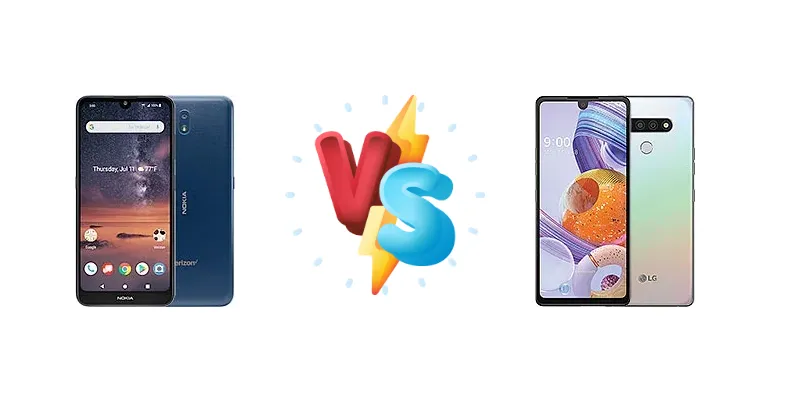
The LG Stylo 6 and Nokia 3 V represent two approaches to the ultra-budget smartphone market. The Stylo 6 aims for a larger screen and more processing power, while the Nokia 3 V focuses on a clean Android experience and affordability. This comparison dissects their key differences to determine which device delivers the best value for users prioritizing essential smartphone functions.
🏆 Quick Verdict
For most users, the LG Stylo 6 offers a more compelling experience. Its octa-core Helio P35 chipset provides a noticeable performance advantage over the Nokia 3 V’s Snapdragon 429, making it better suited for multitasking and moderately demanding apps. While both phones are entry-level, the Stylo 6’s extra processing power justifies the potential price difference.
| Network |
|---|
| 2G bands | GSM 850 / 900 / 1800 / 1900 | GSM 850 / 900 / 1800 / 1900 |
| 3G bands | HSDPA 850 / 900 / 1700(AWS) / 1900 / 2100 | HSDPA 850 / 900 / 1900 / 2100 |
| 4G bands | 1, 2, 4, 5, 8, 13 | LTE |
| Speed | HSPA 42.2/5.76 Mbps, LTE Cat4 150/50 Mbps | HSPA 42.2/5.76 Mbps, LTE (2CA) Cat6 300/50 Mbps |
| Technology | GSM / HSPA / LTE | GSM / HSPA / LTE |
| Launch |
|---|
| Announced | 2020, August 20. Released 2019, August 23 | 2020, May 20. Released 2020, May 20 |
| Status | Discontinued | Discontinued |
| Body |
|---|
| Build | Glass front, plastic back, plastic frame | - |
| Dimensions | 161.2 x 76.2 x 9.1 mm (6.35 x 3.00 x 0.36 in) | 171.2 x 77.7 x 8.6 mm (6.74 x 3.06 x 0.34 in) |
| SIM | Nano-SIM | Nano-SIM |
| Weight | 188.6 g (6.67 oz) | 219 g (7.72 oz) |
| | - | Stylus |
| Display |
|---|
| Resolution | 720 x 1520 pixels, 19:9 ratio (~269 ppi density) | 1080 x 2460 pixels (~395 ppi density) |
| Size | 6.26 inches, 97.8 cm2 (~79.6% screen-to-body ratio) | 6.8 inches, 109.8 cm2 (~82.5% screen-to-body ratio) |
| Type | IPS LCD | IPS LCD |
| Platform |
|---|
| CPU | Quad-core 1.8 GHz Cortex-A53 | Octa-core (4x2.3 GHz Cortex-A53 & 4x1.8 GHz Cortex-A53) |
| Chipset | Qualcomm SDM429 Snapdragon 429 (12 nm) | Mediatek MT6765 Helio P35 (12 nm) |
| GPU | Adreno 504 | PowerVR GE8320 |
| OS | Android 9.0 (Pie), upgradable to Android 10, Android One | Android 10 |
| Memory |
|---|
| Card slot | microSDXC (dedicated slot) | microSDXC (dedicated slot) |
| Internal | 16GB 2GB RAM | 64GB 3GB RAM |
| | eMMC 5.1 | eMMC 5.1 |
| Main Camera |
|---|
| Features | LED flash | LED flash, panorama, HDR |
| Single | 13 MP, f/2.2, 1/3.1", 1.12µm, AF | - |
| Triple | - | 13 MP, (wide), PDAF
5 MP, 120˚, (ultrawide)
Auxiliary lens |
| Video | 1080p@30fps | 1080p@30fps |
| Selfie camera |
|---|
| Single | 5 MP, f/2.2, 27mm (wide), 1/5.0", 1.12µm | 13 MP, 1/3.1", 1.12µm |
| Video | - | 1080p@30fps |
| Sound |
|---|
| 3.5mm jack | Yes | Yes |
| 35mm jack | Yes | Yes |
| Loudspeaker | Yes | Yes |
| Comms |
|---|
| Bluetooth | 4.2, A2DP, LE, aptX | 5.0, A2DP, LE |
| NFC | No | No |
| Positioning | GPS, GLONASS, BDS | GPS |
| Radio | FM radio | No |
| USB | microUSB 2.0, OTG | USB Type-C 2.0 |
| WLAN | Wi-Fi 802.11 b/g/n | Wi-Fi 802.11 b/g/n, Wi-Fi Direct |
| Features |
|---|
| Sensors | Accelerometer, proximity | Fingerprint (rear-mounted), accelerometer, proximity |
| Battery |
|---|
| Charging | 10W wired | - |
| Type | Li-Ion 4000 mAh | Li-Po 4000 mAh |
| Misc |
|---|
| Colors | Blue | White |
| Models | - | LMQ730TM, LM-Q730TM |
| Price | About 140 EUR | About 200 EUR |
Nokia 3 V
- Clean, near-stock Android experience
- Highly affordable price point
- Potential for longer software support (Nokia's reputation)
- Significantly weaker processor performance
- Slow 10W charging
- Likely lower-quality display
LG Stylo 6
- More powerful octa-core processor
- Larger display for better media consumption
- Potentially better camera performance
- More customized Android interface
- Potentially shorter software support
- May be slightly more expensive
Display Comparison
Neither device boasts a standout display. Both utilize 12nm chipsets, suggesting similar power constraints impacting display capabilities. While specific display specs (resolution, brightness) are missing, the LG Stylo 6’s larger size likely provides a more immersive viewing experience. The Nokia 3 V, being a more budget-focused device, likely employs a lower-quality panel, potentially impacting color accuracy and viewing angles. The absence of high refresh rates on either device is expected at this price point.
Camera Comparison
Without detailed camera specifications, a direct comparison is difficult. However, given the market segment, both phones likely feature basic camera setups. The LG Stylo 6, being positioned slightly higher, may have a marginally better main sensor. It’s crucial to note that the inclusion of low-resolution auxiliary sensors (often 2MP macro lenses) on either device adds little practical value. Image processing will likely be basic on both, prioritizing speed over advanced features. Expect acceptable results in good lighting conditions, but poor performance in low light.
Performance
The core difference lies in the chipsets. The LG Stylo 6’s MediaTek Helio P35 is an octa-core processor (4x2.3 GHz Cortex-A53 & 4x1.8 GHz Cortex-A53), offering significantly more processing power than the Nokia 3 V’s Qualcomm Snapdragon 429, a quad-core 1.8 GHz Cortex-A53. This translates to faster app loading times, smoother multitasking, and a more responsive user interface on the Stylo 6. While both are based on the Cortex-A53 architecture, the higher clock speeds and additional cores of the Helio P35 provide a tangible performance boost. The Nokia 3 V’s Snapdragon 429 is adequate for basic tasks, but will struggle with more demanding applications.
Battery Life
Both devices feature 12nm chipsets, suggesting comparable power efficiency. The Nokia 3 V’s 10W charging is slow by modern standards, indicating a focus on minimizing cost. While battery capacity isn’t specified, the Nokia 3 V’s emphasis on affordability likely means a smaller battery. The LG Stylo 6, with its more powerful processor, may consume slightly more power, but the potential for a larger battery capacity could offset this difference. Expect all-day battery life with moderate usage on both devices, but the Stylo 6’s faster processor might drain the battery quicker during intensive tasks.
Buying Guide
Buy the Nokia 3 V if you prioritize a streamlined, near-stock Android experience and absolute affordability. It’s ideal for first-time smartphone users or those needing a basic device for calls, texts, and light web browsing. Buy the LG Stylo 6 if you value smoother performance for everyday tasks, enjoy media consumption on a larger screen, and don’t mind a more customized Android interface. It’s a better choice for users who occasionally play mobile games or use multiple apps simultaneously.
Frequently Asked Questions
❓ Will the Nokia 3 V struggle with popular social media apps like Facebook and Instagram?
The Snapdragon 429 in the Nokia 3 V is a basic processor. While it can run these apps, expect slower loading times and occasional lag, especially when multitasking or using the apps for extended periods. The LG Stylo 6’s Helio P35 will provide a noticeably smoother experience.
❓ Is the LG Stylo 6 a good option for playing casual mobile games?
The LG Stylo 6 is better suited for casual gaming than the Nokia 3 V. The Helio P35’s octa-core configuration provides more processing power for running games, though don’t expect to play graphically demanding titles at high settings. The Nokia 3 V will likely struggle with even moderately demanding games.
❓ Does either phone support Android updates beyond the initial release version?
Nokia has a generally better track record for providing software updates, even on its budget devices. While neither phone is guaranteed long-term support, the Nokia 3 V is more likely to receive at least one major Android version update. LG’s update support for the Stylo 6 is less predictable.
❓ How long will it take to fully charge the Nokia 3 V with its 10W charger?
With its 10W charging, the Nokia 3 V will take a significant amount of time to fully charge – likely between 3 and 4 hours, depending on the battery capacity. This is considerably slower than most modern smartphones.